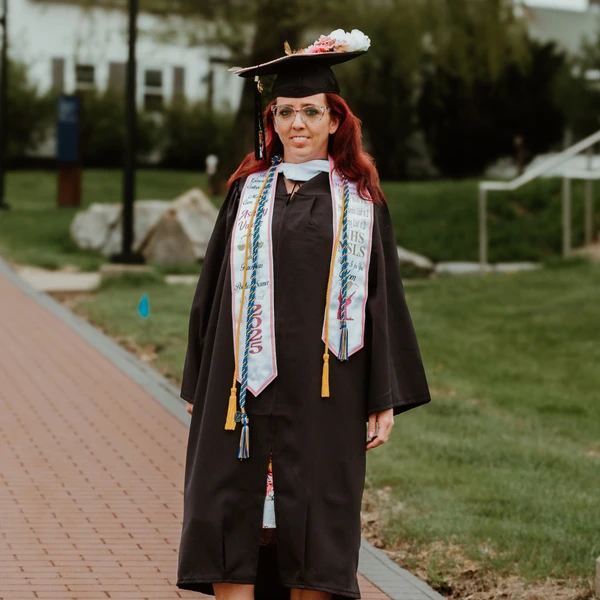
Ashley Valdez
1x
Finalist
Ashley Valdez
1x
FinalistBio
I am a rising 2L law student at Texas Tech University School of Law and a mother of five, working to build a better future for my family through education and advocacy. As a nontraditional student, I returned to school after navigating significant life challenges, including supporting my family through my husband’s disabling accident and rebuilding my life as a survivor of domestic violence.
Balancing law school, parenting, and financial responsibility has required discipline, resilience, and a deep sense of purpose. I am pursuing a legal career driven by a passion for justice—particularly in areas like women’s rights, family law, and access to resources for underserved communities.
My goal is not just to succeed in law school, but to use my education to create meaningful change for people who feel overlooked or unheard. I believe my experiences give me a unique perspective and the determination to advocate fiercely for others.
Education
Texas Tech University
Doctoral degree program (PhD, MD, JD, etc.)Majors:
- Law
Southern New Hampshire University
Bachelor's degree programMajors:
- Political Science and Government
Miscellaneous
Desired degree level:
Doctoral degree program (PhD, MD, JD, etc.)
Graduate schools of interest:
Transfer schools of interest:
Majors of interest:
- Legal Professions and Studies, Other
Career
Dream career field:
Legal Services
Dream career goals:
Sports
Soccer
Junior Varsity1999 – 20034 years
Public services
Volunteering
VITA — tax preparer2026 – PresentVolunteering
Meals on wheels — Delivery driver2009 – 2016
TRAM Purple Ribbon Scholarship
I am a survivor of intimate partner violence. My first marriage was shaped by alcoholism and addiction, and the harm those forces produced — to me, to the home we tried to build — is the part of my history that doesn't appear on a transcript. I survived it. I left it. And on the way out, I learned what it actually takes to extract a family from a system designed to keep them tied to it.Years later, alcohol's harm would arrive at my family again, this time in the form of a drunk driver who crossed into my second husband's lane on his motorcycle and nearly killed him. The civil suit that followed, against the bars that had overserved the driver, became the door I walked through to law school. Two marriages, two collisions with what alcohol-related harm does to families. That is not coincidence. It is the foundation under everything I am building now.What I bring to the work of eradicating intimate partner violence is, before anything else, knowledge from the inside. I know what it is to weigh whether a protective order will be enforced or only enrage. I know how custody dynamics quietly punish the parent who leaves. I know the way the legal system can both rescue and retraumatize, sometimes inside the same week. I know what it costs survivors to keep showing up — and I know what it costs more when the institutions that claim to help us don't.Existing initiatives — shelters, hotlines, legal aid clinics, family violence units, and court-based advocacy programs — do extraordinary work with chronically inadequate resources. The gaps I have seen most closely are familiar to anyone who has tried to use them: protective orders that fail at the moment of greatest danger, family courts that treat coercive control as he-said-she-said, civil legal aid stretched too thin to serve every survivor who qualifies, and a chasm between criminal remedies and the civil mechanisms that often matter more to a survivor's day-to-day safety. The infrastructure to address IPV exists. It does not yet work consistently, and it does not work equally for every survivor.I am using my education at Texas Tech School of Law to build the specific skill set I think is most underweighted in this fight: civil litigation in service of survivors. Most public attention, and most policy reform, focuses on criminal prosecution of abusers. That matters, but it is not where most survivors find day-to-day safety. Civil work — protective orders, divorce, custody, housing, and the dram shop and third-party liability claims that surface where alcohol and drugs were enabling factors — is where the actual terrain of safety gets defined. I plan to practice in that space. I am already shaping my coursework toward it, finishing my first year in the top third of my class, and logging volunteer and pro bono hours alongside my studies because I want my legal education to be as much about practice as theory.I am not coming to this work to learn about it. I am coming to multiply what I already know, and to put it to use for the next family standing where mine once stood.
TRAM Themis Scholarship
When I first encountered the legal system, I wasn't a student. I was a plaintiff — sitting across the table from attorneys who were trying to hold the bars that had overserved a drunk driver accountable for the wreck that nearly killed my husband. I learned what dram shop liability was the hard way, but I also learned what civil litigation can do when it works: it can make industries that profit from harm pay for the damage they cause. And I learned what it can't do — bring back the years lost, the sense of safety taken, the futures permanently rerouted.That experience is why I came to law school, and it is the social justice issue I want to spend my career on. Drunk driving — and the corporate, regulatory, and legal infrastructure that enables it — rarely gets named in social justice conversations, but it should. Drunk driving deaths and injuries fall disproportionately on working-class families, on communities with limited public transit, and on people without the resources to pursue civil suits even when they are clearly owed one. Venues that overserve face an inconsistent, underenforced patchwork of accountability. The victims I have seen up close — both my own family and others I have met since — are too often left to absorb costs that were entirely preventable.I want to do this work in plaintiffs' civil litigation, focused on dram shop, personal injury, and related consumer-protection cases. That is where the leverage is. A well-tried civil case does not just compensate one family — it changes how venues train their staff, how insurers price risk, how cities enforce licensing. It is, in its own quiet way, one of the most effective social justice tools we have.This is not a future I am waiting to step into. As a 1L I shaped my coursework around it, finished the year in the top third of my class, and logged volunteer and pro bono hours alongside it. I also run a real estate LLC of my own — work that has made the contracts, landlord-tenant law, and regulatory compliance I encounter in textbooks anything but abstract. The skills civil litigation requires — reading carefully, asking the right questions, sitting patiently with long timelines, and advocating for someone whose stakes are nothing like your own — are skills the last decade of my life has already begun teaching me.Why this, and why me? Because I already know this fight, and I know how isolating it can feel from the plaintiff's chair. I know what my family needed from a lawyer at our worst moment, and I know what we didn't always get. That gap — between the lawyering victims need and what they actually receive — is what I want to spend my career closing. Not by abandoning corporate law or regulatory reform, both of which matter, but by sitting at the table where the people who were harmed most actually need someone to be sitting.
Public Service Scholarship of the Law Office of Shane Kadlec
My interest in law comes from a lifelong desire to advocate for people who feel unheard, overlooked, or powerless. As a nontraditional law student, mother of five, survivor of domestic violence, and wife to a disabled husband, I have experienced firsthand how deeply legal systems affect everyday life. Those experiences showed me both the importance of the law and the difference a strong advocate can make during some of the hardest moments a person can face.
I grew up in a low-income household and have spent much of my life navigating challenges that forced me to become resilient, resourceful, and determined. Over time, I became increasingly passionate about issues involving women’s rights, civil liberties, access to education, disability advocacy, and economic fairness. I realized that many people struggle not because they lack intelligence or work ethic, but because they lack access to information, resources, or someone willing to fight for them. That realization is what ultimately inspired me to pursue a legal career.
Law appeals to me because it combines critical thinking, writing, advocacy, and problem-solving with the opportunity to create meaningful change in people’s lives. I genuinely enjoy the intellectual challenge of legal education, but more importantly, I value the purpose behind it. I want a career where I can use my skills to help people navigate difficult situations, understand their rights, and feel empowered rather than intimidated by the legal system.
Since beginning my studies at Texas Tech University School of Law, I have become especially interested in constitutional law, civil rights, and advocacy-focused areas of practice. Law school has strengthened my ability to think analytically, communicate effectively, and approach complex problems from multiple perspectives. It has also reinforced my belief that the law is one of the most powerful tools for protecting individuals and improving communities.
Pursuing law has required enormous sacrifice. I balance school with raising five children, supporting my family, and commuting weekly between Odessa and Lubbock. Despite those challenges, I have never been more certain that this is the path I am meant to pursue. Every obstacle I have overcome has strengthened my commitment to becoming an attorney who is compassionate, driven, and committed to serving others.
Ultimately, I want to use my legal education not only to build a stable future for my family, but also to advocate for people who need someone in their corner. I believe the law has the power to change lives, and I want my career to reflect that purpose.
Jeffrey J. Douglas First Amendment Scholarship
Free expression is deeply personal to me because I know what it feels like to have your voice minimized, ignored, or controlled. As a nontraditional first-year law student, mother of five, survivor of domestic violence, and wife to a disabled husband, I did not arrive at law school through a straight or easy path. Much of my life has been shaped by learning not only how to speak up for myself, but also how to advocate for others whose voices are often overlooked.
My interest in free expression is rooted in the belief that people cannot meaningfully pursue justice, equality, or democracy without the ability to speak openly, challenge authority, and share their lived experiences. I grew up in a low-income household with limited resources and little connection to systems of power. Over time, I learned how easily vulnerable people can feel silenced—whether by fear, financial hardship, abuse, social stigma, or lack of access to education. Those experiences shaped my commitment to protecting the rights of individuals to speak freely, especially when their perspectives are unpopular or uncomfortable.
Since beginning law school at Texas Tech University School of Law, I have become increasingly interested in constitutional law and civil liberties, particularly the role the First Amendment plays in protecting political advocacy, criticism of government, protest movements, and open discourse. I believe free expression is essential not only for individual liberty, but also for societal progress. Historically, many of the rights Americans now consider fundamental were advanced because people were willing to speak out despite opposition or personal risk.
Outside the classroom, I have consistently used my voice to advocate for issues I care deeply about, including women’s rights, reproductive autonomy, affordable access to education, disability awareness, and broader civil and human rights concerns. I have also volunteered through community service programs, including serving as a volunteer tax preparer to help individuals and families who may not otherwise have access to financial assistance or guidance. Experiences like these have reinforced my belief that advocacy and access to information are powerful tools for empowerment.
At the same time, I recognize that free expression can be complicated and uncomfortable. Protecting speech means protecting viewpoints we may disagree with, and maintaining a society where open dialogue can occur without fear of censorship. Law school has strengthened my appreciation for the importance of balancing robust discourse with respect, accountability, and the rule of law.
As I continue my legal education, I hope to use my voice—and eventually my legal career—to advocate for people who feel unheard, marginalized, or powerless. Free expression is not simply an abstract constitutional principle to me; it is the foundation that allows people to tell their stories, demand accountability, and pursue meaningful change.
Jack Saunders Memorial Scholarship
My life is divided by a single date: May 17, 2019. That night, a drunk driver hit my husband on his motorcycle and left him paralyzed. I was pregnant with our fourth child, and everything we had built came apart in a single phone call. Our household was shaped by hospitals, uncertainty, and financial strain. I was no longer just a wife and mother trying to hold life together. I became a caregiver, an advocate, and the person responsible for keeping my family moving forward when it felt like the ground had disappeared beneath us.
Even ordinary tasks felt impossible. I had to learn how to navigate medical systems, insurance issues, and new financial realities while helping my children process a trauma none of us were prepared for. There were days when survival itself felt like the only goal. I was exhausted, scared, and painfully aware that no one was coming to rescue us.
What ultimately helped me win was refusing to let hardship define the rest of my life. I could not control what had happened, but I could control what I did next. I learned to speak up in rooms where I once felt intimidated. I asked questions, pushed for answers, and advocated fiercely for my family. I stopped seeing resilience as an abstract idea and started living it every day.
That challenge changed me. It showed me how vulnerable people can be when they are forced to rely on systems they do not understand and cannot easily access. It also showed me the power of advocacy — how much it matters to have someone who knows how to fight, explain, and stand beside people in moments of crisis. That realization is a large part of why I chose to pursue law.
Now, as a first-year law student and mother of five, I carry those lessons into every class and every opportunity to serve others. Through my school's Volunteer Income Tax Assistance program, I help low-income filers navigate a system most of them find confusing and intimidating — work that reminds me every week why I am doing this. My path has not been neat or easy. It has been shaped by struggle, sacrifice, and persistence, but those experiences have given me empathy, grit, and a deep sense of purpose. I know what it feels like to be overwhelmed, unheard, and uncertain of where to turn. I also know what it means to keep going anyway.
I did not win because life became easy. I won because I refused to let tragedy have the final word. I rebuilt. I kept my family together. I turned pain into purpose. And now I am pursuing a legal career so I can help others do the same when life asks more of them than they ever thought they could give.
On April 16th, I learned about this scholarship and knew immediately I had to apply, even though the timing made one piece of the application harder than I would have liked. I reached out that same day to two of my professors at Texas Tech University School of Law, both of whom have agreed to write letters of recommendation on my behalf. Their letters are still being drafted but should arrive within the next few days. I could not let the deadline pass — a scholarship created in memory of someone who wanted to use the law to help ordinary people through the hardest moments of their lives speaks directly to why I am pursuing this degree. If the committee is willing, I will forward both letters the moment they arrive.
Jerrye Chesnes Memorial Scholarship
Returning to school as a parent has been one of the hardest and most meaningful decisions I have ever made. I am a nontraditional law student, a mother of five, and a wife whose family’s life was permanently changed by my husband’s accident, which left him paralyzed. Going back to school was not just about pursuing a degree—it was about rebuilding our future.
One of the greatest challenges I face is balancing the constant demands of motherhood with the intensity of law school. As a 1L, the workload is relentless. Cases, readings, and assignments never truly stop, yet neither do the needs of my children. I am constantly shifting between roles—student, caregiver, provider, and parent. There is no clean separation between school and home. I study in the margins of my day, often late at night when everything is finally quiet, or in small pockets of time between responsibilities.
Logistically, even attending law school requires sacrifice. Each week, I commute hours between Odessa and Lubbock, leaving my family behind to attend classes and then returning home to resume my responsibilities. That drive represents more than distance—it represents the constant push and pull between my goals and the people I love most. There is never a moment where I am not aware of both.
Financial pressure has also been a defining challenge. After my husband’s accident, our family had to adapt to an entirely new reality. Returning to school meant choosing long-term stability over immediate security, even when that choice felt risky. Supporting a household while pursuing a law degree has required careful planning, sacrifice, and resilience. There have been moments of exhaustion and doubt, when continuing forward felt overwhelming, but stopping has never truly been an option.
Another challenge has been overcoming the internal doubt that comes with being a nontraditional student. Sitting in a classroom surrounded by younger peers, it is easy to question whether I belong. But I have learned that my life experience is not a disadvantage—it is a strength. The challenges I have faced have made me more disciplined, more focused, and more determined than I have ever been.
What I have overcome is the idea that difficult circumstances should define my limits. My children are watching me do this, and that matters. I want them to see perseverance in action. I want them to understand that even when life changes unexpectedly, even when things feel impossibly hard, you can still choose to move forward.
Returning to school while raising children and navigating life after my husband’s accident has tested me in every way. But it has also strengthened me. I am not just pursuing a law degree—I am building a better future for my family and showing my children what resilience, courage, and determination truly look like.
Margot Pickering Aspiring Attorney Scholarship
My name is Ashley Valdez. At 36 years old, I am a devoted mother of five and a wife to a
wonderful man. My path has been filled with triumphs and struggles, and these experiences have deeply prepared me for a career in law.
My story begins in West Texas, where I was raised by a hardworking single mother whose
resilience shaped my life. She was a first-generation high school graduate who supported us by waiting tables. Despite her limited resources, her sacrifices inspired me daily.
I faced many challenges in my life, including escaping an abusive marriage to an alcoholic,
which initially left me feeling powerless and isolated. Over time, I realized I needed to prioritize
my children’s well-being, which drove my decision to leave. Though it was difficult and filled
with anxiety, the thought of giving my children a safer environment strengthened my resolve.
Leaving felt like a huge weight lifted, allowing me to reclaim my identity and rebuild my life.
Navigating custody battles was a significant challenge, overwhelming with complex legal
terminology and procedures. As I explored family law, I began to see it as a protective
framework, igniting my passion for advocacy for myself and my children. Each step taught me
resilience and the importance of standing up for what is right, transforming me into my own
advocate. This experience deepened my respect for the legal system and inspired me to engage actively in family law, recognizing legal knowledge as a powerful tool for empowerment.
After remarrying, while 8 months pregnant with my fourth child, my life took a tragic turn when
my husband was hit by a drunk driver and left paralyzed and in a coma. During this chaos, I gave birth to our daughter without him by my side. Once he returned home, I balanced caring for him and our newborn, and we faced financial struggles. We decided to pursue legal action against those responsible for his accident, which took my interest in law, and turned it into a passion. I could not get enough knowledge about how the law and court worked. During a mediation session, I very clearly recall a conversation with our attorney, Keith, wherein I discussed my interest in the law and the long-forgotten dream of being an attorney. He told me I would be great at it and should go for it. Even adding that I would have a job waiting for me when I passed the bar. I spent several weeks weighing the decision of whether I could truly pursue my goal of obtaining a bachelor's degree and attending law school. I carefully considered all factors, from my responsibilities as a mother to the challenges I had faced and reflected on my capacity to balance them while embarking on this journey. Four months later, in February of 2023, I applied to Southern New Hampshire University and was accepted within a week. Though I had doubts from my previous college experiences, I approached this journey with renewed determination. I excelled, achieving an A average and earning spots on the President's and Dean's Lists. However, In July 2024, I experienced the heartbreaking loss of my mother, resulting in my only B grades during my time at SNHU. Despite my grief, I sought support from professors and advisors, remaining committed to my academic path. I completed my degree plan in March 2025 and will graduate with Latin Honors on May 4th, 2025.
Each chapter of my life has shaped me into a person fueled by passion, resilience, and
determination. I understand that the law is a powerful tool for justice and empowerment, and I
am eager to contribute meaningfully to this field. My unique life experiences have prepared me to become a skilled advocate for those in need, and I look forward to the opportunities that lie ahead. All of my experiences have led me here, to this moment, to this opportunity, and prepared me in a way that never could have been possible at 18. I am ready and committed to succeeding in law school and would be greatly honored to be given the opportunity to attend.
Ethel Hayes Destigmatization of Mental Health Scholarship
My experience with mental health has shaped nearly every part of who I am—how I understand myself, how I relate to others, and what I want to do with my life.
For a long time, I didn’t have the language to explain why certain things felt harder for me than they seemed for others. I was recently diagnosed with ADHD as an adult, and that diagnosis came with a mix of relief and grief. Relief, because things finally made sense—the constant mental noise, the difficulty shutting my brain off, the cycles of burnout. But also grief, because I realized how long I had struggled without understanding why. Alongside that, I’ve dealt with anxiety that often shows up as overthinking, restlessness, and an inability to truly “turn off.” For years, I pushed through it, assuming that was just how life felt.
At the same time, my life has included experiences that intensified those struggles. I am a survivor of domestic violence from my first marriage, which reshaped my sense of safety and trust. Later, my husband was in a life-altering accident that left him paralyzed. Overnight, I became a caregiver, a provider, and the emotional anchor for my family—all while raising five children. There was no pause to process what I was going through. Like many people, I coped by compartmentalizing and moving forward, even when I was overwhelmed.
These experiences showed me how invisible mental health struggles can be. From the outside, I was functioning—I was showing up, taking care of my family, and now pursuing law school. But internally, there were times I was exhausted, anxious, and carrying more than I knew how to process. That disconnect changed how I see other people. I’ve learned that you never truly know what someone is dealing with, and that has made me more patient, more understanding, and more intentional in my relationships.
My understanding of strength has also changed. I used to believe strength meant pushing through no matter what. Now, I see it differently. Strength is being honest about what you’re carrying. It’s asking for help when you need it. It’s learning how your mind works and finding ways to support yourself instead of fighting against it. My ADHD diagnosis, in particular, has helped me reframe how I approach challenges—not as personal failures, but as differences I can learn to work with.
These experiences have directly shaped my goals. As a law student, I am drawn to advocacy work that helps people who feel overlooked or unheard—especially those whose struggles aren’t immediately visible. Mental health intersects with so many areas of life, and I’ve lived through situations where better support, understanding, or advocacy could have made a meaningful difference. I want to be someone who helps bridge that gap.
More personally, my journey has shaped the kind of environment I want to create for my children. I want them to grow up in a home where mental health is talked about openly, where they feel safe expressing what they’re going through, and where they understand that struggling does not mean failing.
Ultimately, my experiences with mental health have made me more resilient, but also more compassionate. They have shaped my relationships by teaching me the importance of empathy and honesty, and they have shaped my aspirations by giving me a clear sense of purpose. I want to use both my education and my lived experiences to help others navigate difficult situations and to be part of a broader effort to bring mental health out of the shadows.
I’ve learned that acknowledging these struggles doesn’t make you weak—it’s what allows you to move forward. And that understanding is something I carry with me in everything I do.
Taylor Swift Fan Scholarship
One performance that has always stuck with me is Taylor Swift singing All Too Well at the Grammy Awards in 2014. It wasn’t flashy or overproduced—she was just sitting at the piano, singing a song that clearly meant something to her. But that simplicity is exactly what made it so powerful. It felt less like a performance and more like a real moment that we just happened to be watching.
What really stood out to me was how emotional it was. You could hear it in her voice—she wasn’t just hitting the notes, she was feeling every word. There are parts where her voice gets a little strained or rough, and instead of taking away from the performance, it actually makes it stronger. It made me believe her. It made the story feel real, not rehearsed.
I think that’s why it’s stayed with me over the years. Taylor Swift is known now for huge, perfectly planned performances, and she does those incredibly well. But this moment showed something different. It reminded me that at the core of everything she does is storytelling and honesty. She didn’t need a big stage or special effects to connect with people—just a piano and a song.
On a personal level, I find that really meaningful. It takes a lot of courage to be that open, especially in front of millions of people. Most of us try to hide our emotions or make things look more put together than they really are. Watching her lean into that vulnerability instead of covering it up is something that stuck with me.
That performance is a good reminder that sometimes the most impactful moments aren’t the most polished ones. They’re the ones that feel real. And I think that’s why it continues to resonate—not just because it was a great performance, but because it felt honest in a way that people can connect to.