Gender
Female
Ethnicity
Black/African
Hobbies and interests
Tennis
Martial Arts
Lacrosse
Volunteering
Church
Robotics
Science Olympiad
3D Modeling
Poetry
Reading
Action
Adventure
Classics
Fantasy
Folk Tales
Social Issues
I read books multiple times per week
US CITIZENSHIP
US Citizen
LOW INCOME STUDENT
Yes
Asha Archer
1x
Finalist1x
Winner
Asha Archer
1x
Finalist1x
WinnerBio
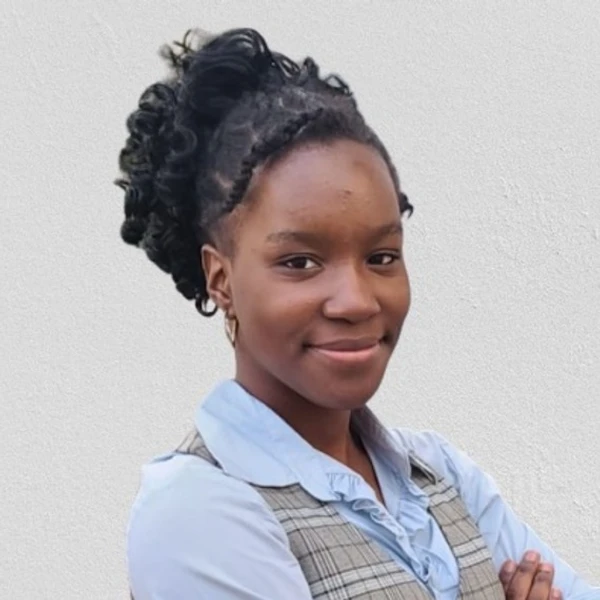
"I want you to become someone better than I am," my mother said one afternoon. She, like many other parents, wanted to see her children surpass them in wealth and accomplishments. For us, this meant elevating myself academically, and through my continued dedication to community service. From a young age, I was captivated by the inner workings of machines and the logic behind how computers and robots functioned. Additionally, I am a student-athlete balancing tennis, lacrosse and karate with school. I have learned to excel in any environment through problem-solving and decision-making. My patience and amiable attitude has been an asset that never withers in any situation. Scholarships will help alleviate the financial responsibilities and allow me to focus on pursuing mechanical engineering. Despite my family and community obligations, I work tirelessly to keep the promise I made to my mother years ago.
Education
Midwood High School
High SchoolGPA:
4
Miscellaneous
Desired degree level:
Doctoral degree program (PhD, MD, JD, etc.)
Majors of interest:
- Mechanical Engineering
- Engineering Physics
- Mechatronics, Robotics, and Automation Engineering
Career
Dream career field:
- Mechanical or Industrial Engineering
Dream career goals:
A heartfelt passion for mechanical engineering and machine learning has since evolved into a deep commitment to creating innovative, intelligent machines, and software that can solve real world problems and change the way we approach challenges.
Ball Crew
US Open2024 – Present2 yearsIntern
HE3AT and Cisco2025 – 20261 yearSystems and AI Lab - Student Researcher
NYU ARISE2026 – Present8 monthsKarate Instructor
Zentora2023 – Present3 yearsTennis Coach
NYJTL2025 – Present1 year
Sports
Lacrosse
Junior Varsity2025 – 2025
Awards
- Most Improved Defense
Karate
Intramural2014 – Present12 years
Awards
- The 30 Star Trophy For Excellence
- AAU Gold in Kata and Kumite
- 1st Degree Black Belt
Tennis
Varsity2014 – Present12 years
Awards
- Bronze at Carry Lee's Doubles Tournament
- LTTA MVP
- LTTA Most Improved
Research
Mechatronics, Robotics, and Automation Engineering
NYU ARISE — Student Researcher2026 – 2026
Public services
Volunteering
SBJC — Youth Director2023 – PresentVolunteering
Midwood High School Robotics — Mentor2025 – PresentVolunteering
World Champion Karate Center — Coach and Mentor2023 – PresentVolunteering
SJBC Samaritan Hands — Youth representative2023 – Present
Future Interests
Advocacy
Volunteering
Entrepreneurship
AROC AI/ML Scholarship
As artificial intelligence begins to transform nearly every part of today’s society, we must ask ourselves what it is costing us. From popular chatbots to specialized research tools, most artificial intelligence uses large amounts of electricity and water to power data centers. This increases carbon emissions and strains local water supplies. Growing up, I wanted to understand how these systems actually work and how to make them more environmentally sustainable. Through the New York University ARISE program, I had the opportunity to gain hands-on experience in the Systems and AI Lab, where I studied how to make modern machine learning models smaller, and more efficient.
My research focused on CLIP (Contrastive Language-Image Pre-training), a vision-language model that learns relationships between images and text. I worked directly with the CLIP model using Python, PyTorch, Jupyter Notebooks and my own code. I would examine CLIP’s layers of processing units and determine how important each layer was for the models overall performance. I did this by defining or coding my own functions and experimenting with various metrics, including cosine similarity, embedding drift and inference speed. In my experiment, I was able to see that at least one of the layers currently used in CLIP could actually be removed while maintaining almost the same semantic understanding and potentially improve efficiency. My goal was not simply to make CLIP learn faster. I wanted to identify what are the necessary steps machine learning researchers can take to advance their AI models without continually increasing the computational resources required to run them.
This experience showed me that AI is more than just a tool that I can use. It is something that I can help to improve. As a society, we want our technology to be smarter, and faster, while also being compact, and environmentally friendly. Yet, it is difficult to understand what it takes to make these models work the way we want them to. Before ARISE, I thought of AI as an already powerful and full-fledged tool. However, through my research, I began to understand the amount of work, code, energy and time behind the model’s seemingly effortless functions. There are so many machine learning elements that allow AI models to function effectively, and finding ways to prune unnecessary ones without affecting the model’s capabilities is far more complicated than I realized.
I hope to continue exploring AI and machine learning throughout college and eventually combine it with my interests in mechanical engineering and robotics. I want to build intelligent machines that can interact with and improve the world around them. I also would like to research ways to make AI powering systems more efficient. Whether that would mean optimizing existing models, developing new algorithms, or creating robots that can operate without using a lot of computational resources, I want my work to make newer, advanced technology that is more practical and accessible.
My experience at ARISE not only gave me more than technical skill, but it gave me a new perspective on the responsibility that comes with creating smart technology. I want to be a part of a new generation of engineers who think about not only what technology can do, but also what it takes to serve a community productively. This scholarship would support my future educational goals in this area of study by giving me the opportunity to continue learning, experimenting, and contributing to a field that is so rapidly shaping our world. Ultimately, I hope to take what I have learned from my research and use it to create purposeful technology that addresses the environmental and practical costs to make it.
Kenyada Me'Chon Thomas Legacy Scholarship
Since I could remember I was captivated by the movement of machines and the dialogue of functioning robots. Whether I was building from scratch, or teaching myself programming languages, I loved every second. Mechanical engineering became more than an interest. It became the lens that showed me how to transform ideas into functional systems.
There was one problem, however, curiosity alone wasn’t enough. Every engineer knows that no matter how great the design, it will fail if a port isn’t connected. For me, the connection was an opportunity. In the Far Rockaway community there was a serious lack of free STEM programs. I remember the first time I looked for a local robotics program. I imagined what it would feel like to sit at a workbench and be surrounded by sensors, and screws. When I finally found a program, my excitement turned into disappointment when I realized it cost a fortune. For the moment, it felt like that door had been closed before I could reach for the handle. I couldn’t help but wonder how many future engineers never developed because of this lack of opportunities.
Looking back, that setback became an important stage. Systems and robots weren’t made to avoid difficulties, they were made to overcome them. In fact, they are upgraded in the midst of obstacles and strengthened after responding to challenges. Instead of abandoning my curiosity, I continued to search for environments that challenged me to think differently while exploring my interests.
That recalibration began with my high school’s CTE Engineering track. There I was able to explore my passion with like-minded peers. My ideas improved under discussion, and my outputs became streams of innovation. At the same time, I entered NYU’s ARISE Program. I wasn’t just solving textbook problems, I was confronting real world questions with uncertain, yet infinite answers. Sometimes experiments failed, but every challenge was an invitation to dig deeper. My heart was filled with a sense of belonging.
Even though I was experiencing the life I desperately wanted in my youth, there were still many kids that didn't have the same access to STEM programs. I had to do something. Through my school's robotics team I was able to turn that desire into action by creating workshops, community events and virtual sessions that introduce engineering in a fun and engaging way. I wanted these programs to proved the kind of exposure that I wish I had growing up. I wanted to show young students that STEM is just about solving complex questions. It is about being creative, collaborating, problem solving, and building confidence. The more kids I helped the more fulfilling that work became. No robot I built could every top the satisfaction I felt the moments where a child's face light up after creating their first Scratch game or seeing their rubber-band drag racer cross the finish line.
From searching for robotics programs to leading my own STEM programs, my life has been driven by adaptability. Although uncertainty influenced my early life, it never determined my identity. Instead, it became a teacher that pushed me into a deep respect for diligence, curiosity, and purpose. I am fascinated by how different my current state is from my initial blueprint. The significance of my redesign wasn’t just creating my own path, but building one for students that are looking for an opportunity like me.
You Deserve It Scholarship
WinnerI recently learned a powerful lesson: how to transform the various challenges once meant to bind us into the foundation upon which we flourish.
From a young age, I was captivated by the inner workings of machines and the logic behind how computers and robots functioned. Going above and beyond with any little project that I had my hands on was never a question someone on my team had to ask. Whether I would build the robot from scratch, teach myself programming languages or stay after class to test extra designs, I loved every fleeting second.
There was an assessment for my robotics class called "Find the Endpoint" where a team had to design a robot that could navigate a course using various sensors. Everything was going well until the last day–the distance sensor on our robot wouldn’t pick up the first obstacle when presenting. No amount of debugging could fix it before the deadline approached. I felt like all of our hard work meant nothing and I began to question if I belong in engineering. Mr. Hudacek told me a harsh truth: “Not everything we build will succeed. It’s our duty as engineers to find the solutions that can solve our problems–no matter how imperfect”.
These words gave me a realization: the reason my designs felt lacking and the reason I doubted myself was because I focused my energy on achieving perfection rather than growing from imperfections. I realized that setbacks weren't walls to stop progress, but steps for us to climb. From that day forward, I re-ignited the flame that drew me to engineering. This heartfelt passion has evolved into a commitment to creating innovative machines, and software that can solve real-world problems. Today, I’m working with New York Junior Tennis League (NYJTL) to program an app that will aid coaches in lesson-planning.
Despite my motivations and academic excellence, the reality of my financial situation is constricting me. My family relies solely on my mother’s income, and although she works tirelessly, her income can’t cover the high cost of attendance, such as housing, of most engineering-based institutions. This scholarship would allow me to focus on pursuing my passion for engineering and my commitment to changing the way we approach problem-solving without financial burdens.
Instead of being paralyzed by an unspoken obligation to get everything exactly correct, I’ve learned to think critically and move my team forward with confidence.