
Hobbies and interests
Advocacy And Activism
Anime
Anthropology
Archaeology
Art History
Astrology
Botany
Camping
Classics
Collecting
Communications
Concerts
Conservation
Dungeons And Dragons
English
Gardening
History
Human Rights
Jewelry Making
Journaling
Liberal Arts and Humanities
Linguistics
Magic
Magic The Gathering
Marketing
Medicine
Meditation and Mindfulness
Mythology
Nutrition and Health
Philosophy
Poetry
Politics and Political Science
Shopping And Thrifting
Social Justice
Sociology
Spirituality
Sustainability
Tarot
Theater
Witchcraft
Writing
Reading
Adult Fiction
Anthropology
Art
Classics
Criticism
Cultural
Fantasy
Folklore
Gothic
Health
Horror
Literature
History
Philosophy
Social Issues
Spirituality
Women's Fiction
I read books daily
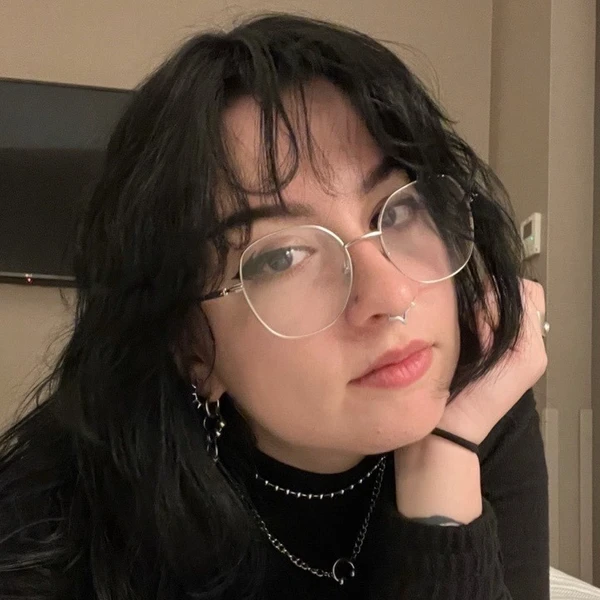
Ash McChesney
1x
Finalist
Ash McChesney
1x
FinalistBio
Greetings and Salutations! My name is Ash. I am a desert transplant currently residing in the great, green forests of the Pacific Northwest, with no plans on ever returning to the south.
I have always possessed a strong and, at times, overwhelming love of storytelling. There is little I find much joy in as breaking down a good book to its barest, grisly bones. My favorites range from lesser-known works, such as The Tenant of Wildfell Hall and The Wretched of the Earth, to our well-loved favorites, such as Wuthering Heights and Notes from Underground.
And beyond this, my love extends deeper, older. It is a love that I feel transcends time and continents, a shared love that connects all of humanity. Storytelling does not exist in only books — it is in every cave painting, every smudged work of art, every smoke-stained room. My ultimate dream lies here, with history. In Museums, parks, and wild spaces. Creation itself! An act of god that we perform on earth.
Suffice to say. If I cannot be found reading, my next likely haunts are as follows:
1. Walking my dog at the park down the street.
2. Brewing loose-leaf teas, straining herbal oils, concocting tinctures and salves.
3. Leaving shiny offerings in a tin on my porch for the crows that live in my tree.
4. Hunched and aging at my silversmithing desk.
5. Elbow-deep in the soil in my front yard, trying to form an emotional connection with the local insect population.
Education
Arizona State University Online
Bachelor's degree programMajors:
- English Language and Literature, General
Minors:
- Anthropology
- Liberal Arts and Sciences, General Studies and Humanities
Miscellaneous
Desired degree level:
Master's degree program
Graduate schools of interest:
Transfer schools of interest:
Majors of interest:
- Museology/Museum Studies
- Library and Archives Assisting
Career
Dream career field:
Museums and Institutions
Dream career goals:
Production Manager
Arizona Pain2022 – 20242 yearsOperations Analyst
Arizona Pain2023 – 20241 year
Sports
Badminton
Club2017 – 2017
Arts
Sunrise Mountain High School
TheatreMuch Ado About Nothing, Twelfth Night, Grand Central Station, Shrek the Musical, Bang Bang! You're Dead, Footloose2015 – 2017Freelance UX/UI Design
Design2022 – 2024
Public services
Volunteering
FoodnotBombs — Volunteer2025 – Present
Future Interests
Advocacy
Volunteering
Philanthropy
RonranGlee Literary Scholarship
“I come to the fields and vast palaces of memory, where are treasures of innumerable images, brought into it from things of all sorts perceived by the senses. There also is stored whatever we think, either by enlarging or diminishing, or by varying in any way those things which the senses have touched; and whatever else has been committed to it and laid up, which oblivion has not yet swallowed up and buried.”
In this passage, Augustine presents the nature of memory itself. Interestingly, he does not present it as an immaterial product of experience, or a confounding menagerie of our lives. Instead, he presents memory as tangible and unstable architecture, one that is purposed with the preservation of truth yet actively and innately reshapes it, thus arguably revealing a deeper anxiety that the self can never fully know or trust itself without divine intervention. Where to turn when your own mind and memory are against you.
Augustine’s powerful metaphor of memory as “vast palaces” immediately establishes an unsettling, texture-rich tension: the mind is expansive, ordered, golden, and grand, yet impossible to fully survey, inconsumable in its vastness. We know palaces as monoliths of the past, often crumbling, uncertain in their construction and safety. Beautiful, but unpredictable. Cordoned off by museum tape. Drawing this association is not a comforting image, really, but it is certainly a gothic-adjacent one -- painting memory as an aged labyrinth filled with time-distorted images, altered past perceptions, and half-buried truths we have forgotten and re-remembered incorrectly. By emphasizing that stored experiences and thoughts are subject to “enlarging or diminishing” and “varying,” Augustine acknowledges that memory is not faithful to reality, a fact that is now well established through social and neurological studies conducted in the modern age. Instead, memory is a creative home; it is interpretive and, therefore, unreliable. It is a painful thing he has forced the reader to acknowledge: that the individual who relies on memory is always working with a compromised source.
Crucially, Augustine’s concern is not merely an epistemological one, but also a moral one. If the palace of memory restructures sensory truth, then self-knowledge, which is so central to confession, repentance, and salvation, prominent and vital concerns of the era, rests on very unsafe ground. How do we repent if we do not correctly remember what it is we are repenting for? Oblivion here is crucially personified as something, or someone, that “swallows up and buries,” suggesting that the loss of memory is a kind of spiritual, metaphysical erasure, conjuring the chilling, Dickens-like image of being swallowed whole. By doing so, he inadvertently argues that what is forgotten cannot be examined, confessed, or redeemed. When it is lost, it is gone, and if we are the sum of our memories and experiences, then it is this singular loss that erases us and consigns us to that true, unknowable oblivion.
Death and loss are described in many different lights across literature, so we must understand that his use of the word "Oblivion" is an intentional one. Underlying this passage is Augustine’s profound fear of the interior darkness, or emptiness. His fear is that the mind contains so much more than the self can manage, and that introspection and self-actualization can only lead to a confused and distorted conclusion. It poses an interesting question to the reader: Can we know ourselves? Are we even capable of it when the act of self-perception is through a broken lens? As a lover of the gothics, I always search for their influence, and here the gothic influence lies in this inward, nearly supernatural turn. It lies in the realization that the most haunted place is not the external world, but the self’s own inner architecture, palaces, and fields. Memory, for Augustine, is a living and unreliable architecture that both preserves and reshapes, underscoring his deeper anxiety that one can never truly know oneself.
Alexandra Rowan Voices of Tomorrow Scholarship
The sun is already blistering by the time Ren settles into her square of dirt and stone.
The dig site is buzzing with low voices, the thwick of damp towels. The earth here is rich and dark, sticking to shoes and clothes like taffy. Everyone moves with measured steps. They all know precisely what they are here for.
A young gentleman uncovers a fragment of pottery that will likely be displayed in a museum case. A woman two squares away is handing something out of sight with that faraway expression that tells everyone she’s got something good. All around is history being unearthed from its century-grave. This is Ren’s first field assignment, and she feels achingly out of place. She’s desperate to prove herself, and the other archeologists can smell it on her.
Okay, breathe.
She’s here for a reason, was invited for a reason. Ren belongs here just as everyone else does. Has earned it with sweat and tears and her own blood. Her mother's blood, too, and her mother's mothers. Out of everyone here, she is the only one with ancestral ties to the site itself.
Ren kneels in her own square and starts to dig.
It isn’t long before everything else fades away.
Yes, she remembers now. Remembers why she chose to fly across the country for school and study archeology, why she is here. Ren digs her fingers in deep, feels the coolness beneath the ground, and remembers.
The stories she grew up with are many. Told over bedtime, holidays, and Sunday dinners. Stories of villages nestled in these very hills — of artisans, of storytellers. Of history. Her own history.
Ren clutches the necklace at her throat, bearing a small pendant with a spiral. Her family’s crest.
Ren digs.
Time passes.
The sun is hot. Ren peels away a layer of dirt with her brush, smears a dark run of earth across her face. The very earth her grandmother sang about.
Her knees start to ache. The crowd around her thins out as they pull more from beneath them. Tools, pottery. Her own brush snags on something small. A pebble? Perhaps an errant root. She wiggles a finger into the dirt to pry it aside, but a small bead rolls into her hand instead.
It is no larger than her fingernail. Cold, too — the death-cold that things become after living buried for centuries.
It isn’t silver. It isn’t jeweled, or large, or headline worthy at all. Behind her is an entire world, organized and laid out on water-wicking sheets. This small bead wouldn’t even be worth their time. She should log it and move on quickly.
Ren rubs the dirt away with her thumb.
How many hands had held this relic before her? Ren imagines it on a necklace, sitting in a collarbone dip. Braided into the hair of a mother, a daughter.
How many starlit nights? Or warm, winter hearths? Was it passed down, a gift, a token of forgiveness? It’s so light in her hand, as if it barely exists. It rolls, and on the other side is a small, carved spiral.
The tightness in her throat is nearly pain. Her feet carry her before she realizes.
The project lead is a shrewd man. He glances briefly at the find she offers in her palm and nods, but it’s a weak one. “Small, but we can log it anyway.”
That’s all he says. He turns to a colleague holding a nearby artifact, and just like that, her bead slips into obscurity.
But not for Ren.
Kristinspiration Scholarship
A disease is running rampant in this world. It corrupts, it rots from the inside out. It is singlehandedly ruining the next generation, and yet you won't see it reported on the evening news. This disease is anti-intellectualism.
The fear of knowing, of thinking itself. It has been implanted in our homes, our families, our neighbors. There is such thing as healthy skepticism, but this has gone far beyond what is healthy -- our educators, our very institutions are under attack.
And what are we, without education? Absolutely nothing. Education is the cooking meat, the medicinal plant, the rolling wheel. If we did not possess the capacity to learn and adapt, we would still be living in caves and eating our food raw. We improve because we learn, and it, quite honestly, sickens me to see intellect become public enemy number one. Who ever expected critical thinking itself to become so hated?
To me, education is the way to a brighter, more egalitarian world. A right that women have only had access too in small amounts, when considering history as a whole. Education is the key to self-possession, to standing on your own two feet. It isn't "indoctrination", to go to college. It's broadening your worldview, and to some, this is the most terrifying thing in the world.
When it comes to legacy, I've never put much thought into it. I do not plan on having children, and since the concept of a legacy is often enshrined within that context, it simply hasn't come up for me. But when I think now of what I want to leave behind, the answer is clear as day. Opportunity. Improvement. Interconnectedness. If I had the capacity to impact every single person on this earth, I would want them to know to lead with curiosity, not contempt. That learning about each other and setting aside hateful rhetoric is the only way that we will continue to advance.
I cannot speak to every person in the world, unfortunately. What I can do is speak to every person I know. Live as what I believe an example should be, and that is someone that pursues knowledge despite hardship. I want to plant a seed of desire in the heart of every woman -- desire to grow into more than what they are told they can be. Desire to pursue greater heights, and to grow comfortable with the idea of being uncomfortable in this pursuit.
Education is important because it is all that we have in this world. I hope to leave behind a legacy that reminds people of that.
Andrea Worden Scholarship for Tenacity and Timeless Grace
Honestly, I’ve never had a traditional path through college.
I first started school back in 2018, right out of high school. I was determined, and excited, but had to drop everything when my dad’s medical issues became too serious for me to ignore and too expensive to justify spending money on anything else. My family needed help, and at that time, being there for him mattered more than my degree. Stepping away from school wasn’t easy, it felt like losing momentum and falling behind, but I did it because family comes first, always. That choice changed my life and shaped a lot of who I am now, including pushing me into the medical field. I am happy to report that after a few years he recovered, and a few more after that, I chose to go back to college.
Coming back to college years later has made me a non-traditional student in every sense! I’m going to be older than most of my classmates, I will work full time 40-hour weeks while going to school, and most notably, I’ve had to really rebuild my confidence after feeling like I fell behind. After feeling like I failed.
But I’ve also gained a kind of perseverance I didn’t have at eighteen, now that I'm twenty-six. I know what it’s like to have things fall apart and to choose to get back up anyway. I know that failure is only a temporary state, until we choose to keep trying. That resilience is something that I have earned, and it is what drives me now. I carry it with me like a trophy, because it is.
Kindness and compassion have always guided me, and I've made an intentional decision to let them. I feel this world wants us to become apathetic, and the best way to combat that is to see every individual as a person. There was one moment that has stayed with me: a patient came in to my work alone, scared, in pain and looking for a pain management team that would help her. She wouldn't stop apologizing for being “difficult” and it broke my heart, because I knew then that nobody had really listened to her. It is a very common thing to see in the health field, but she was so young that it was shocking to see her so disheartened and downtrodden. Maybe she reminded me a little of myself, and maybe that makes my offered hand a little selfish, in a way, but I wanted to be there for her. In the moment, it felt like the most important, human thing in the world.
I sat with her longer than I technically was supposed to. I explained things in her care package step by step, and did my best to make sure she didn’t feel alone. She cried, and I let her. Later she told me I was the first person who had made her feel heard in months. That experience changed me, and I think about her often. It reminded me how powerful it is to treat someone with patience and humanity, even in small moments. Its sad, truly, how we must make the choice to inject humanity into our lives, instead of simply having it, but it is this fact that it must be a choice in the first place that makes it powerful. Kindness and compassion is a decision, and in going back to school I am choosing them for myself, too.
That’s the kind of person I want to be in my academic life. I want to lift others up, encourage them, and show compassion in spaces where people often feel invisible or intimidated. Returning to school after so many detours has taught me that success isn’t linear, and neither is life! Success is built on resilience, on choosing to keep going even your the timeline isn't "the norm", and looks different to every single person. To me, success is standing in a bookstore, a museum. Success is loving my life.
What drives me now is the belief that things don't end with the setbacks, and the fact that time is passing, and will continue to pass even if I don't choose to go back to school. In four years I'll be thirty no matter what - but only I get to control what thirty looks like.
So I chose to come back. I chose to keep learning, and to build a future I can love and be passionate about. I do my very best to carry that same spirit of perseverance and kindness with me, and I hope to honor people like Andrea by continuing that.
Bick First Generation Scholarship
By the time I was sixteen, I had already attended twelve different schools.
No, my family wasn't miliary -- that's the first thing everyone asks when I tell them. Military would've been better. Maybe it would have afforded us a house on a base, or some community to commiserate with. No, my mother wasn't in the armed forces. She just had itchy feet.
I hated it.
But we had to go where the money was, even if it was barely enough to get by. We weren't city people by any stretch, any she tried to stick us in a small town whenever there was opportunity, but we were always moving. Changing states, schools, communities. Changing friends, when I was in one place long enough to make them. Sure, you can blame some of it on my mom -- she was never particularly talented at holding a job down once she had the luck to grab it, but my family always blamed it on her education. A drop out, didn't even go back for her GED. She couldn't. She had kids to take care of. And moving that much so young, it takes things from you. Important things. Opportunities. Growth. I was set bet in a lot of ways by it, yeah, but the biggest one I felt was my social skills.
Everywhere I went I was new. Eventually you realize there's no point in making roots when you're going to be moving again anyway, so I stopped trying to be anything but the new girl. I eventually got the hang of the "social skills" thing, but it took some time. By the age of eighteen, I had had enough.
I didn't want to live a life like that. I didn't want to max out at the height my diploma would take me, I wanted to go further. I looked at my mom, god love her, and decided I would never live that life. I wouldn't let her live it forever, either. I would not be miserable.
But misery is a sickness, and it infects you from the inside out. After so many years of being passed up, written off, looked down on by college grads above her station, college had left a bad taste in my mothers mouth. She called it "getting out of the system", but now I know it was just the seeds if the anti-intellectualism movement. Against the odds, against common sense, she fought me on it. I went anyway.
For awhile, at least. My dad ended up getting sick and I dropped out too. Better places for the money to go, and all that.
But I'm older now. Stronger. More resilient. I want a life I can love. I want to be free from the burden of debt to make my family's life better. I want to chase knowledge and have it fulfill me. So I am choosing to return to school, finish my degree, and no one can stop me.
Wicked Fan Scholarship
I’m a fan of Wicked because it puts the spotlight on something I don’t think we see enough of in popular stories. The complex, transformative, and sometimes terrifying power that is feminine friendship.
At its core the story isn’t really about romance, even though romance is present. It’s about two young women who challenge each other, change each other, grow together, and ultimately choose loyalty to one another over everything else. I love how Elphaba and Glinda’s relationship shows all the messy, emotional, deeply human parts of friendship that aren't shown in common media: conflict, growth, forgiveness, sometimes hatred, and the kind of connection that shapes who you become. The kind of connection forged in conflict, and made stronger by it.
Romance takes a back seat, and that feels refreshing to me when a story has female main characters. Wicked isn’t about who the heroine ends up with or who kisses who, but rather about how these two extremely different young women learn to expand their worldview and understand one another, even when the odds are against them, and by understanding one another grow to understand themselves. It celebrates women finding strength in each other, not competing or being defined by the men in their lives, and that’s a message that really resonated with me the moment I saw it. Wicked feels feminist in a way that’s sincere, especially now, when pseudo-feminism has taken over the hollywood industrial complex. It gives women the space to be ambitious, flawed, passionate, ugly, human and powerful, all without apology.
Bright Lights Scholarship
My plans for the future center around earning a college degree and building a career that actually means something to me and my community. Neither of my parents earned their GED, so going to college isn’t just about getting a job. It’s about changing the direction my family has been headed in for generations, and challenging the anti-intellectualism that is prevalent in families like mine. I’m studying English with the goal of moving into museum studies and history, because I want to work in spaces that preserve stories and make history feel alive!
I can see myself working in museums or archives, helping build exhibits and programs that highlight different voices and make people feel connected to the past. I love research, storytelling, and highlighting that bridge to our ancestors that lives in us all. This path lets me bring all of that together in a way that matters.
This scholarship would make a huge difference in my ability to get there. As a first-generation college student, I’m doing all of this on my own, without a financial safety net. Tuition, books, and living expenses stack up terrifyingly fast, and every bit of support directly impacts my ability to stay focused on my education instead of constantly worrying about money. I will be working full time while I pursue my degree, and 40 hour work weeks on top of being a full time student is enough to have on one person's plate - and considering I will already be needing to take out loans, every little ease of that burden counts.
With this scholarship, I’d have more breathing room to fully dedicate myself. It would give me just a bit more of the stability I need to keep pushing forward and eventually become the first in my family to graduate, opening doors not just for myself, but hopefully for someone in my family who comes after me. I want my siblings to feel safe to pursue their education, and I want my mom to WANT to get her GED. It's a hard thing to convince, but I am going to lead by example.
I am no stranger to hard work. None of my family is. I know I will have to toil and labor under system that doesn't care about me to get to what I want, to earn my degree - but I don't care. I still want it. I want it more than I knew I was capable of wanting something. With a scholarship, my goal is that much closer within reach.
Bulkthreads.com's "Let's Aim Higher" Scholarship
From a young age, I have been drawn to the stories beneath the surface - the fingerprints pressed into artifacts, the voices preserved in literature, the cultural memory carried in a whale song (my favorite animal). As I pursue my degree in English with the intent to move into museum studies and history, what I want to build isn't a machine or a product. I want to build a bridge. Or rather, enlighten them to the bridge that is already within us all. A bridge between people and the past.
And I want to build myself career where I can help shape how these stories are preserved, share them with the next generation. Museums are houses of a thousand things; they are storytellers, educators, and for me, anchors. I feel that people feel disconnected from history because it is presented as static or academic. It isn't! My goal is to build spaces where history feels alive, like your mothers kitchen as she teaches you a family recipe. I want people to see themselves reflected.
This future I am building begins with my education, of course. Studying English Literature strengthens my ability to analyze, communicate, and craft with clarity. Pairing that with museum studies and history will give me the tools I need to achieve my goals.
The impact I hope to make is rooted in connection, the connection of ages. Museums can be transformative places, I think. Especially for communities that have been historically underrepresented or misrepresented in the hopes of lightening a difficult past. By helping to build exhibits that include diverse and accurate perspectives, highlight the voices of those who suffered, and encourage critical thinking about what we are told, I can contribute to a future where history feels real, and shared. Ultimately, I just want to be a storyteller.
Aren't we all?
RonranGlee Literary Scholarship
"Gilgamesh, where are you wandering?" said Siduri. "You will never find the life for which you are searching. When the gods created mankind, they allotted him death, but like they retained in their own keeping. As for you. Gilgamesh, fill your belly with good things; day and night, night and day, dance and be merry, feast and rejoice. Let your clothes be fresh, bathe yourself in water, cherish the little child that holds your hand, and make your wife happy in your embrace; for this too is the lot of man."
- Epic of Gilgamesh
In the Mesopotamian work, Epic of Gilgamesh, our hero's desperate pursuit of immortality is at the forefront of all he does and pursues. After the death of his dear friend, Gilgamesh's fear swallows him whole -- a fear not only of death, but it's crushing inevitability. The finality. The end. In counseling a poet named Siduri, the reveals that the true meaning of life is not achieved through living forever, but that it is existence itself and all of its small joys that defines human mortality.
His journey takes him across oceans in the vain hope that he might escape this lot of man, and in these journeys he meets Siduri, an alewife who offers him a fresh perspective. That the pursuit of eternal life is futile and foolish, and that the true joys are to be found in the fleeting experiences that the mortal possess within their grasp. That one must rejoice, cry and wail in equal measure, and that it is this accepting of a mellow hedonism that defeats the fear of death, and nothing else. That accepting the conditions of mortality is what leads to a rich life, and not the pursuit of the lot of the gods.
She starts this by challenging him. "Gilgamesh, where are you wandering? You will never find the life you are searching for." She is asking him to consider himself and his purpose, to truly look at what he is doing with a critical eye and not a panicked one. This is the beginning of confronting the truth that his goal is unattainable. It is a significant turning point, for Gilgamesh, a question he has not yet asked himself. And in asking this question, we break him of his belief that his kingly status earns him a spot amongst the gods. She brings him back to his bare, human bones.
Then, she reminds him of the inescapable truth; that "When the gods created mankind, they allotted him death, but like they retained in their own keeping." Gilgamesh is prideful, and arrogant. A reminder that he is not exempt from the rest of mankind, that immortality does not belong to him, and never did. Instead, she offers an alternative. "“As for you, Gilgamesh, fill your belly with good things; day and night, night and day, dance and be merry, feast and rejoice.”
A line of philosophy adopted more heavily in modern cultural spheres; the idea that embracing our short life's simple pleasures is what makes joy significant, that in life's brevity, we must seize the day, an ancient Mesopotamian "carpe diem." She argues that he is not meant to pursue divinity -- that in fact humanity is designed to live fully within their limits. She uses ordinary, daily pleasures to highlight this. Eating, dancing, enjoying the sensation of being clean. By utilizing commonplace joys to support her argument, she highlights the separation of lavishness. He need not even be a king, to live fully. Siduri challenges the expectations he has for himself, suggesting that joy and happiness is not measured in time or in gold, but in the small things.
And profoundly, she emphasized the requirement for human connection. "Cherish the little child that holds your hand, and make your wife happy in your embrace; for this too is the lot of man." The word "too" is emphasized here, she has emphasized that the embrace of relationships is just as vital as the embrace of simple joys, that they are mutually exclusive, both in their own right the divine obligation of the living. This does bring us back full circle to his significant relationship, that with his friend Enkidu.
In the Epic of Gilgamesh, Siduri's counsel is the catalyst for his eventual development. She gently reminds him of his humanity, all while soothing the fears of death by reminding him that the meaning of existence is to, simply put, exist in your entirety. That life is meaningful because of it's brevity, not in spite of it.
Redefining Victory Scholarship
A Man Helping Women Helping Women Scholarship
What does it mean to make a positive impact?
What comes to mind are the big things. Affecting change in massive ways, the faces of advocacy and perseverance we all know and love. Hellen Keller, Harriet Tubman, Virginia Woolf. These are women who made tidal waves in their time.
But we can't all be a Harriet Tubman. I think that sometimes the "scale" of what positive impact can be turns people away from pursuing it in the first place. We think of making an impact, and we think of changing the world.
But change doesn't have to come at such a magnitude. Positive change can be in a handshake, a smile, or a karaoke night. And making an impact on the world doesn't have to be so unattainable.
For me, making a positive impact means less about breaking and more about preserving.
Museums are way-stations. Liminal spaces in time where past and present meld into one beautiful, eon-spanning image. People think of college as their ticket to money, fame, and fortune. They pursue it with the goal of financial independence. And while it's true we need to be able to support ourselves, it diminishes the impact and necessity of the schools of education that don't exist for the purpose of making money. It diminishes the museums.
Reading, writing, storytelling. History and art. These are necessities, and they are dying. While the tech sector gorges itself on money and graduates, the arts are withering away under the scrutiny of an increasingly profit-driven mode of existence. It isn't our fault that we need to be financially safe, but it is our fault if we don't fight back against a system that fails to recognize the necessity of keeping these areas of study alive.
Who are we, if not storytellers? Where would we be, if not for the historians and record-keepers? Education for the sake of getting a good job is important, but education for the sake of humanity, for the sake of preserving what we do and who we are, is arguably the most vital aspect of pursuing a degree. I think so, at least. In this way, I fight back against the anti-intellectualism movement, the communities and figures that tell me it is pointless to pursue something that won't make me a million dollars. To them I say, what of your professors? What of the people who got you here? What of the English teacher in high school who told you to reach for the stars?
So I will preserve.
I will pursue my education in the arts with as much vigor and dedication as a tech CEO. I will speak at museums, I will write stories and novels and plays.
I will keep humanity alive.
Harvest Scholarship for Women Dreamers
There is this shared experience of women when they are still girls. Digging your hands in the dirt, making potions of sticks and mud and leaves. Standing in the wind. Playing with the bugs. We get older, and quieter, and we stop making potions, but the hunger for it never leaves. The hunger to lie in the fields and listen to the sky.
My hunger is loud.
Working in museums is a difficult goal. The pay is low for the education required, the workforce is oversaturated with underqualified applicants, and the demand for positions in curation and management is nearly nonexistent. It is competitive. It is unsteady. It is the adult equivalent of playing in the dirt, and I want it more than I have ever wanted anything in my life.
It is difficult to see the forest for the sake of the trees, at times. Capitalism is good at doing that, good at obscuring joy through the lense of self interest and preservation. Why do anything if it can't make you money? You don't need to love it, the murder machine whispers. You just need to live it. But I am not satisfied with that. I could never be. Not when there is a screaming wind outside, a winter tree stripped of its leaves that crunch so nicely.
It will take work. Much of it. I am not young anymore. I am jaded by the workforce, but that somehow only fuels me more. I know what life tastes like when I am living for money and not for joy, and I can't do it.
So I will work. I will toil under the 40-hour work week and get my college credits in the night, in the in-between hours. I will sleep little, and relax even less. It will take approximately two years, if I take summer classes. Another two for my master's degree, and by then I'll be cresting thirty-one. My parents say it's a little late in the game to start playing, but I disagree. Thirty-one is going to come no matter what, and I don't want to be stuck in the same place when it does.
And then, after, it will take sacrifice. More of it, if you can believe. Working where I can, because as I said, it is a competitive field. My dream job won't just BE there when I graduate. But that's okay, I can wait. Because it will come eventually, and when it does, I will be ready. Maybe I'll be thirty-five by then. Maybe forty. But forty is coming. And I want to be a Curator with my hands in the dirt when it does. Working in a museum, standing in the wind.
J. L. Lund Memorial Scholarship
For me, it has always started with the whales.
An unexpected beginning, when the end desire lies in stories in history. But that doesn't matter. I can still feel that squeezing, ardent love in my chest, fresh and newborn as the day I first heard a humpback whale song.
Did you know whales can live for up to 200 years? Their songs penetrate water, space, and time. Somewhere in the ocean, there is a mother singing the same lullaby to her child that her own mother sang to her hundreds of years past. Every pod has its own unique cadence and flow, too. A thousand languages echoing in the sea, older than us, older than humanity itself. What is history and storytelling, if not something we carry through the ages? In their songs, in their skin - harpoon points embedded for longer than you have been alive. Some of the oldest artifacts pulled from the earth are made of whale bones, spears and scrapes, and jewelry. Always jewelry.
In cave paintings across the world, there are whales. Chilean paintings and South Korean Petroglyphs show whale hunts. Norway's caves depict them as beings of worship, beings of spirit, of symbol. I look at those paintings and I say, "I know you." You are the same whale that sprayed at me in the cove of Depoe Bay. You are the same whale I know from my childhood storybook. I know you. I know you.
I get that aching squeeze in my chest. It is the same feeling I have when I see an old painting, when I am forging jewelry from silver. I see my hands working the metal, and beneath them is the shadow of a thousand others, my ancestors and yours. I know you. I know you.
And now, I find it in my books. In the words of yesterday that tell of tomorrow. In the stories past that still spear me to the ground, make me cry, make me smile. Is that not history itself?
What is the difference between the novel in your hand and a whale song?