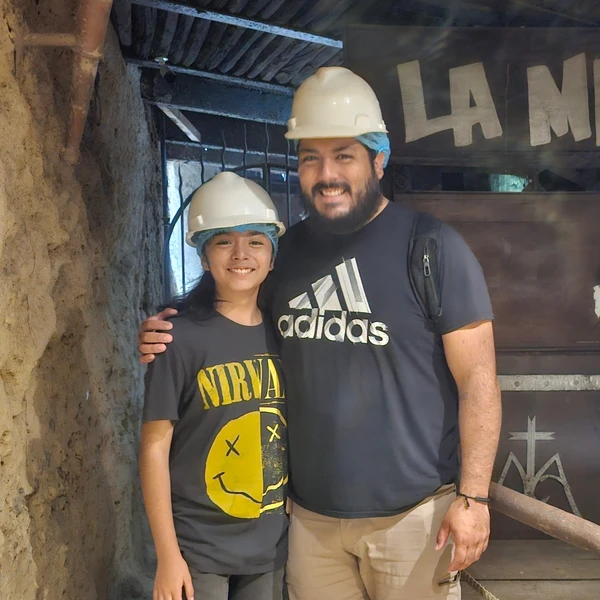
Arturo Acuna Gutierrez
2x
Nominee2x
FinalistArturo Acuna Gutierrez
2x
Nominee2x
FinalistBio
I am a father of 3 beautiful children, husband to a beautiful wife, and I am back of the journey to continue and finish my education. I am passionate about mathematics and am looking to improve my job opportunities with the changing market. I love watching my kids grow up, and I would love to be an example of someone that finishes the goals they set out for themselves.
Education
The University of Texas at Arlington
Bachelor's degree programMajors:
- Mathematics and Statistics, Other
Collin County Community College District
Associate's degree programMajors:
- Engineering, General
Miscellaneous
Desired degree level:
Doctoral degree program (PhD, MD, JD, etc.)
Graduate schools of interest:
Transfer schools of interest:
Majors of interest:
- Mathematics and Statistics, Other
Career
Dream career field:
Financial Services
Dream career goals:
Senior Construction Materials Technician
TEAM Consultants, Inc.2017 – Present9 years
José Ventura and Margarita Melendez Mexican-American Scholarship Fund
I'm a first generation immigrant from Mexico, the oldest of three, and the first to pursue higher education. My parents came here with high school educations and always encouraged education as the path to something better. I was brought here when I was two, but didn't learn that I was undocumented until my senior year of high school. After graduation, I spent two years in Mexico waiting for my residency interview, where my daughter was born. Those years brought an identity crisis I wasn't prepared for. Was I from here or from there?
When I returned and attempted college the first time in biomedical engineering, I was caught between worlds, working as much as possible to send money to Mexico, focused entirely on surviving instead of the future. I let it slip away. Life took me into construction quality assurance, where I've worked my way up. But at 32, I reached a point where the path forward wasn't clear. Hourly wages plateaued, and the next positions would mean a pay cut. Being competent at my job wasn't enough to move forward.
Then ChatGPT launched, and something shifted. I wanted to understand how it worked. I started learning everything I could about the mathematics behind large language models: linear algebra, optimization algorithms, statistical foundations. I taught myself to code. What started as curiosity became an obsession, and I realized I was rediscovering a passion I'd abandoned. Mathematics has always been my strongest subject. This time felt different. This time, I knew exactly why I was doing it.
I still remember the moment I realized I had hit a wall. I was working on a portfolio management system using a liquid neural network. I had research papers all around me. The idea was there, but the language to put it all together was failing me. It wasn't from lack of effort. It was simply from a lack of knowledge and understanding. I could build things that functioned, but I couldn't fluently read or write in the mathematical language the research required. That's when I understood: I needed to go back to school to learn how to think and communicate in mathematics properly.
The decision was bold. I'm the primary breadwinner, supporting my twelve-year-old daughter in Mexico, where I pay for her private school and everything she needs, plus my household here with my fiancée, out three-year-old son, and my ten-year-old stepson. Going back meant cutting my work hours in half, losing overtime, and mileage reimbursement. I took out a $14,000 personal loan to cover tuition and bridge the income gap. My fiancée is also returning to school, and we're navigating this together.
This isn't just about earning a degree. It's about building tools I'll need for the future while pursuing what genuinely excites me. I'm working toward applied mathematics research and computational geometry fields where I can contribute meaningfully. I want to understand the mathematical language that will let me modify and articulate my own ideas. Right now, I'm like someone who can recognize a tune but can't read music.
More than that, I'm showing my children what sustained commitment looks like. I want them to see that it's possible to acknowledge gaps in your knowledge, take on something difficult, and build something better. Being 32, balancing fatherhood, managing a household, and pursuing advanced mathematics isn't the traditional path. But it's mine, and I'm determined to see it through. That determination, to honor the sacrifices my parents made, to create opportunities my children can build on, to pursue my passion, is what brought me back to school and what keeps me going.
Harvey and Geneva Mabry Second Time Around Scholarship
I'm a first generation immigrant from Mexico, the oldest of three, and the first to pursue higher education. My parents came here with high school educations and always encouraged education as the path to something better. I was brought here when I was two, but didn't learn that I was undocumented until my senior year of high school. After graduation, I spent two years in Mexico waiting for my residency interview, where my daughter was born. Those years brought an identity crisis I wasn't prepared for. Was I from here or from there?
When I returned and attempted college the first time in biomedical engineering, I was caught between worlds, working as much as possible to send money to Mexico, focused entirely on surviving instead of the future. I let it slip away. Life took me into construction quality assurance, where I've worked my way up. But at 32, I reached a point where the path forward wasn't clear. Hourly wages plateaued, and the next positions would mean a pay cut. Being competent at my job wasn't enough to move forward.
Then ChatGPT launched, and something shifted. I wanted to understand how it worked. I started learning everything I could about the mathematics behind large language models: linear algebra, optimization algorithms, statistical foundations. I taught myself to code. What started as curiosity became an obsession, and I realized I was rediscovering a passion I'd abandoned. Mathematics has always been my strongest subject. This time felt different. This time, I knew exactly why I was doing it.
I still remember the moment I realized I had hit a wall. I was working on a portfolio management system using a liquid neural network. I had research papers all around me. The idea was there, but the language to put it all together was failing me. It wasn't from lack of effort. It was simply from a lack of knowledge and understanding. I could build things that functioned, but I couldn't fluently read or write in the mathematical language the research required. That's when I understood: I needed to go back to school to learn how to think and communicate in mathematics properly.
The decision was bold. I'm the primary breadwinner, supporting my twelve-year-old daughter in Mexico, where I pay for her private school and everything she needs, plus my household here with my fiancée, our three-year-old son, and my ten-year-old stepson. Going back meant cutting my work hours in half, losing overtime, and mileage reimbursement. I took out a $14,000 personal loan to cover tuition and bridge the income gap. My fiancée is also returning to school, and we're navigating this together.
This isn't just about earning a degree. It's about building tools I'll need for the future while pursuing what genuinely excites me. I'm working toward applied mathematics research and fields where I can contribute meaningfully. I want to understand the mathematical language that will let me modify and articulate my own ideas. Right now, I'm like someone who can recognize a tune but can't read music.
More than that, I'm showing my children what sustained commitment looks like. I want them to see that it's possible to acknowledge gaps in your knowledge, take on something difficult, and build something better. Being 32, balancing fatherhood, managing a household and pursuing advanced mathematics isn't the traditional path. But it's mine, and I'm determined to see it through. That determination, to honor the sacrifices my parents made, to create opportunities my children can build on, to pursue my passion, is what brought me back to school and what keeps me going.
Ricardo Cortez Legacy of Achievement Scholarship
I took out a $14,000 personal loan to make this work. That's what it cost to cover tuition and bridge the income gap when you cut your work hours in half to pursue a degree. As I return to school, I'll be making $28.50 an hour. I averaged 45-50 hours per week with overtime at time and a half, plus mileage reimbursement for the roughly 300 miles I drive weekly between construction sites. That income supported my household, my fiancée, our three-year-old son, my ten-year-old stepson, and my twelve-year-old daughter in Mexico. For my daughter, I pay $300 from every check plus any extra private school expenses, medical expenses, and whatever other emergency that arises.
Now, limiting my work to Monday, Wednesday, and Friday, maybe Saturdays if available, I've cut the income in half. No more overtime. Half the mileage reimbursement. My fiancée works from home but makes about half, and she's starting school this winter too. The loan was my solution to maintain everything: keep paying for my daughter's education and needs, keep the household stable, cover my tuition, and avoid disruption to the life my family depends on. It works on paper. But it also means I'm carrying the weight of that debt while trying to focus on applied mathematics coursework that demands complete attention.
This $500 scholarship wouldn't erase that burden, but it would provide meaningful relief. Practically, it's a chunk toward loan repayment, reducing the pressure to find side income while I'm studying. That matters more than it might sound. Right now, I'm trying to avoid splitting my energy between academics and hustling for income, because I know that maintaining strong grades opens doors to scholarships and opportunities down the line. This scholarship buys me focus and the ability to be fully present in my studies rather than constantly calculating how quickly I need to pay down the debt.
The impact goes beyond the practical. My three children are watching everything I do. My daughter in Mexico sees her father working toward something better while still prioritizing her needs. My stepson and youngest see what it looks like to take on a difficult challenge while managing the responsibilities of being a father and provider. I want to model for them that pursuing education is possible, even when life is complicated and the weight feels enormous. But I also want to be honest with them about what that takes: the sacrifices, planning, and determination to keep everything balanced.
The truth is, being a father means making it look manageable even when the world feels like it's on your shoulder. You figure out the logistics. You take out the loan. You cut your hours and adjust and keep moving forward. This scholarship doesn't change that I'm willing to carry that weight, I've already committed to it. What it does is lighten the load just enough that I can focus on excelling rather than just surviving. It means I can put more energy into becoming the mathematician and researcher I'm working toward, rather than constantly strategizing about money.
I know what this opportunity means, both for me and my family. Being a father paying child support while going back to school means you're constantly trying to figure out how to provide for today while building something better for tomorrow. A lot of times it feels like you have to pick one or the other. This scholarship helps make it possible to do both. It's not just about the money, it's about knowing that someone sees the work that goes into this balancing act and thinks it's worth supporting.
STEAM Generator Scholarship
My parents came from Mexico with high school educations and worked hard. My father worked in fast food, and my mother worked in bakeries. They always encouraged education as the path to something better than breaking your back in service or construction work. They believed in the American dream even when the system felt designed to keep us guessing. I didn't learn I was undocumented until my senior year of high school. By then, it was too late to adjust course with the limited knowledge my family and I had about navigating the system.
After receiving my entire education and graduating high school here, I spent two years in Mexico waiting for my residency interview. That is where my daughter was born. Those years brought an identity crisis I wasn't prepared for. Was I from here or from there? Which me was my authentic self? When I returned and attempted college the first time, I was caught between worlds - trying to reintegrate into a family and situations I'd been away from, working as much as possible to send money back to Mexico, focused entirely on surviving the present instead of investing in the future. I wasn't mature enough to recognize the opportunity in front of me or to use the resources available. Academic culture was foreign. The system was confusing. I let it slip away.
Now, at 32 and pursuing applied mathematics, I understand what being first-generation really means. It's not just about being the first in my family to attend college, it's about the responsibility to honor the path that brought me here. My parents made sacrifices I'm only now beginning to fully appreciate. The determination I feel isn't about proving I belong anymore; it's about honoring what life has given me and what they made possible.
My career goals in applied mathematics research, computational biology, and computational geometry aren't just about professional achievement. They're about showing my three children that higher education is within reach, that curiosity and sustained effort lead somewhere meaningful. I want them to see their father complete what he started. More than that, one of my dreams is to eventually establish a scholarship fund, however modest, to help other first-generation students navigate this path with more knowledge and support than I had.
Being first-generation means carrying the weight of opportunity forward. It means not wasting what others fought to give you. And it means building something that outlasts your own journey and paves the way for others.
Phoenix Opportunity Award
My parents came from Mexico with high school educations and worked hard. My father worked in fast food, and my mother worked in bakeries. They always encouraged education as the path to something better than breaking your back in service or construction work. They believed in the American dream even when the system felt designed to keep us guessing. I didn't learn I was undocumented until my senior year of high school. By then, it was too late to adjust course with the limited knowledge my family and I had about navigating the system.
After receiving my entire education and graduating high school here, I spent two years in Mexico waiting for my residency interview. That is where my daughter was born. Those years brought an identity crisis I wasn't prepared for. Was I from here or from there? When I returned and attempted college the first time, I was caught between worlds - trying to reintegrate into a family and situations I'd been away from, working as much as possible to send money back to Mexico, focused entirely on surviving the present instead of investing in the future. I wasn't mature enough to recognize the opportunity in front of me. Academic culture was foreign. The system was confusing. I let it slip away.
Now, at 32 and pursuing applied mathematics, I understand what being first-generation really means. It's not just about being the first in my family to attend college, it's about the responsibility to honor the path that brought me here. My parents made sacrifices I'm only now beginning to fully appreciate. The determination I feel isn't about proving I belong anymore; it's about honoring what life has given me and what they made possible.
My career goals in applied mathematics research and computational biology aren't just about professional achievement. They're about showing my three children that higher education is within reach, that curiosity and effort lead somewhere meaningful. I want them to see their father complete what he started. I also want to work towards establishing a scholarship fund of my own to help other first-generation students navigate this path with more knowledge and support than I had.
Being first-generation means carrying the weight of opportunity forward. It means not wasting what others fought to give you. And it means building something that outlasts your own journey and paves the way for others.