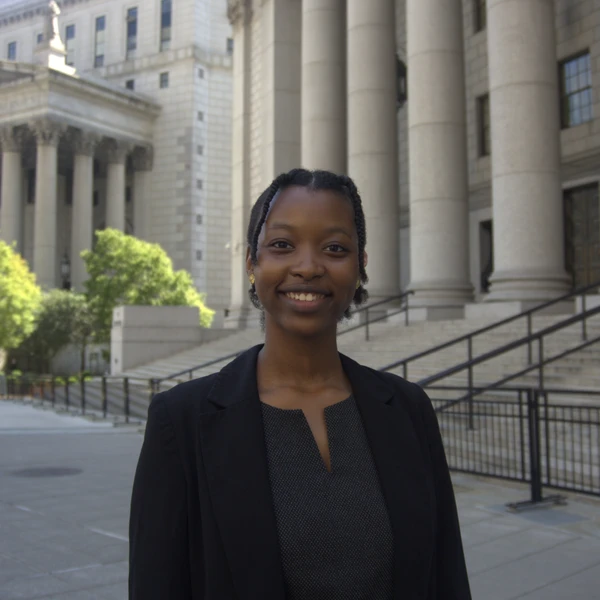
user profile avatar

Annick Niyonsaba

1x

Finalist

Bio

My name is Annick Niyonsaba. I was born and raised in NYC. I also attend school in the city. I am dual-enrolled at Baruch College and the Macaulay Honors College, studying Political Science and Economics. This summer, I am interning at a law firm that specializes in civil rights and civil liberties, conducting summer research at the intersection of fintech and energy access, and volunteering for the Street Homeless Advocacy Project.

Education

CUNY Bernard M Baruch College

Bachelor's degree program
2024 - 2028
  • Majors:
    • Political Science and Government
  • Minors:
    • Economics

Bayside High School

High School
2020 - 2024

Miscellaneous

  • Desired degree level:

    Doctoral degree program (PhD, MD, JD, etc.)

  • Graduate schools of interest:

  • Transfer schools of interest:

  • Majors of interest:

    • Legal Professions and Studies, Other
  • Not planning to go to medical school
  • Career

    • Dream career field:

      Legal Services

    • Dream career goals:

      Research

      • Finance and Financial Management Services

        Bitcoin Policy Institute — Undergraduate Summer Research Fellow
        2026 – Present
      • Community Organization and Advocacy

        Civic Futures Lab | Carnegie Young Leaders Program | Design for America | Watson Foundation — Team Lead for "How the Unhoused Live: A Lens into New York City's Safe Havens & Traditional Shelters" Project
        2025 – Present

      Public services

      • Volunteering

        Street Homeless Advocacy Project — Outreach Lead
        2024 – Present

      Future Interests

      Advocacy

      Politics

      Volunteering

      Philanthropy

      Entrepreneurship

      Our Destiny Our Future Scholarship
      My name is Annick Niyonsaba; I am a rising junior at Baruch College. I was born and raised in Queens, New York, but I am ethnically Burundian. My parents immigrated to the United States from Burundi to escape political violence and ethnic persecution. They settled in the United States for stability, the opportunity to continue higher education, better job opportunities, and to financially support our family back home. They instilled in me the importance of showing up for my community and for others. The principle was rooted in their lived experience, with each of their fathers killed as a byproduct of ethnic division set in motion by colonialism, or, for my paternal grandmother, the deterioration of her health with the absence of a community that could help her access health care professionals and vital medicine regularly. I heard these stories and many more growing up, which transformed how I view community and my role in it. Specifically, I have grown up understanding the broader implications of community division or the absence of one, and it has become clear to me the importance of cultivating community. In college, I have discovered that one of the ways that I want to make a positive impact on the world is through creating inclusive spaces that bring communities together to address civic issues that are often overlooked, like street homelessness in New York City. I am incredibly proud to have worked toward this goal, leading an outreach team through the Street Homeless Advocacy Project. Not only have I brought college students across different New York City schools together, but I have also done so with the goal of helping the city’s homeless population voluntarily leave the streets for transitional housing, all while creating opportunities for my peers and their unhoused neighbors to establish meaningful connections. But, equally, I believe it is important that we not only establish these relationships but also find ways to advocate for them. Good advocacy, however, requires a firm understanding about the community, their needs, and how to bridge the gap between these two. Through the Civic Futures Lab, I led a team of students in learning about street homelessness, the city’s support system for the homeless, and doing street homelessness outreach. By the end of the Spring 2026 semester, our efforts culminated in a mini documentary that captured the insights we gathered, which was screened to an audience of 75 during our end-of-semester spring expo. Invigorated by the expo’s success, my Civic Futures team knew the natural next step would be to scale the mini documentary into a full-length film, in which we would prioritize centering the stories and lived experiences of the unhoused people we have met and hope to meet. Ultimately, we want their stories to challenge misconceptions and mobilize New Yorkers to take a vested interest in the issue and join in conversations about how New York City can improve its support systems for the unhoused. To achieve this objective, however, my team and I understand that the quality of our film will directly impact our ability to effectively communicate our message. Furthermore, it is my utmost hope that my group and I can do justice to the stories and lived experiences of the city’s homeless, and a part of that involves producing a high-quality film. Therefore, receiving this $1,000 scholarship means that my team is able to invest in high-quality filming equipment, including microphones, headphones, LED panels, etc., providing me with yet another opportunity to make a positive impact in both my community and the world.