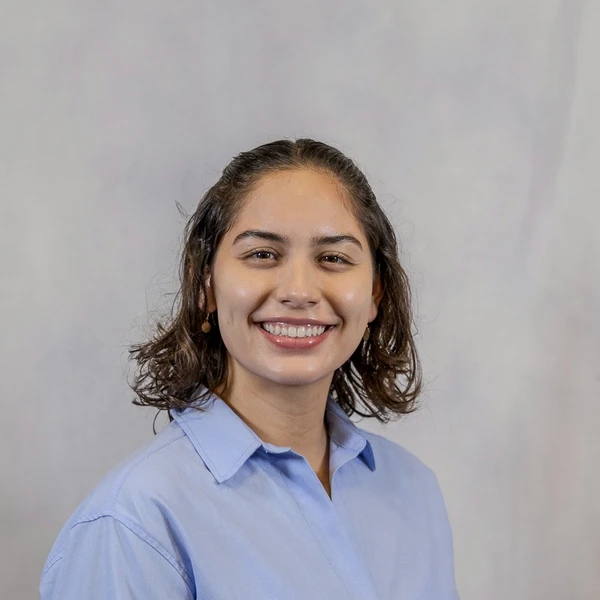
Aurora, IL
Gender
Female
Ethnicity
Hispanic/Latino
Hobbies and interests
Swimming
Coaching
Volunteering
Economics
Medicine
Biomedical Sciences
Reading
Adult Fiction
Young Adult
Tragedy
I read books multiple times per week
Annabel olivo
1x
Finalist
Annabel olivo
1x
FinalistBio
Hi, I’m Annabel Olivo, a first-generation, low-income graduate of the University of Chicago’s Class of 2026, where I studied Economics on the pre-med track with a minor in Health & Society. This fall, I will begin my Master of Public Health at Emory University while continuing my collegiate swimming career.
My experiences as both an athlete and a patient have shaped my passion for medicine, public health, and health equity. After spending years searching for answers to a rare vascular condition, I gained a firsthand understanding of how difficult it can be to navigate the healthcare system and advocate for yourself. Those experiences inspired my interest in reducing health disparities and improving access to care.
I am especially interested in children’s health and maternal health, where I hope to combine compassionate patient care with efforts to address the broader social and systemic factors that influence health outcomes. As a swimmer, researcher, mentor, and advocate, I strive to use my experiences to support others and create meaningful change in the communities I serve.
Education
Emory University
Master's degree programMajors:
- Public Health
University of Chicago
Bachelor's degree programMajors:
- Business/Managerial Economics
Miscellaneous
Desired degree level:
Master's degree program
Graduate schools of interest:
Transfer schools of interest:
Majors of interest:
- Public Health
Career
Dream career field:
Medicine
Dream career goals:
Assistant Coach
FVPD Riptides2021 – Present5 years
Sports
Swimming
Varsity2022 – Present4 years
Awards
- All American
- CSCAA All America
- NCAA finalist
- Record Holder
Research
Medicine
University of Chicago Orthopedic Surgery — Fellow, Researcher2024 – Present
Arts
BAND
Music2018 – 2022
Public services
Volunteering
Comer's Children's Hospital — volunteer2026 – Present
Future Interests
Advocacy
Politics
Volunteering
Philanthropy
Entrepreneurship
José Ventura and Margarita Melendez Mexican-American Scholarship Fund
When I was growing up, college felt like something that belonged to other families.
My parents never graduated from high school. My mother works as a bilingual preschool classroom assistant, and my father paints houses. They worked hard every day to provide for our family, but nobody in my family knew how to navigate college because nobody had ever gone. Growing up, I did not hear conversations about universities, applications, or career plans. College did not feel possible.
Being a first-generation Mexican-American college graduate means understanding that my story begins before I was born. My grandparents were born in Mexico, and although my parents were born on the U.S.-Mexico border, they carried with them the values of hard work, sacrifice, and family. Spanish was their first language, while English was mine. When I was eight years old, my mother had to return to work, and I spent much of my time with my grandparents. They taught me Spanish, but they also taught me pride in where I came from and gratitude for the opportunities I had.
One of the biggest turning points in my life came when I started swimming. Through swimming, I met kids whose families viewed college as an expectation. They talked about where they wanted to go to school when they were only nine or ten years old. At the same time, I attended a middle school where many students did not believe college was realistic. For the first time, I realized how much a person's future is shaped by what they are exposed to. Seeing those two worlds side by side made me believe that college was real for me.
Swimming also changed my family. My father struggled with addiction when I was younger. As he became involved in the swim community and spent time around other parents, I watched him work to rebuild his life. He showed me what resilience looks like. He taught me that your past does not have to define your future and that change is possible.
Those lessons stayed with me throughout my education. When I graduated from the University of Chicago, I became the first person in my entire family to earn a bachelor's degree. Not just the first among my siblings, but the first among my parents, grandparents, aunts, uncles, and cousins. That degree represented far more than four years of hard work. It represented generations of sacrifice and a dream that nobody in my family had before.
Today, I coach young swimmers, and many of them remind me of myself. Coaching taught me how important mentorship and opportunity can be. Sometimes all it takes is one person to help a child believe that something is possible. I want to be that person for others, like others were for me.
This fall, I will continue my education at Emory University as a Master of Public Health student. I want to work at the intersection of healthcare access, community health, and health policy because I have seen how closely they are connected. The communities I grew up around did not experience these challenges separately, and I believe meaningful solutions require us to view them together.
Being a first-generation Mexican-American college graduate is one of the greatest honors of my life. I am proud to be the first person in my family to earn a college degree, but what matters most to me is that I will not be the last. My education is a reflection of my family's sacrifices, and I hope to use it to create opportunities for others just as others helped create opportunities for me.
Zelaya Creativity Scholarship
One of the most unexpected classes I took at the University of Chicago was a course on comics and medicine. As an Economics major on the pre-med track, I initially enrolled because I thought it would be an interesting break from science courses and statistics. I expected to learn about graphic novels and visual storytelling. Instead, I found a new view of medicine.
Throughout the course, we discussed the gap that often exists between physicians and patients. While doctors are trained to think in terms of diagnoses, treatment plans, and clinical outcomes, patients experience illness very differently. Patients experience fear, uncertainty, frustration, grief, and hope. The challenge is that these experiences are often difficult to communicate through words alone.
That is where comics became so powerful.
Through comics, patients could visually represent experiences that would be nearly impossible to describe in a medical chart. Pain could be drawn as a shadow following someone through their day. Anxiety could appear as a figure sitting beside a patient during a doctor's appointment. A complicated diagnosis could be transformed into a story that felt understandable rather than overwhelming. Comics allowed patients to communicate their experiences in ways that traditional medical language often cannot.
The class made me realize that medicine is not only about understanding disease. It is also about understanding people.
This lesson resonated with me because of my own experiences navigating healthcare. Throughout my life, I have seen how easily patients can feel unheard or misunderstood. I have also experienced firsthand how difficult it can be to find answers when something is wrong. These experiences taught me that knowledge is important, but communication is equally important. The best physicians are not only experts in medicine; they are also experts in listening.
As I continue my education through Emory University's Master of Public Health program and work toward becoming a physician, I hope to carry that lesson with me. I am particularly interested in pediatrics and women's health because these are areas where advocacy is often essential. Children cannot fully advocate for themselves, and parents are often left trying to navigate difficult decisions while worried about their child's wellbeing. Similarly, women's concerns are too often minimized, dismissed, or overlooked. In both cases, listening carefully can be just as important as prescribing the right treatment.
One day, I hope to combine medicine, public health, and storytelling to improve the way healthcare information is communicated. Whether that involves patient education materials, visual storytelling, or other forms of health communication, I want to help bridge the gap between what healthcare providers say and what patients understand.
The comics and medicine course taught me that every patient has a story that extends far beyond a diagnosis. As a future physician, I hope to ensure that those stories are heard, understood, and respected.
Pay It Forward Scholarship
I don't want to become a physician because my life was hard.
I want to become a physician because hardship taught me how the world works.
I grew up watching people I love fight impossible battles. My father's addiction. My mother's mental illness. Poverty's hold on me like a beast pulling me down. Grief that arrived too early and stayed too long. Illness. Loss. The quiet understanding that some people begin life carrying weights they never chose.
I learned early that the world is not fair.
I learned that suffering is not equal.
I learned that the people who need the most help are the people with the least support.
For a long time, that reality made me angry.
I was angry that some children grow up believing struggle is normal. Angry that some families spend their lives fighting battles they didn't create. Angry that vulnerability is treated like weakness. Angry that the world seems to ask more from some people than it ever asks from others.
But anger is a dangerous thing. It can harden a person. It can make them bitter.
Mine became fuel.
My life has taught me what it feels like to search for answers and find none. To watch people I love suffer. To sit with uncertainty. To learn that strength is not the absence of pain but the decision to keep moving through it.
Some of the most important lessons I have learned about healing did not come from a classroom.
They came from watching my father choose sobriety.
They came from watching my mother carry burdens that no one else could see.
They came from standing at my best friend's funeral, trying to speak, only to discover that grief had stolen my voice before I ever reached the podium.
In that moment, surrounded by people who loved her, I realized something I will never forget: illness never belongs to just one person. It ripples outward. It reaches parents, siblings, friends, entire communities. When one person suffers, others suffer beside them.
That realization changed me.
It is why I want to study medicine.
Not because I believe I can save everyone.
Not because I believe every tragedy has a lesson.
But because knowledge is power. Every lesson I learn, every person I serve, and every skill I develop is another way of pushing back against a world that too often leaves vulnerable people behind.
The greatest gift I can offer someone is not pity.
It is understanding.
It is advocacy.
It is the ability to look at a person who feels overwhelmed, unseen, or forgotten and say, "I believe you. I am here. Let me help."
My experiences could have made me resentful.
Instead, they made me determined.
I want to spend my life fighting for people who feel like they never had a fighting chance, because I know what that feels like. And if there is one thing my life has taught me, it is this:
The world may hurt people.
But that does not mean we stop fighting for one another.
YOU GOT IT GIRL SCHOLARSHIP
Being a “You Got It Girl” does not mean everything came easily to me. It means I kept showing up anyway.
I am a low-income, first-generation Hispanic student-athlete at the University of Chicago, where I compete in NCAA swimming. Because I redshirted due to injury, I plan to continue swimming in graduate school as well. A lot of my life has been about learning how to move forward without a roadmap. My parents did not finish high school, so when it came to academics, college, and understanding how to build a future, I had to teach myself a lot. They have always loved and supported me, but they could not guide me through applications, financial aid, or the unspoken rules of higher education. I had to figure out how to succeed in school, how to balance athletics and academics, and how to keep believing in myself even when I felt like I was doing everything alone.
Swimming became one of the biggest places where I learned who I was. I have been swimming since I was nine years old, and the sport has shaped me in ways that go far beyond competition. It taught me discipline, consistency, and how to keep going when no one sees the work behind the result. It also gave me a place to grow into a teammate, leader, and coach. I currently compete at a high level and have raced at NCAA meets, but what matters most to me is not just what I have done in the pool. It is the person swimming has made me outside of it.
One of the biggest setbacks of my life came when I started losing feeling in my leg while racing. I knew something was wrong, but it took two years to get answers. I was eventually diagnosed with May-Thurner syndrome and Pelvic Congestion syndrome, and I am now preparing for surgery. That experience challenged me physically, mentally, and emotionally. There were times when I felt frustrated, overlooked, and exhausted. I started to hate both my body and the sport I loved because I could not understand why this was happening to me. But I did not quit. I kept going, and over time I found my way back to swimming with a different understanding of strength. I realized resilience is not always loud. Sometimes it is simply choosing not to give up on yourself.
I also believe one of my biggest strengths is how I show up for other people. On my team, people call me “mother” because I am dependable, calm, and the person others trust when things get hard. I have supported teammates through personal struggles, mental health challenges, and the pressure that comes with being a student-athlete. I have also coached swimmers for years, and that has become one of the most meaningful parts of my life. I know what it feels like to need guidance, so I try to be that person for others.
The person I admire most is my best friend Megan, who died of brain cancer. She lived with cancer for five years and kept beating the odds when she should not have had to. She was a disabled Division I athlete who competed in wheelchair racing at her university. She won state while she had cancer. Even while she was dying, she planned her own funeral. Megan showed me a level of courage I do not think I will ever forget. What inspired me most about her was not just that she kept competing, but that she kept living with so much intention, strength, and grace in the face of something devastating. She reminds me that strength is not just about performance. It is about heart, dignity, and the decision to keep showing up when life is unimaginably hard.
This scholarship would help me in a very real way. As a low-income student, financial support matters deeply. It would help ease the pressure of continuing my education while also continuing my athletic journey. I plan to keep swimming in graduate school, and I also plan to pursue a future in public health and medicine. More than anything, this scholarship would support someone who is building toward something bigger than herself. I want to keep competing, keep mentoring, and keep using my experiences to advocate for women athletes, especially around injury, mental health, and being overlooked.
If there is one thing I would want people to know about me, it is this: I have had setbacks, barriers, and moments that could have broken me, but I kept showing up. I kept working. I kept caring for other people. I kept believing there was more ahead for me. To me, that is what it means to be a You Got It Girl.
First Generation Scholarship For Underprivileged Students
I am a first-generation, low-income Hispanic student at the University of Chicago, and one of the biggest challenges in my life has been learning how to move through systems that were never clearly explained to my family or to me. Growing up in Aurora, Illinois, I saw early how much opportunity depends on guidance. My parents have always supported me, but they could not walk me through college applications, financial aid, or the many unspoken rules that shape who feels prepared for higher education. Like many first-generation students, I had to teach myself how to navigate those spaces. That experience has shaped not only who I am, but also the kind of person I want to be for others.
Being first-generation has meant more than simply being the first in my family to attend college. It has meant learning how to ask questions without feeling embarrassed, how to keep going when I felt behind, and how to stay confident in rooms that were not built with people like me in mind. It has also meant carrying a deep awareness that access changes lives. In my own family, I have seen how timing, support, and opportunity can shape outcomes across generations. I went to the University of Chicago on full scholarship, and my younger sister was recently accepted to college. That matters to me because it shows that when one person learns how to navigate these systems, it can begin to open doors for others too.
My experiences in healthcare have also deepened my sense of purpose. I spent two years and thousands of dollars in out-of-pocket costs before being diagnosed with May-Thurner syndrome, a condition that was manageable once someone finally identified it. I was also diagnosed with severe ADHD at twenty, after years of symptoms being overlooked. Those experiences taught me how easily people can go unseen by systems that are supposed to help them, especially women, low-income families, and communities of color. They pushed me toward a future in medicine and public health, where I hope to focus on access, equity, and advocacy.
I want to inspire other first-generation students not by pretending this path is easy, but by being honest about how difficult it can be and showing that difficulty does not mean you do not belong. I want to be the kind of mentor I needed when I was younger: someone who explains the steps, helps make hidden rules visible, and reminds students that asking for help is not weakness. Whether that means mentoring younger students, encouraging them through the college process, or simply showing them that someone with a background like theirs can succeed in rigorous academic spaces, I want my example to make higher education feel possible and worth pursuing.
My goal is not just to earn my degree. It is to use everything I have learned to make the road less confusing and less lonely for the students coming after me. That, to me, is one of the most meaningful parts of being first-generation: not only opening the door for yourself, but holding it open for others.
Saswati Gupta Cancer Research Scholarship
My career goal is to become a physician who combines patient care with public health, research, and advocacy. I want to build a career focused on improving how serious illnesses, including cancer, are understood, treated, and experienced by patients and families, especially those who are too often overlooked by the healthcare system.
This goal is deeply personal to me. My best friend died of brain cancer, and I spoke at her funeral. Losing her changed the way I see medicine, illness, and the responsibility of care. It made me understand that diseases like cancer do not affect only one person. They reshape families, friendships, and entire communities. Her death also pushed me to begin therapy, which eventually led to my own ADHD diagnosis. That experience showed me how easily people can go unseen in healthcare, especially children who cannot fully advocate for themselves, women whose pain or concerns are often minimized, and low-income and minority patients who face structural barriers to diagnosis, treatment, and support.
As a low-income, first-generation Hispanic woman, I have seen how inequity shapes opportunity and health. Those experiences have pushed me toward a career where I can help patients directly while also improving the larger systems around them. I plan to pursue graduate training in public health and then attend medical school so I can contribute to research, prevention, and more equitable care.
Professionally, I hope to combine scientific inquiry with compassion. I want my career to be defined not only by treating disease, but by helping create a healthcare system that is earlier, fairer, and more humane for every patient.
Speed League Swimming: Rising Stars Scholarship
The last time I raced, I could not feel my leg.
In the middle of the swim, I knew something was wrong. By the end, I was crying. At the time, I had no answer for what had been happening to my body. It took two years for me to be diagnosed with May-Thurner syndrome and Pelvic Congestion syndrome, and I am preparing for surgery this week. That race forced me to ask something I never wanted to: if swimming had hurt me this much, did I still love it enough to stay?
The answer was yes. For a while, I hated both myself and the sport. I was frustrated and stuck in the uncertainty of knowing something was wrong while struggling to get answers. Over time, I found my way back to what I always loved about swimming: the silence, the discipline, and the comfort of being alone in the water while still surrounded by teammates. I was not ready to let it go. More than anything, I want the chance to leave the sport on my own terms, with joy and peace.
I believe I am the kind of athlete Speed League Swimming (SLW) was built for because I have lived this sport from every side. I swim for the University of Chicago and have competed at the NCAA level, as well as at Futures, Pro Swim Series, and ISCA. My main events are the 100 freestyle, 200 IM, and 200 freestyle. I have been swimming since I was nine. Swimming is not just something I do. It is one of the ways I understand discipline, pain, leadership, and identity.
Swimming taught me how to build something instead of waiting to be invited. I started coaching when I was fifteen, but even before that, I would show up early to practice and help however I could. Eventually, my high school coach gave me the chance to coach the summer league team, and I never stopped. Now, at twenty-two, I coach my club team, Fox Valley Park District Riptides, and volunteer coach with the Hyde Park community.
Coaching has shaped me as much as competing has. It made me more technical, patient, and committed to helping athletes grow as swimmers and people. It also taught me that other people’s greatness does not take anything away from my own. Growing up around elite athletes, including Leah Hayes, taught me how to be genuinely proud of someone else’s success instead of threatened by it. That shaped the teammate and leader I became. On my college team, they call me “mother” because I am calm, dependable, and the person people trust when life feels heavy. I have supported teammates through serious personal and mental health struggles, and those experiences made me certain that the future of swimming has to include mental health, compassion, and longevity, not just performance.
That is one of the biggest reasons I believe SLW is needed now. The current system gives swimmers discipline and the chance to chase excellence, but it leaves too much unmet. Swimmers are expected to train at an elite level and organize their lives around the sport, yet the professional path after college is so limited that even top swimmers often have to move on immediately. Swimming asks for commitment yet offers little security and long-term opportunity in return.
I think the sport overlooks people in ways that go deeper than money. Swimming is still inaccessible to communities because it depends on pools, coaching, and exposure. It is also one of the only sports that is a life skill, yet we do not treat learning to swim as something every child deserves. Swimming saves lives. At the same time, women in swimming face pressures that are often ignored, especially around body image, eating disorders, and the mental toll of constant evaluation in a sport where your body is visible. We need a future in which athletes are not just celebrated for performance, but genuinely cared for.
That vision connects directly to why I am pursuing a Master of Public Health and medical school. My diagnosis opened my eyes to inequities in healthcare, especially when women’s pain is minimized or delayed. It took two years to get answers, and that changed my goals. I want to work in health policy, management, and mental health, and advocate for systems that do not overlook people the way I felt overlooked. That includes athletes too.
SLW represents the kind of future I want for this sport: one that creates a real professional path after college, makes swimming more visible, and treats swimmers like the high-level competitors and people they are. If I were part of Speed League Swimming, I would bring more than my races. I would bring the perspective of someone who has competed, coached, mentored, suffered, and come back, and I would contribute as a voice for athlete mental health, injury advocacy, and accessibility.
My financial outlook makes opportunities like this especially meaningful. I am a low-income, first-generation Hispanic woman, and I will be taking on significant debt to continue my education. My parents did not get the chance to fully complete high school, but they have always supported me. I have had to teach myself nearly every part of this process. I am the first in my family to graduate from high school, attend college, and swim at this level. I have not received scholarships, and I know graduate school will be a major burden. Still, I have never let difficulty define the limits of my future.
That is why I believe I am the kind of athlete SLW was built for. I know what this sport asks of people, and I know how much it can take. But I also know what it can become if athletes are given the visibility, care, and opportunity they deserve. I want to help build a future where the next generation of swimmers does not have to fight so hard just to be seen.