Gender
Female
Hobbies and interests
Coding And Computer Science
Piano
Science Olympiad
Robotics
Cybersecurity
Anika Seshan
1x
Finalist1x
WinnerAnika Seshan
1x
Finalist1x
WinnerBio
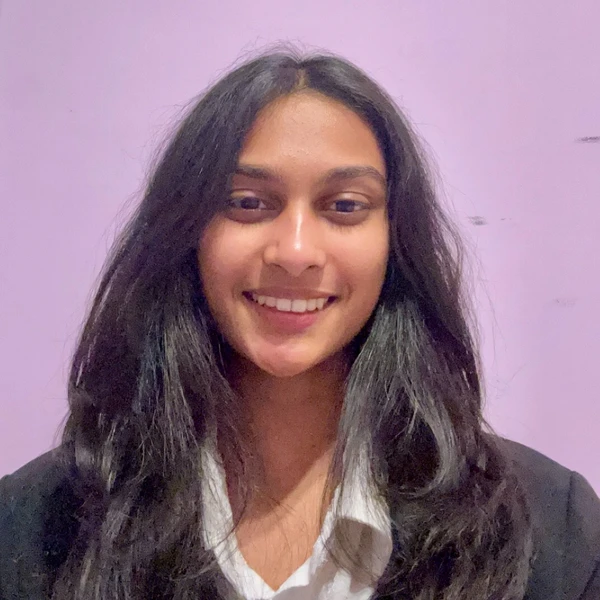
My name is Anika Seshan, and I am an incoming freshman at Cornell University studying Electrical and Computer Engineering. I am deeply passionate about FIRST Robotics, cybersecurity, and teaching, with multiple years of hands-on experience across all three areas. I have been actively involved in competitive programming and robotics both as a participant and mentor, and I plan to continue supporting STEM education through mentoring, volunteering, and outreach.
In addition to my technical work, I have led and contributed to several STEM initiatives focused on accessibility and impact, including research projects that apply machine learning to real-world social and environmental challenges—one of which earned recognition at an AI research symposium. I also have extensive experience teaching computer science, including leading introductory Python instruction, and I enjoy making complex ideas approachable for younger students.
Outside of engineering, I am a classically trained pianist with over a decade of competitive and performance experience, and I value creativity as a core part of problem-solving.
Education
Bridgewater-Raritan High School
High SchoolMiscellaneous
Desired degree level:
Bachelor's degree program
Majors of interest:
- Electrical and Computer Engineering
- Mechatronics, Robotics, and Automation Engineering
Career
Dream career field:
Computer Hardware
Dream career goals:
Mechanical Captain
FIRST Robotics2022 – Present4 yearsCybersecurity Intern
Vietnam Veterans Memorial Fund2025 – 2025Technical Instructor
iCode2023 – Present3 years
Research
Computer Science
Indepedent Researcher2023 – 2024
Public services
Advocacy
G.I.R.L.S. — As co-founder and president, I've reached 6k+ girls across 17 countries, raised $5k+ for tuition and school supplies for all-girls schools in India, created 50+ hours of educational material.2022 – 2026Volunteering
Hindu Temple — Created a free Intro to Python course and taught 50+ students in 10+ classes. Earned PVSA Gold2022 – Present
Future Interests
Advocacy
Volunteering
Entrepreneurship
Joanne Pransky Celebration of Women in Robotics
WinnerConner - Detroit, 2039
He still remembers the phantom pains in the stub that used to be his right hand, even three years after the accident. Dr. Blackwell told him that he would feel it less over time, but every morning he still woke up reaching, unsuccessfully, for the glass of water on his nightstand. Then, on a quiet Tuesday afternoon, Conner saw his printed hand for the first time.
The process took six hours. Layer by layer, biocompatible polymers and thermoplastic polyurethane dropped from the printer’s nozzle, guided by a 3-D model of his remaining hand. But the real magic happened when they connected the regenerative peripheral nerve interface, NeuroLimb’s new bioamplifier, to his severed nerves, effectively translating neural signals into movement.
When he flexed his new fingers for the first time, he wept.
Within weeks, he took up the piano again, cherishing each time he pressed into the keys. Conner felt the goosebumps on his hand rise from the cold chill of the window. He stared at his hand in disbelief. Now, he could finally hold both of his daughter's tiny hands. The prosthetic wasn’t perfect; in fact, he had to exchange it often due to poor connection and software updates, but finally, Conner had gotten his life back.
Conner knew he had to help others in the same way that Dr. Blackwell did for him, so advancing the future of prosthetics became his whole life. He took up engineering, worked on design after design of prosthetic, each new one rendering the last obsolete. “This is the future,” he’d say, holding up his hand at tech conferences. “This will change thousands of lives.”
Yet, he never asked where the old designs went.
Kala - Chennai, India, 2039
The smell always hit you first; it was acrid, chemical, and smelled like burning plastic mixed with death and decay. It clung to everything in her village: her clothes, her water, and worst of all, her hair. The dump appeared a couple of months ago, just beyond the river that once flowed with clear blue water.
There it sat, the mountain of discarded prosthetics, each obsolete within months as NeuroLimb released new models. Hands, legs, arms, most of them barely used, all tossed away because a newer sensor came out. NeuroLimb always called it “planned innovation,” but to her, it was just poison.
Aditya and his friends all developed respiratory problems. Lakshmi’s mother lost her baby, a miscarriage that would break her. The fish in the river soon vanished, and the monsoon rains turned black as they flooded the ground. Protesting was futile, as NeuroLimb always had warrants signed by officials who had never even heard of Kala’s village.
She studied the discarded limbs carefully, tears forming in her eyes from pure rage. Such sophisticated technology, all going to waste. The elastomers would take centuries to decompose, and the praseodymium, extracted from mines that destroyed other small villages, would sit there, left to last for years.
“This is how you’ve changed our lives,” she wrote beneath pictures of black rivers and sick children, posting them all over the Internet. “This is the price of your progress.”
Conner - Detroit, 2040
He had never seen anything so vile in his life. On the internet, a girl named Kala’s images stopped him cold: a landscape of discarded limbs with a “NeuroLimb” logo plastered over every single one. Millions of copies of his own hand, all piled up, rotting away.
He had just finished his master's in engineering with a minor in robotic prosthetics, yet looking down at his own hand, he couldn’t be more disgusted by it. How many iterations had NeuroLimb gone through? He recalled five major models in the past ten months, each rendering the last “incompatible” with the new software. He’d even upgraded twice already.
He looked outside his window, staring at the digital ads projected onto all the buildings. He flinched when he saw his own face staring back at him. There he was, smiling and pointing to his prosthetic hand, the perfect poster-boy for a NeuroLimb ad.
He felt sick. He knew something needed to change.
He sent Kala a message: “I had no idea, but with your help, I will fix this.” Soon, he was on a plane heading to India.
Kala - Chennai, 2040
Kala didn’t trust him when he first flew to India; after all, he was just another engineer claiming to have all the solutions. Yet, to her surprise, he came with questions rather than answers, a willingness to listen, and, most importantly, humility.
They spent months sorting through the dump. Conner identified components that could be reused, elastomers that could be reprocessed, and precious materials worth recovering. Kala explained to him the potential of recycling these parts, creating quality prosthetics funded by recovering these valuable materials instead of wasting them.
“The technology isn’t the problem,” Kala admitted, “But the waste isn’t inevitable. I know that we can change the system if we focus on how we discard this technology instead of simply how we make it.”
New York, 2041
Surrounded by thousands of activists and innovators alike, Conner and Kala walked up on stage, proud to accept their award. Their company, Nova-Prosthetics, partnered with NeuroLimb to reduce prosthetic waste by over 90% in just one year, clearing rivers and reducing air pollution on a global scale.
“I don’t believe that technology can ever solve all our world’s problems,” Kala began speaking, holding the award in her hand. “I know too intimately the costs of careless innovation. However, progress doesn’t require sacrifice; it just requires responsibility.”
Conner flexes his hand onstage, one that has been upgraded solely with reusable parts. Now, instead of looking at it with regret, he looks at it with hope.
“Our work is not perfect," he adds. "Technological advancements will never be. But it’s better. And we will always strive for better.”