Age
23
Gender
Gender Variant/Non-conforming
Hobbies and interests
Advocacy And Activism
Environmental Science and Sustainability
Rock Climbing
Research
Exploring Nature And Being Outside
Sustainability
Coffee
Ceramics And Pottery
Hiking And Backpacking
Human Rights
Kayaking
Reading
Fantasy
Criticism
Cultural
Environment
Historical
History
Self-Help
Gothic
I read books daily
US CITIZENSHIP
US Citizen
LOW INCOME STUDENT
Yes
Anastacia Hippely
1x
Finalist1x
Winner
Anastacia Hippely
1x
Finalist1x
WinnerBio
I am studying Environmental Science with a minor in Geology.
Education
Sam Houston State University
Bachelor's degree programMajors:
- Environmental Geosciences
Minors:
- Geological and Earth Sciences/Geosciences
Lone Star College System
Associate's degree programMajors:
- Environmental Geosciences
Miscellaneous
Desired degree level:
Doctoral degree program (PhD, MD, JD, etc.)
Graduate schools of interest:
Transfer schools of interest:
Majors of interest:
- Ecology, Evolution, Systematics, and Population Biology
Career
Dream career field:
Environmental Services
Dream career goals:
To help prevent and find solutions to climate change.
Lab Analyst Assistant
Texas Research Institute of Environmental Science2024 – 20262 yearsBarista, Buster, Cashier
Wisdoms Vegan Bakery and Cafe2019 – 20223 years
Sports
Rock Climbing
Club2022 – Present4 years
Research
Political Science and Government
Lonestar Honors College — Student written Research2021 – Present
Arts
school art class
Drawing2016 – 2019
Public services
Volunteering
Sleep in Heavenly Peace — sanding wood2022 – 2022Volunteering
LifePoint Church — Setting Up and taking down the portable church2019 – 2021
Future Interests
Advocacy
Politics
Volunteering
Philanthropy
Entrepreneurship
Goths Belong in STEM Scholarship
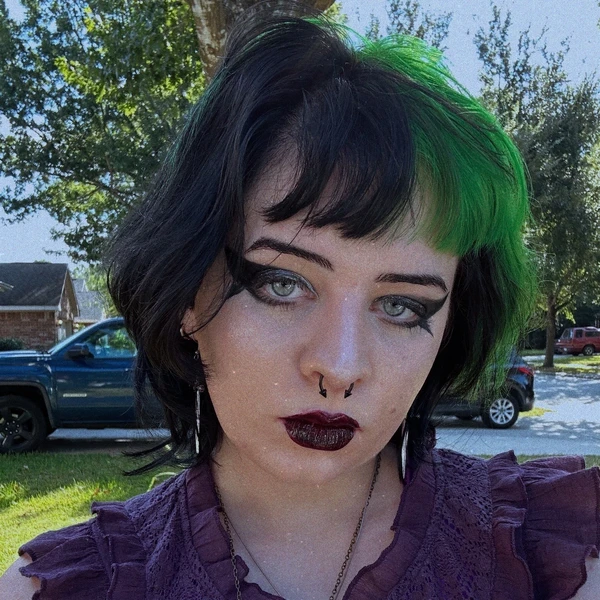
WinnerBeing Goth isn’t just about how I look on the outside, but how I actively make choices to advocate and support the communities around me. Attending the local concerts, discussions arose about what each of us could do to improve the world around us.
Protests, mutual aid, education, and our own day-to-day choices. As a bitter, low-income queer teenager in Texas, I resonated with the messages of hope and change. The messages of inequality, calling out the unjust system, and untaught history that got expressed through music at local punk and goth shows ignited that flame of passion and perseverance, which inspired me to take Environmental Science and African American Studies in high school as my electives to further build on the foundation of knowledge I already had. I was learning the impact climate change had at a disproportionate rate in low-income neighborhoods that are majority People of Color. Having grown up on “the wrong side of the tracks” in Houston, I’ve felt and seen the impact of climate change on low-income communities. The physical, mental, and economic health of my friends and me is constantly threatened by climate change. I became even more outraged, for my friends, for my community, for me. Frustrated at how the system has us set up for poverty. This is what kept me within the alternative spaces. I would often ask myself, “Why isn’t anyone doing anything?” That question got answered at a concert when a band opened up with “YOU are someone, DO something to make a change.” I never even wanted to pursue higher education, but this experience changed my mind. I was someone, and I love my community enough to try to make the world a safer place for them. Because of this experience, I am pursuing education in Environmental Science with a focus on Intersectional Environmentalism.
However, due to my appearance and assortment of oddities in the lab assistant's office, I was faced with a lot of judgment from the funding department last year. I was harshly criticized and had to move cubicles multiple times because of claims that “We have a different vision for the appearance of the office,” despite having been given explicit permission to decorate as I please, which eventually led me to just move my station into the lab away from other departments' view. The other departments also would spread rumors about me, saying that I come into work high (which is funny because I am sober living) only due to my appearance. Eventually, with the budget cuts that happened this past year, they decided to cut me first from my job despite my lab managers' and supervisors' protests. I remain in contact with them, and they overheard the funding department stating some unsavory words about my appearance, despite it being within uniform, and having been a good labby. Despite this, I will continue with my studies and volunteer with labs to gain more experience in research. That environment was simply not meant for me, and I will find my place.
I can see myself contributing to Environmental Science by finding solutions that will reduce air pollution in low-income communities to prevent disease, and how climate change affects the spread of invasive species. I have done some undergraduate research projects on using GIS and warming climate studies to track the trajectory of invasive spread to predict its next growth cycle and take preventative measures beforehand. I am also shooting for the goal to pursue graduate school, and eventually contribute as a supportive educator to underrepresented students to pursue Earth STEM as well.
Ventana Ocean Conservation Scholarship
Our ocean is a vast ecosystem that hosts 15% of the animal species we know of and 95% of the ocean is still undiscovered. The current climate crisis and plastic pollution have vast effects on our ocean and the animals within it. We are in a state of an increased extinction rate due to the current unsustainable behaviors we as humans practice. I learned about this devastating news around 14 years old and immediately looked into reducing waste by trying to follow a plastic-free lifestyle, and then participating in climate activism. I continued by expanding my learning and how I can make changes to my lifestyle, and lead by example thus inspiring my friends to make small changes. Throughout my life, I have felt drawn to the ocean. I was born in Oceanside California to a dad who used to surf after work and on the weekends, and I never knew a moment where I couldn't swim. But, seeing how the Oil Industry has affected the beach near where I live now, Galveston Texas, I had become angry at how we took something beautiful and ultimately destroyed it. Climate change has also caused the heat of Ocean water to increase which has thrown off the balance of the ecosystem, killing hundreds of thousands of coral reefs, fish, and sea animals migrating to locations they have never been known to roam.
My senior year of high school was when I took an AP Environmental Science class where I learned about how I could take this passion and make it into a career, and potentially make a positive impact through research. I was extremely enthralled at the idea and from that moment forward I knew what I wanted to pursue. I joined my local community college and entered the honors college to instantly take on the responsibility of writing research papers and taking internships in Environmental Science and Geology. No matter what class I took, I would always redirect the subject to match my major so that I could also raise awareness on the subject. This has opened up meaningful conversations between my peers and has brought them to care and put effort into volunteering and making sustainable baby steps. This new group of activists and I within the honors college had decided to join the eco club. I have seen the importance of awareness, and my education has allowed me to easily answer the questions people have had.
I am planning to use my degree to continue to perform research on Climate Change, Sustainability, and coming up with effective and changeable permanent solutions for the items and materials we consume. I want to be able to continue scientific research that is digestible to a wider audience so that more people can understand and start caring about a critical issue, that needs attention now.
Climate Conservation Scholarship
Planet Earth is the only inhabited planet with life being both flora and fauna to human knowledge, and it is actively ravaged by the effects of the industrial revolution leading to catastrophic events. The consequences of modern technology led to climate change; as a result, there has been an increase in extinctions, leading to less biodiversity and affecting the delicate food web maintained in nature. Climate change has also caused increased natural disasters, primarily affecting third-world countries, which have killed people and caused more refugees to seek asylum. This can be changed; individually, we can vote with our dollar, make changes in behavior, vote for the future of our planet, and educate others to follow in the same direction. The ripple effect is a perfect example of how effective change can improve our planet's health; once each person becomes educated on sustainability, they can share that knowledge with a few people they know, and those few will tell the people they know. Finally, when everyone is educated on sustainability, we can make better choices in our city planning and government policies, which would also cause a ripple effect of a decrease in emissions and pollution. I am majoring in environmental science, with my personal life being dedicated to sustainability through making plastic-free switches, composting, supporting the local farmer's markets, utilizing carpooling instead of traveling alone, solar panel handheld chargers, developing into a vegan diet, and informing others about the personal impact on the planet. I spend my weekend volunteering to plant native seeds and trees and remove invasive species from my area. I am also a climate and native flora species activist, and I encourage and grow native plants to ensure the solidity of soil through the roots and also to prevent dangerous slopes from ruining the homes of wildlife. I am researching the association between poverty and third-world health and the quality of life affected by modern society's climate and environmental crisis. To allow me to engage in the Take Flight program will grant me the necessary experience for further research opportunities and a smooth transition into undergraduate school in pursuit of a Ph.D. Having experience with lab equipment during my primary education in North West Arkansas and my first interaction with viewing through a microscope lens, using a pipet, and properly loading slides, though seemingly minor at the time, has enacted a hobby of utilizing the necessary tools to stimulate my curiosity. I occasionally will use Petri-dishes to collect fungus, mold, and spores to analyze the safety and balance of my compost ecosystem.
Elizabeth Schalk Memorial Scholarship
My mom raised me alone with a long-distance father for most of my life. My parents married young in a small town without opportunities for a successful life. My father seemingly had one path to support himself and his wife out of high school, and with JR ROTC, the Marines seemed like the best choice. So my parents packed up and moved to Camp Pendleton, California. My introduction to this world of a military child was in the arms of my lonely working mother and my father on the phone in Japan. The physical lack of my father in my life would be a recurring theme. I was two years old when I met my dad for the first time, and even then, he spent most of his time at work. My dad graduated from boot camp, but we still were in poverty, so we had to move into my grandparent's house for three more years. Every military child knows the experience of having to move as often as her parent gets called to duty, and my family wasn't exempt from that experience. My father had to move away for the National Guard in Texas to support the family, while my mom also worked full time. I was given responsibilities at that age to watch my younger brother, take care of the house, and take care of myself at a very young age. I had to grow up fast, which subjected me to saying goodbye to my childhood and developing trauma.
During my time with my dad, he would divulge his downtime to alcohol. His unresolved PTSD from the military translated into a mindless, violent drunk. I have become a victim of his violence as I was the oldest child and the closest person to him. He would rant about the state of our finances, the horrors of being unprepared for adulthood, and the pressures of society that forced him into the military, blaming my existence on our endless debt. The military had torn our family apart, with no place to call a permanent home, with pains that spread like wildfire. I had learned to become smart, silent, submissive, and scared of someone I used to go to for comfort. My mother became depressed, my younger brother would self-isolate, and I would attempt to fix the situation. This butterfly effect led to the development of my mental health issues. After making multiple attempts at my life at sixteen, medical professionals sent me to a mental hospital where I was diagnosed with depression and PTSD.
Because of these experiences, I had to work extra hard to help get myself and my family to a better position in life. It started with addressing alcohol, which took courage and consistency. Then, I had to address the trauma. Finally, I had to learn dedication, consistency, bravery, empathy, patience, taking criticism, and healing. My journey with my family was an endless amount of battles we won. These experiences made me into the strong, hardworking, dedicated person I am today, with a healthy relationship with my father, who is currently overseas, and the breaking of generational curses through therapy. I am now furthering my education because of the lessons I learned and the strength I gained.
Bryent Smothermon PTSD Awareness Scholarship
My mom raised me alone with a long-distance father for most of my life. My parents married young in a small town without opportunities for a successful life. My father seemingly had one path to support himself and his wife out of high school, and with JR ROTC, the Marines seemed like the best choice. So my parents packed up and moved to Camp Pendleton, California. My introduction to this world of a military child was in the arms of my lonely working mother and my father on the phone in Japan. The physical lack of my father in my life would be a recurring theme. I was two years old when I met my dad for the first time, and even then, he spent most of his time at work. My dad graduated from boot camp, but we still were in poverty, so we had to move into my grandparent's house for three more years. Every military child knows the experience of having to move as often as her parent gets called to duty, and my family wasn't exempt from that experience. My father had to move away for the National Guard in Texas to support the family, while my mom also worked full time. I was given responsibilities at that age to watch my younger brother, take care of the house, and take care of myself at a very young age. I had to grow up fast, which subjected me to saying goodbye to my childhood and developing trauma.
During my time with my dad, he would divulge his downtime to alcohol. His unresolved PTSD from the military translated into a mindless, violent drunk. I have become a victim of his violence as I was the oldest child and the closest person to him. He would rant about the state of our finances, the horrors of being unprepared for adulthood, and the pressures of society that forced him into the military, blaming my existence on our endless debt. The military had torn our family apart, with no place to call a permanent home, with pains that spread like wildfire. I had learned to become smart, silent, submissive, and scared of someone I used to go to for comfort. My mother became depressed, my younger brother would self-isolate, and I would attempt to fix the situation. This butterfly effect led to the development of my mental health issues. After making multiple attempts at my life at sixteen, medical professionals sent me to a mental hospital where I was diagnosed with depression and PTSD.
Because of these experiences, I had to work extra hard to help get myself and my family to a better position in life. It started with addressing alcohol, which took courage and consistency. Then, I had to address the trauma. Finally, I had to learn dedication, consistency, bravery, empathy, patience, taking criticism, and healing. My journey with my family was an endless amount of battles we won. These experiences made me into the strong, hardworking, dedicated person I am today, with a healthy relationship with my father, who is currently overseas, and the breaking of generational curses through therapy. I am now furthering my education because of the lessons I learned and the strength I gained.
Sean Allen Memorial Scholarship
Surrounded by tall trees and piles of rocks, with no phone in the middle of summer, with an active imagination, I could be anything I wanted. I could be a pirate in a crow's nest, a pilot doing tricks in the air, or even a squirrel hiding nuts for the winter. I grew up in Northwest Arkansas in the Ozarks; being outside in the hills and caves is an after-school pastime for everyone there. I am so blessed to have had my childhood in such a beautiful area with my amazing extended family. My Uncle Peter and Uncle Chris would watch my brother and me after school while my parents were at work, and they would actively take us on adventures outside. We would walk barefoot from the river behind their house to a local park, catch minnows, learn to forage, learn to craft with natural materials and get bug bites, scrapes, and bruises. I fell in love with nature and the environment I would play in; I never wanted to go inside. I had a tree that was my favorite because it had branches that cradled perfectly for a seat my size, and I would stick my homework or a book in my mouth and climb to my seat to do my assignments. Friday night rolled around, and uncle Peter had a club event he had to attend while watching me one night. I had finished my homework and was excited about the mystery location I was headed to. I entered this strange shaped building to see a colorful wall of odd shapes and people who moved like spider monkeys. I remember the feeling to this day; I was in awe and starstruck immediately. My uncle had a wad of cash in his pockets and some change and was trying to see if he could pay for me to participate, and he didn't have enough, but the owner of the gym saw my excitement and let me go for it with my uncle's supervision. I watched my uncle run up a wall and hit the bell; I had no words.
My Uncle peter decided it was time for me to learn outdoor climbing, so we took a trip on a three-day weekend to the devil's den, so we could go spelunking and learn to climb with our own gear! Years later, even when I moved to the city due to poverty, I still visit my family specifically for the Ozarks; we all go to Beaver lake and climb to the top of the cliff to jump off of it as a tradition. I keep my skills fresh by joining my friends in the Lonestar Climbing club by going to inspire rock. I am not the best at it, I may not be able to grab a flake or crimp, but I am getting better, and I’ve made memories and have felt more accomplished from each route.
I am going into the field of Environmental Science because of my strong love for nature, and rock climbing is a skill I also find essential when it comes to getting appropriate data samples to evaluate the state of the water and air quality properly. I am also a climate and native flora species activist, and I encourage and grow native plants to ensure the solidity of soil through the roots and also to prevent dangerous slopes from ruining the homes of wildlife.
Veterans Next Generation Scholarship
My mom raised me alone with a long-distance father for most of my life. My parents married young in a small town without opportunities for a successful life. My father seemingly had one path to support himself and his wife out of high school, and with JR ROTC, the Marines seemed like the best choice. So my parents packed up and moved to Camp Pendleton, California. My introduction to this world of a military child was in the arms of my lonely working mother and my father on the phone in Japan. The physical lack of my father in my life would be a recurring theme. I was two years old when I met my dad for the first time, and even then, he spent most of his time at work. My dad graduated from boot camp, but we still were in poverty, so we had to move into my grandparent's house for three more years. Every military child knows the experience of having to move as often as her parent gets called to duty, and my family wasn't exempt from that experience. My father had to move away for the National Guard in Texas to support the family, while my mom also worked full time. I was given responsibilities at that age to watch my younger brother, take care of the house, and take care of myself at a very young age. I had to grow up fast, which subjected me to saying goodbye to my childhood and developing trauma.
During my time with my dad, he would divulge his downtime to alcohol. His unresolved PTSD from the military translated into a mindless, violent drunk. I have become a victim of his violence as I was the oldest child and the closest person to him. He would rant about the state of our finances, the horrors of being unprepared for adulthood, and the pressures of society that forced him into the military, blaming my existence on our endless debt. The military had torn our family apart, with no place to call a permanent home, with pains that spread like wildfire. I had learned to become smart, silent, submissive, and scared of someone I used to go to for comfort. My mother became depressed, my younger brother would self-isolate, and I would attempt to fix the situation. This butterfly effect led to the development of my mental health issues. After making multiple attempts at my life at sixteen, medical professionals sent me to a mental hospital where I was diagnosed with depression and PTSD.
Because of these experiences, I had to work extra hard to help get myself and my family to a better position in life. It started with addressing alcohol, which took courage and consistency. Then, I had to address the trauma. Finally, I had to learn dedication, consistency, bravery, empathy, patience, taking criticism, and healing. My journey with my family was an endless amount of battles we won. These experiences made me into the strong, hardworking, dedicated person I am today, with a healthy relationship with my father, who is currently overseas, and the breaking of generational curses through therapy. I am now furthering my education because of the lessons I learned and the strength I gained.
Elijah's Helping Hand Scholarship Award
I remember the moment I learned about gender dysphoria and the existence of a gender binary holding me back. I was able to recognize that throughout childhood, I had experienced gender dysphoria. Throughout my childhood, gender was never significant; I dreaded being separated into boys' and girls' teams as I felt I belonged in neither. However, I was different, and I knew that, and my peers understood that I didn't fit within the standards I was placed in due to my assigned sex. Unfortunately, this difference made me a target of bullying from my peers for three years. My mom would pick me up from school, and almost every day, I would break out into tears because of the hatred I received. I was confused, insecure, and scared. Eventually, my mom took me out of that school because of the bullying, and I would start a new life. I would create a new version of myself, repress those feelings, and "act ladylike."
Entering middle school made me remember who I was before I let other people tell me how I should be. I remember my chest started developing at the start of age eight, and I was horrified. I would take the thick ribbons from the dress my mom bought me that I was required to wear to church, tie them so tightly around my chest, and make a knot so tight that I would wake up with poor sleep and rib pain. My mom would take me to purchase my first bra, so I measured my chest at home and subtracted a few inches to get the tightest sports bra possible; I refused any other type of bra. I would sleep with these binding sports bras and refuse to take them off; I would often wear two to flatten my chest. Finally, the undiagnosed dysphoria got so bad that I would refuse to play water games at sleepovers for fear of having to wear a swimsuit and take my sport bra binders off. When I did get hit with water, I remember having such an extreme panic attack that I took it out on my friends at age ten.
I came out to myself when I was twelve as genderqueer and still unsure of my sexuality. I remember feeling so scared, like a sinner, evil. I gave it a few months and then finally decided to cut my long hair so that I could feel comfortable, yet I couldn't tell anyone who I really was. Finally, I met people like me during my first year of high school just like me, and I could be myself with that small group. Yet, the dysphoria persisted, and I remained suicidal. The depression became so bad that I made so many attempts on my life that sent me to the mental hospital, which led me to meet professionals to diagnose me and prescribe me medication and therapy. Through this experience, I learned I wasn't alone and that I could be myself.
I am currently twenty years old, a medicated non-binary queer STEM student at a community college, and a part-time worker in a state fighting to irradicate my existence. The funds from my work are still being put away to my top-surgery fund, and I refuse to touch it for the sake of my mental health, even to the point that I still don't have my own car. I am working endlessly in my education so that I can transfer to a state where I am legally allowed to transition and find a stable job for the sake of getting top surgery.
Your Dream Music Scholarship
Family Line by Conan Gray is the song that is currently the most important to me. The song discusses family trauma in a way I can relate to. The emphasis on being a child that grew up in a broken home and attempting to heal speaks to me as I have been diagnosed with PTSD from my family trama. Conan Gray and I have both lived a life with angry military fathers with alcohol addiction, and even though we don't view ourselves as a representation of our family, we can't escape our genetics and upbringing. Conan sings about how he has his father's eyes in a way that speaks to my soul, the fear of what I might grow to become, and the issue with viewing himself without seeing the hurt someone else did to me. I immediately started crying when I Listened to "watch the fathers with their little girls, And wonder what I did to deserve this; how could you hurt a little kid? I can't forget, I can't forgive you 'Cause now I'm scared that everyone I love will leave me." I heavily relate to both a physically absent father and when he is present, he was emotionally absent. This song made me realize that I am not alone in this pain, that I am not alone in the difficult healing process, and that my healing process will last a lifetime because I can not escape that family line.