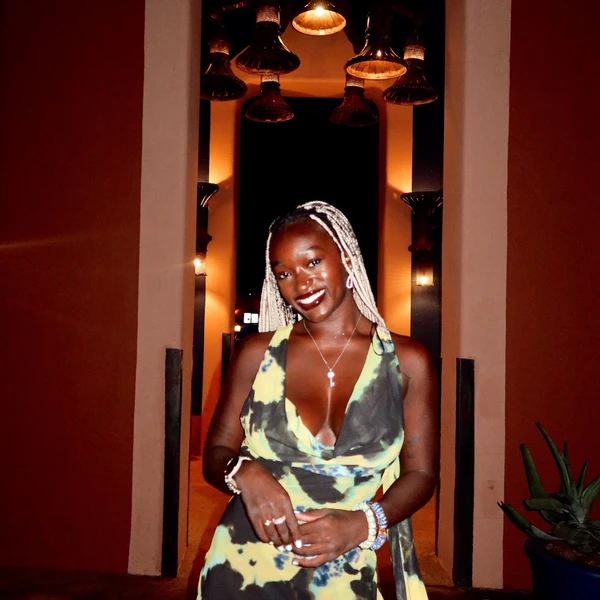
Hobbies and interests
Advocacy And Activism
Calisthenics
Cheerleading
Surfing
Criminology
Community Service And Volunteering
Social Justice
Social Media
Fitness
Running
Business And Entrepreneurship
Reading
Academic
Adult Fiction
Anthropology
Biography
Contemporary
Classics
Education
Economics
History
Health
Law
Leadership
Magical Realism
Realistic Fiction
Politics
Psychology
Romance
Social Issues
I read books daily
Amie Boakye
1x
FinalistAmie Boakye
1x
FinalistBio
I am a dedicated scholar and aspiring criminal neuroscience researcher with a dual bachelor’s degree in Psychology and Political Science from the University of North Carolina at Chapel Hill, graduating with distinction in May 2025. Driven by a passion for understanding how trauma shapes brain development and influences behavior, I have conducted prison visits, interviewed exonerees, and contributed to two research publications, exploring the intersection of neuroscience, criminal justice, and social policy. Beyond academics, I'm deeply committed to community service, having completed over 4,000 hours supporting underserved populations and survivors of violence. My advocacy and mentorship extend into digital initiatives, where I have a social media platform of 125,000. Fluent in Spanish, I also engage with international communities, including planned research in Barcelona, to investigate behavioral neuroscience across cultural contexts. While pursuing this work, I am also navigating significant financial instability and am currently working to avoid housing insecurity. Despite these challenges, I have remained fully committed to my academic, research, and service responsibilities, continuing to contribute to scholarship, community engagement, and advocacy. These circumstances have not diminished my dedication; rather, they have reinforced my resolve to pursue research and policy work that addresses structural inequities, trauma, and access to justice.
Education
Walden University
Master's degree programMajors:
- Clinical, Counseling and Applied Psychology
Minors:
- Neurobiology and Neurosciences
- History and Political Science
University of North Carolina at Chapel Hill
Bachelor's degree programMajors:
- Clinical, Counseling and Applied Psychology
- Political Science and Government
Minors:
- Foreign Languages, Literatures, and Linguistics, Other
- Neurobiology and Neurosciences
Miscellaneous
Desired degree level:
Doctoral degree program (PhD, MD, JD, etc.)
Graduate schools of interest:
Transfer schools of interest:
Majors of interest:
- Psychology, General
- History and Political Science
- Criminology
Career
Dream career field:
criminal neuroscience
Dream career goals:
Certified Trainer
Darden2021 – 20254 years
Sports
Cheerleading
Varsity2016 – Present10 years
Awards
- All American
Research
Neurobiology and Neurosciences
University of North Carolina CH ACM Lab — Research Assistant2022 – 2023
Arts
N/A
Photography2021 – Present
Public services
Volunteering
YMCA, IVHQ, UN Youth Volunteer, Personal Passion Projects — Volunteer Coordinator2014 – Present
Future Interests
Advocacy
Politics
Volunteering
Philanthropy
Entrepreneurship
Arnetha V. Bishop Memorial Scholarship
I’ve learned that when it comes to mental health, honesty matters more than sounding impressive, so I’m going to write this the way I would to someone who actually knows me. I’ve tried to kill myself three times. I say that plainly because that is the reality I survived, and because it is the foundation of why I am here. Mental illness was not something I observed from a distance or learned about in a textbook. It lived in my body. It convinced me, more than once, that the world would be better without me in it. I am alive today not because I was strong every moment, but because at certain moments I held on long enough for help to reach me. That changed how I see people in pain forever.
In one year, I lost eight friends to death. Some were violent. Some were sudden. Some were slow and devastating. Grief stopped being an event and became the background noise of my life. I learned how to go to class while mourning. How to laugh while missing people who would never answer again. How to keep breathing while carrying loss that still to this day feels unbearable. That year taught me something no course ever could; something I can't quite put into words just yet.
I’m also an athlete, and honestly, movement saved me when words couldn’t, but at times it made everything worse. Running, training, stretching, pushing my body gave me an outlet, but if you’ve ever been on a team where the coach destroys every ounce of who you are and kills your love for the sport, you know exactly what I mean. Athletics taught me discipline, but more than that, it taught me how to sit with discomfort without quitting on myself. There were days my body was the only thing I trusted to keep me here. That complicated relationship between mental health and movement is something I carry into how I understand healing. Healing isn’t always soft. Sometimes it’s just choosing to show up anyway.
I've always felt this internal pull toward psychology, trauma, and justice. If you asked my parents, they would tell you I've been weirdly obsessed with this since 5 years old. I’ve spent time in prisons. I’ve listened to people who were wrongfully convicted. I’ve sat with stories that made it painfully clear how often trauma is punished. When you hear someone explain how their worst moment became their life sentence, you don’t forget it. It changes how you think about mental health, responsibility, and care.
I want to work in mental health because I know what it feels like to be dismissed, misunderstood, or written off. I want to be the kind of professional who sees the whole person, not just the diagnosis. I care deeply about serving marginalized communities. I also speak openly about mental health on my social media platform because silence almost killed me, and I refuse to let it take someone else without a fight. I want to build a career with a basis in honesty, advocacy, and dignity. Mental health didn’t just influence my beliefs or my career goals. It shaped me.
I’m here because someone once helped me stay. I want to be that someone for others.
Dr. Jade Education Scholarship
At its core, the life of my dreams is one where I am no longer living in survival mode. In my dream life, I wake up without the constant knot in my stomach wondering if rent will clear, if groceries will stretch another week, or if one unexpected expense will unravel everything I’ve worked so hard to hold together. I have stability. I have a safe place to live. I have food on the table without having to calculate every dollar or choose between necessities. That sense of security is not something I take lightly, because I know intimately what it feels like to live without it.
The life of my dreams is one where my time, energy, and intellect are no longer consumed by simply trying to stay afloat, but instead are fully directed toward the work I feel called to do. I am able to focus deeply on my graduate studies, research, and professional development without exhaustion constantly chasing me. I am present, not burnt out. I am learning, not just surviving.
In that life, my education is not just for me. It becomes a tool I use to directly serve others. I see myself working in criminal neuroscience and justice reform, researching how trauma reshapes the brain and how that science can be used to prevent harm, expose injustice, and restore dignity. I am sitting across from individuals who have been wrongfully convicted, listening to their stories, helping translate their pain into evidence that cannot be ignored. I am contributing to research, policy, and advocacy that challenges a system that too often criminalizes trauma instead of understanding it.
The life of my dreams also includes using my voice far beyond academic spaces. I currently have a social media platform with over 125,000 people, and in my dream life, that platform is not just numbers, it is impact. It is a space where I speak honestly about mental health, justice, healing, and ambition. It is where I show what it looks like to pursue education while struggling, to care deeply about the world without becoming hardened by it. I want to continue using that platform to educate, uplift, and reach people who may never step into a classroom but still deserve access to knowledge, hope, and truth.
As a Black woman, the life of my dreams means freedom from the pressure to constantly prove that I deserve to be in the room. It means inspiring young Black girls who see themselves in me to believe that they can be soft and strong, academic and athletic, intellectual and creative. I want them to see that there is no single way to be brilliant, no single path to success, and no limit on what they are allowed to dream.
I dream of having the time and resources to surf and dive, passions that make me feel so alive, and deeply connected to nature. Being in the ocean reminds me how small I am and how vast the world is, and that perspective keeps me humble and hopeful.
The life of my dreams is one where I am not constantly choosing between my basic needs and my purpose. It is a life where I am stable enough to be generous, grounded enough to lead, educated enough to challenge injustice, and visible enough to inspire others to believe in themselves.
Healing Self and Community Scholarship
As an African American woman who has lived with depression, anxiety, ADHD, and suicidal thoughts, I understand firsthand how untreated mental health challenges can limit opportunity, deepen trauma, and perpetuate cycles of harm. My academic focus is in criminal neuroscience, where I study how trauma and mental illness can alter neural pathways and influence behavior. Many crimes are not inevitable; they are consequences of unaddressed mental health issues.
I want to contribute to change through multiple avenues. I envision trauma-informed mental health programs in schools and community centers, offering counseling/therapy that are low-cost or sliding-scale for families who cannot otherwise afford care. Early intervention can transform a child’s trajectory, providing the support they need before trauma compounds. I want to advocate for policy reforms that fund mental health services for low-income and BIPOC youth, integrating care directly into education systems and community programs. I want to create educational campaigns for adults to recognize trauma and mental health struggles early, while reducing stigma that too often isolates children and families. I also plan to use evidence from my research to inform programs and interventions, ensuring they are data-driven and effective at preventing cycles of trauma and crime.
My lived experience, academic focus, and dedication to advocacy drive me to create lasting change. I want every child who experiences trauma to know that help is available, that their mental health matters, and that early intervention can change their life and thus, our society.
Ethel Hayes Destigmatization of Mental Health Scholarship
No one tells you how to survive college with mental illness. They hand you brochures about therapy, stress management, and self-care, but they rarely tell you what it feels like to be trapped in your own mind, to feel exhaustion pressing down on your chest even after a full night of sleep, or to struggle with responsibilities that everyone else seems to handle effortlessly.
By the time I reached seventh grade, I had already attempted to take my life once. Two years later, I tried again. By the end of my freshman year of college, I attempted for a third time. I woke up two days later on my roommate’s deflated bean bag, fully aware that I had been barely surviving. I hadn’t told anyone except my closest friend. I had posted vague cries for help on social media, hoping someone would understand the despair I could not articulate myself.
My name is Amie Maxine Awura-Afua Boakye. I am African American, a student, a dreamer, a woman who has carried the weight of mental illness silently while striving to exceed in every way. In a period of seven months, I was diagnosed with three mental illnesses: Major Depressive Disorder, Anxiety Disorder, ADHD. Each diagnosis felt like a mirror, reflecting the ways my mind and body had been fighting, often without my conscious permission. I’ve taken 24 and 25 credit hours in semesters when my mental health made even breathing feel like a challenge. I cheered on a competitive team while my quite literally planning my way out. I studied, I showed up, I smiled, I survived.
These experiences have shaped every part of who I am. They have taught me that resilience is not always graceful. They have taught me that relationships require honesty and vulnerability, that it is okay to lean on others, and that the people who stay are the ones who matter most. They have shown me that the world is not always fair, that systemic barriers and hidden prejudices exist, but that empathy, courage, and persistence can turn suffering into understanding.
My mental health struggles have also shaped my goals. I want to advocate for students like me, for people whose pain is invisible, whose achievements are often overshadowed by the battles they fight privately. I want to build spaces where mental health is not stigmatized, where asking for help is seen as strength. I want to live with intention, to prioritize emotional well-being as fiercely as I pursue academic and professional success.
I have learned that survival is not just staying alive; it is moving forward, learning, and growing, even when your body and mind are screaming no. It is falling forward when falling back seems inevitable. And in that truth, I have found purpose, empathy, and a deep, unshakable commitment to live fully and help others do the same. My journey has been painful and at times unbearable, but it has given me wisdom and perspective. It has taught me that to truly understand the world and the people in it, one must experience both its darkness and its light, and embrace both with courage and compassion.