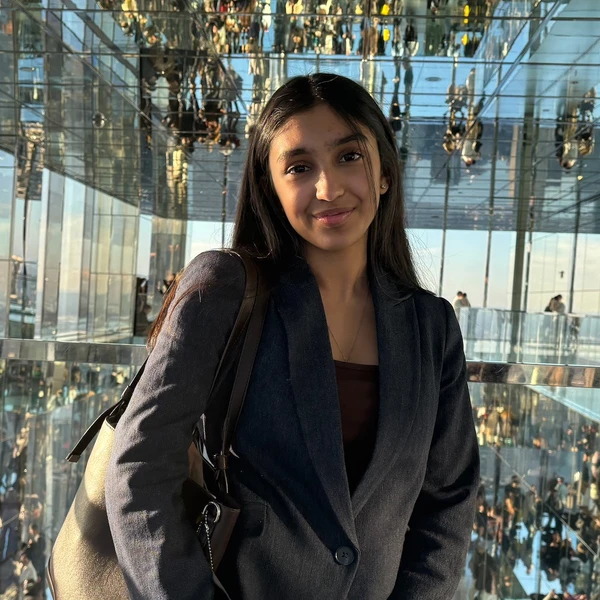
user profile avatar

Ambika Jha

1x

Finalist

Bio

Incoming economics student at NYU, I’m obsessed with how money and policy quietly shape people’s options long before they ever meet a loan officer or sign a lease. In high school, I founded Pathfinders to introduce girls to careers in STEM and business through field trips to companies like SAP, Netflix, KPMG, and Citibank, and I created Open Doors Tutoring to support students with learning differences, focusing on confidence and self‑advocacy as much as homework help. My experiences range from researching credit score bias as a policy advocacy intern with the YWCA of Connecticut to interning at WEConnect International, where I worked on systems that connect women‑owned businesses to global buyers, and running an Etsy shop that supported Indian artisans during COVID. I also lead as President of my school’s Girls Who Code club, served as a LiveGirl Ambassador Program creator and leader, and manage my own investments portfolio, which has strengthened both my quantitative skills and my interest in inclusive finance. Long term, I hope to work at the highest levels of finance, designing fairer credit and investment systems and expanding access to economic opportunity for underrepresented communities.

Education

Greenwich High School

High School
2022 - 2026

Miscellaneous

  • Desired degree level:

    Bachelor's degree program

  • Majors of interest:

    • Economics
    • Computer Science
  • Not planning to go to medical school
  • Career

    • Dream career field:

      Capital Markets

    • Dream career goals:

      To work at the highest levels of finance, designing fairer credit and investment systems while expanding access to economic opportunity for underrepresented communities. I aim to pursue roles in private equity, investment management, or corporate strategy where I can drive systemic change in how financial services are delivered to underserved populations.

    • Founder

      Pathfinders
      2024 – Present2 years
    • Ambassador Program Creator and Leader

      LiveGirl
      2024 – Present2 years
    • Founder

      Open Doors Tutoring
      2024 – Present2 years

    Research

    • Economics

      Sole researcher
      2025 – 2026

    Public services

    • Advocacy

      YWCA of Connecticut — Policy Advocacy Intern
      2025 – 2026

    Future Interests

    Advocacy

    Politics

    Entrepreneurship

    Aserina Hill Memorial Scholarship
    My name is Ambika Jha, and I am a senior at Greenwich High School heading to New York University this fall to study economics. Outside of class, most of my time goes toward programs I have built for other students. I founded Pathfinders, which organizes office visits and mentorship panels at companies like SAP, KPMG, Netflix, and Citibank so high school girls can meet women working in business and STEM. I also created the Ambassador Program at LiveGirl, a nonprofit focused on young women's leadership, where I led a team of 20 students across 12 schools reaching over 7,000 girls. Through Open Doors Tutoring, I work one-on-one with younger students who have learning differences like dyslexia and ADHD, helping them build confidence in school. Last summer I interned at the YWCA of Connecticut, where I researched bias in the U.S. credit scoring system and presented my findings at the CT State Capitol. That research is where the idea for my charity comes from. I spent months studying how a three-digit credit score quietly shapes which families can afford housing, cars, and basic utilities, and which families pay more for all of those things. What struck me most was not the unfairness of the system itself, but how little most people know about how it works until it has already affected them. Students graduate without understanding how credit is built. Families sign agreements with terms they were never taught to read. By the time someone realizes the system exists, it has often already made decisions for them. The charity I would start is called Bridge Capital. Its mission would be to teach young people and families how financial systems actually work before those systems catch them off guard. Volunteers would be trained college students and young professionals who run free financial literacy workshops at high schools, community centers, and libraries in underserved areas. The workshops would cover how to build credit, how interest works, how to read the fine print on loans and leases, and how to open accounts without getting charged fees nobody explained. We would also offer one-on-one coaching for families dealing with specific situations like medical debt or renting for the first time. The goal is not to hand someone a flyer and call it help. It is to sit down with a real person and work through what they are actually facing. I have seen through my tutoring work that people do not lack ability. They lack access to clear, honest information at the right moment. Bridge Capital would try to be that moment for as many families as possible. Aserina Hill gave from her own limited resources so others could have more. The problem I want to address is the same one she understood: that people who have less are often charged more, not because of anything they did, but because no one ever showed them how the system worked.
    Simon Strong Scholarship
    "We just don't see the value in this." I stared at the email for a long time. Not because it surprised me. I'd gotten versions of it before. But this one came the same week a teacher said something similar, and a mentor I trusted suggested I redirect my energy toward something "more realistic." Three separate people, one week, all arriving at the same conclusion about something I had spent months building. I was sixteen, a first-generation Indian-American girl cold-emailing Fortune 500 companies to ask them to host groups of high school girls for office visits. My parents came from India and taught me two things above everything else: work hard, and don't bother important people. I was violating the second rule constantly, and the world was making sure I knew it. What I was building was called Pathfinders. I'd noticed that the girls around me, girls who could write clean code, girls who understood balance sheets, girls who were sharp and hungry and ready, had never once stood inside a professional office or met a woman who looked like them in a leadership role. I hadn't either. I thought if I could just get them in the room, something would shift. I believed that completely. And then I stopped believing it. Each rejection carried a reason, and the reasons piled up slowly. Not relevant. No clear benefit. Not something we'd find valuable. After enough of them, I didn't just feel rejected. I felt foolish. Like I had invented a problem that didn't exist and built a solution nobody needed. I started drafting an email to the girls who'd signed up, explaining that I was shutting it down. I never sent it. What stopped me was a specific memory. A girl from my Girls Who Code club who went quiet every time someone asked what she wanted to do after graduation. She wasn't unsure. She was unimaginable to herself. She couldn't picture a future in those spaces because she'd never seen evidence that one existed for her. I had been that girl. I was still that girl, sitting at my laptop, letting other people's definition of "valuable" quietly replace my own. I sent one more email instead. This time, SAP said yes. That yes became a program that has taken over a hundred students into offices that once felt like they existed for other people entirely. I've watched girls go quiet at the train station and loud on the way home. I've heard "I can actually see myself here" said in a whisper, like something too fragile to say at full volume. The adversity wasn't the rejection. Rejection is just a no. The harder thing was being told, from enough directions at once, that the need I saw wasn't real. That the girls I was trying to reach weren't worth the effort. That I wasn't either. Learning to trust your own judgment when the world is confidently telling you you're wrong is not something anyone teaches you. You only learn it by staying in long enough to be proven right. Hold the line.
    Code Breakers & Changemakers Scholarship
    There are only so many ways to say, “Detail-oriented team player,” before you start to suspect that resumes are less a document and more a shared hallucination. That is what I was thinking the day I ran into a recruiting problem at WEConnect International: roughly 2,000 resumes for two positions. It was a perfect computer science problem wearing human clothing, messy input, inconsistent formatting, hidden signal, and very confident fonts. So I did what I always do when reality becomes chaotic. I tried to make it legible. I researched AI productivity tools, then tested 20 applicant tracking systems and pitched what I learned to a global staff. Somewhere between resume number 437 and resume number 438, my fascination with STEM clicked into place again. Coding is not only about building apps. It is about building filters, translators, and bridges in a world that keeps producing information faster than humans can process it. Passion and curiosity: I love that CS rewards stubborn curiosity. The computer does not care if I am intimidated, it cares if I can reason my way to a solution. I also love that coding lets me take something abstract, like “potential,” and ask, what would it look like if the system actually recognized it? That question drives me as a student who codes in Java and Python, and who has also built on the web side with HTML and CSS. Impact blueprint: My goal is to become a computer scientist who builds tools that widen access, especially for students and communities who are usually told to “self-advocate” inside systems that were never built for them. That is personal. I founded Open Doors Tutoring to support underserved students with learning differences such as dyslexia, dysgraphia, and ADHD, and I developed a three-tier approach focused on confidence, mentorship, and homework help. Tutoring taught me that ability is often there, but the interface is wrong. I want to build technology that meets learners where they are, with accessible design, thoughtful feedback loops, and resources that make progress feel possible. I also work on the people side of the pipeline. As President of my school’s Girls Who Code club, I have organized coding competitions, workshops, and group projects, and partnered with companies for mentorship so beginners can see a place for themselves in tech. I founded Pathfinders to introduce high school girls to STEM and business careers through visits and panels with women leaders, because representation changes what people attempt. Literary landmarks: The book that shifted my mindset is Automate the Boring Stuff with Python by Al Sweigart. It taught me to treat repetitive, boring problems as invitations to build, and it made automation feel like empowerment, not laziness. I also keep the official Python documentation close, because it models a kind of precision I aspire to, clear definitions, careful thinking, and a community that improves the tool for everyone. Educational roadmap: This scholarship would let me go further, faster. It would support tuition, but also the practical infrastructure of becoming a stronger engineer: reliable hardware, software tools, course materials, and opportunities like hackathons and project showcases where I can learn from mentors and build with peers. Most importantly, it would buy me time to keep doing the work I want to do, turning messy human challenges into systems that are more efficient, more understandable, and more fair. I want to be the person who looks at a pile of 2,000 resumes, or 2,000 students, or 2,000 confusing obstacles, and thinks: we can design this better.
    Harvest Scholarship for Women Dreamers
    My “Pie in the Sky” goal is to become the kind of finance leader I once only wrote about in a middle school book report: a woman who uses capital to expand what other people believe is possible for their lives. I want to build a career where I design financial tools and institutions that make it easier for women and underserved communities to fund goals that currently feel just out of reach. In seventh grade, I read about Thasunda Brown Duckett and wrote what I thought was just another assignment. I was fascinated by this woman who grew up watching her parents worry about money and went on to lead one of the largest retirement‑services firms in the country, becoming the 5th most powerful woman in finance. At the time, she felt galaxies away from my reality; I underlined her quotes like they were fiction and handed in my report assuming I’d never see her anywhere but on a page. Four years later, I found myself sitting in an audience at an event as she walked onstage. When I got the chance to speak with her one‑on‑one afterward, it felt like my book report had suddenly stepped into 3D. She didn’t talk about finance as a cold numbers game; she talked about helping families buy their first homes, students pay for college, and retirees design second acts that felt meaningful, not just mathematically sufficient. Hearing her describe finance as a way to serve people, not just portfolios, completely rewired how I saw the field and what I believed someone like me could do in it. After our conversation, I started to imagine myself in decision‑making roles, shaping how money flows instead of just adapting to it. It guided where I spent my time: researching credit score bias as a policy advocacy intern at the YWCA of Connecticut, seeing how a three‑digit number can quietly raise the cost of living for families who can least afford it. Her influence shows up most clearly in the communities I’m building around this dream. With Pathfinders, the organization I founded, I bring high school girls into offices at SAP, KPMG, Netflix, Citibank, and more, so they can meet women in finance and tech and realize that “role model” is not just a chapter in a book, but a person you can email and eventually become. To turn this “Pie in the Sky” vision into reality, I know I’ll need both technical and personal growth. As an incoming economics student at New York University, I plan to dive into economics alongside statistics, finance, and data science, so I can design and test fairer credit models and inclusive investment strategies rather than just comment on them from the sidelines. I want internships in asset management and fintech that let me see how investment decisions are really made, who gets told “yes,” and where bias hides inside models and meetings. Long term, I hope to lead an investment firm or fintech platform that focuses on inclusive finance: using alternative data to expand responsible credit access, backing women‑led and community‑rooted ventures, and making financial education feel humane instead of intimidating. This dream still feels slightly beyond my current reach, which is exactly why it belongs in the “Pie in the Sky” category. But every field trip I organize, policy brief I write, tutoring session I run, and conversation I have with younger girls brings it a little closer, and keeps me moving toward a future where finance is a place where women don’t just participate, they set the agenda.