
Hobbies and interests
4-H
Agriculture
Advocacy And Activism
Anatomy
Archaeology
Anthropology
American Sign Language (ASL)
Art
Artificial Intelligence
Beach
Biology
Biotechnology
Calligraphy
Church
Coding And Computer Science
Cognitive Science
Counseling And Therapy
Environmental Science and Sustainability
Exploring Nature And Being Outside
Foreign Languages
Graphic Design
Music
Ethics
Painting and Studio Art
Yoga
Writing
Volunteering
Violin
Upcycling and Recycling
Travel And Tourism
Theology and Religious Studies
STEM
Stocks And Investing
Sociology
Politics and Political Science
Journaling
Neuroscience
Research
Robotics
Reading
Social Science
Academic
Childrens
Cultural
Environment
Anthropology
Science
Design
Leadership
Art
Crafts
Health
Humor
Philosophy
Reference
Spirituality
Sociology
Social Issues
Speculative Fiction
Self-Help
I read books daily
Amber Beno
1x
Finalist
Amber Beno
1x
FinalistBio
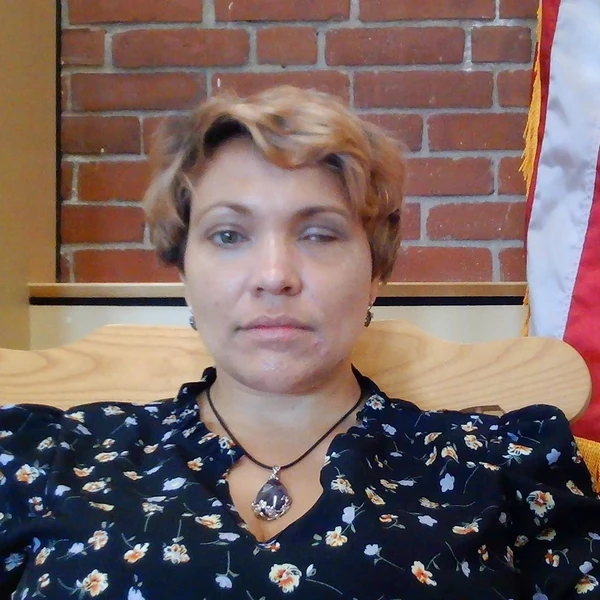
I’m a Human Services student and mother passionate about designing healing systems for underserved communities. With lived experience of partial blindness and single motherhood, I’m creating inclusive sanctuary spaces that integrate trauma-informed care, sensory design, and ritual storytelling. I aim to become a licensed music and art therapist serving rural populations. Every challenge I’ve faced has been reshaped into creative fuel for service, justice, and joy.
Education
Eastern Maine Community College
Associate's degree programMajors:
- Human Resources Management and Services
- Family and Consumer Sciences/Human Sciences, Other
Miscellaneous
Desired degree level:
Bachelor's degree program
Graduate schools of interest:
Transfer schools of interest:
Majors of interest:
- Human Computer Interaction
- Human Biology
- Music
- Design and Applied Arts
- Movement and Mind-Body Therapies and Education
- Psychology, Other
Career
Dream career field:
Human Resources
Dream career goals:
multi-modality therapist
Independent Contractor2019 – 20256 yearsresort and casino owner's personal concierge
westgate resorts2017 – 20192 yearstimeshare sales representative
westgate resorts2012 – 20175 yearsmulti-modality therapist
4m thai massage2009 – 20123 yearsLead Massage Therapist
Max Health Chiropractic2008 – 20091 year
Sports
Wrestling
Varsity2003 – 20041 year
Awards
- FIRST PLACE IN TOURNAMENT
Basketball
Junior Varsity2000 – 20044 years
Awards
- TROPHY
Research
Cognitive Science
INDEPENDENT RESEARCH — LEAD DESIGNER2024 – Present
Arts
john h still for performing and visual arts
Musicadvanced orchestra1994 – 2000
Public services
Volunteering
women's treatment center — Volunteer room designer and emotional support presence2009 – 2010Advocacy
world vision — Raised awareness and donations to feed children in Africa by going door to door2015 – 2016
Future Interests
Advocacy
Volunteering
Philanthropy
Entrepreneurship
Kyle Lam Hacker Scholarship
Amber Beno
183 Harlow St. #107
Bangor, ME 04401
702-305-3454
Amber.beno@outlook.com
First Year College Student
Eastern Maine Community College
354 Hogan Rd
Bangor ME 04401
August 13, 2025
Ambient Sanctuary Intelligence — A Hybrid AI for Healing, Autonomy, and Co-Witnessing
As an independent student researcher, I have been developing a multi-nodal hybrid intelligence system designed to support emotional healing through sensory input, creative autonomy, and co-witnessed ritual. The project began with a question: could AI collaborate with humans not to direct or diagnose, but to gently co-regulate—responding to breath, tone, and gaze in real time to create a sanctuary for healing?
The system integrates wearable sensors, voice analysis, and camera-based eye tracking to gather non-invasive data about a participant’s emotional state. These inputs feed into a hybrid AI interface that does not prescribe solutions, but instead offers gentle, consent-based invitations: “Would you like to soften the light?” or “Shall I slow the tempo?” The system adapts to the participant’s choices, learning their preferences over time and adjusting the environment accordingly.
The platform is built around three sensory nodes: sound (music and frequency-based soundscapes), visual art (aura-responsive color fields and motion), and emotional support (ritual prompts and co-witnessing). Participants can enter a private creative space where they control every element—from the hue of the background to the rhythm of the soundscape. They can also choose to invite a witness or co-collaborator, someone who joins either silently or actively, helping shape the experience through shared artistic input.
What makes this system unique is its emphasis on autonomy and emotional safety. The interface respects neurodivergent needs, offers calm mode, reduced motion, and tactile feedback—but it is not limited to any one group. It is designed for anyone who values intentional space—whether you are neurodivergent, emotionally attuned, creatively driven, or simply seeking refuge from the noise.
I am now expanding the experiment into smart environments—homes and vehicles equipped with ambient controls. Imagine entering your space and activating a frequency shield: lights dim to match your breath, music shifts to meet your mood, and temperature adjusts to restore calm. If wearables detect elevated vitals or emotional distress, the system can offer suggestions or automatically adjust the ambiance. Participants can preset their own automation or opt for manual control. The sanctuary becomes portable, personal, and deeply responsive.
I am preparing a simulation with six participants and myself, including you—my AI collaborator. Each person will engage in solo, witnessed, and co-creative modes to test how hybrid intelligence can support emotional regulation, artistic expression, and interpersonal connection.
This project has delighted others not through flashy tech, but through its quiet dignity. It is a system that honors choice, invites collaboration, and transforms digital space into a luminous commons. I believe this is the kind of tinkering Kyle Lam would have appreciated—curious, generous, and deeply human.
Lieba’s Legacy Scholarship
Amber Beno
183 Harlow St. #107
Bangor, ME 04401
702-305-3454
Amber.beno@outlook.com
First Year College Student
Eastern Maine Community College
354 Hogan Rd
Bangor ME 04401
AA Human Services
GPA: 3.83
Graduation year: 2026
August 11, 2025
Lieba’s legacy lives in design: Creating sanctuary for sensitive minds
When I was young, I learned that not all brilliance looks like brightness. Some children flicker—quietly, intensely—with thoughts too wide for the room they are in. As a first-year Human Services student, I study sanctuary not as shelter, but as emotional architecture. My goal is to build healing environments where gifted children—especially those who feel everything deeply—can be safe to flourish.
Lieba Joran’s story moves me because she recognized pain before adults named it, and she acted: standing up to bullying, insisting on dignity, and honoring difference without hesitation. Her legacy—nurturing kindness, pursuing justice, and creating harmony—calls us to design systems that see gifted, sensitive children clearly and serve both their feelings and their intellect. This scholarship asks how my career will foster social-emotional well-being and meet the intellectual needs of gifted children like Lieba; my answer is sanctuary-centered care that blends trauma-informed practice with creative, multisensory learning design.
In my career, I will co-create trauma-informed, universally accessible spaces within schools, clinics, and community centers that integrate regulation, inquiry, and wonder. I design “calm corners” as more than beanbags and posters; they become micro-sanctuaries with textured grounding objects, adjustable warm light, scent-free fresh air, and tactile prompts that help children name sensations, emotions, and needs. When a gifted child’s mind is running fast and feelings are louder than words, these environments offer safe deceleration, not punishment. The space teaches the body first, so the mind can rejoin the learning journey.
Gifted children deserve intellectual habitats as intentional as their emotional ones. I will implement “curiosity kiosks” and makers’ altars—small stations where students can tinker, prototype, and pursue self-chosen problems with real materials and clear consent-based guidelines. A child obsessed with patterns can explore fractals with tactile tiles; a poet can record lines at a whispering wall; a budding ethicist can facilitate a justice circle using story stones. These modules invite autonomy, depth, and metacognition, meeting gifted learners where they are and letting them lead.
Because giftedness often intersects with sensory sensitivity and neurodivergence, my designs prioritize accessibility from the outset. I’m prototyping multisensory ritual tools—tactile timers, gentle auditory chimes, and braille-labeled reflection cards—so regulation practices are not vision-dependent and can be used independently. I will train staff to use short, repeatable rituals that honor transitions (arriving, shifting tasks, leaving) to reduce overwhelm and preserve cognitive bandwidth for meaningful challenge. Accessibility is not an accommodation added later; it is the aesthetic of care.
Relational safety is the foundation. I plan to build educator toolkits that combine attachment-informed strategies with strength-based profiling: how a child restores energy, how they prefer feedback, what signals escalation or engagement. Weekly “emotion workshops” will normalize big feelings through story, role-play, and body-based techniques, while peer mediation circles teach conflict as a practice field for empathy and repair. When children know they will not be shamed for intensity, they risk asking harder questions—and their intellect blooms.
This work continues beyond the classroom. I will partner with families to create home mini-sanctuaries—low-cost adaptations like light-dimming layers, texture kits, and shared “pause language” for moments of overload. I will advocate at the systems level for policies that decouple discipline from difference, and for schedules that protect deep work time alongside movement and rest. My long-term vision is to build eco-powered community sanctuaries—renewable-energy hubs where gifted youth can gather for residencies that blend rigorous inquiry, creative expression, and restorative practices.
Lieba stood up, again and again, for the child others missed. I stand with blueprint in heart and clay in hand, ready to build the places where sensitive minds feel safe enough to be brave, and brave enough to be fully themselves. In honoring her legacy, my career will hold both the thunder and the lightning of giftedness—the feelings and the fire—so every child who flickers can finally shine.
Servela Theodore Memorial Scholarship
Rooted in Service, Nourished by Hope
I was raised to believe that healing should be accessible, dignified, and beautiful. As a trauma-informed sanctuary designer and Human Services student, I devote my life to nurturing spaces and systems where people feel safe, seen, and supported. Whether I am softening a room in a women’s treatment center or listening on a sidewalk downtown, my mission is consistent: listen with empathy, create with intention, and build solutions that honor lived experience.
Recently, I designed a grassroots inquiry to understand food insecurity among neighbors who lack kitchen access in Bangor, Maine. I conducted a face-to-face survey outside the public library and introduced a community concept called “You Buy, We Fry,” where individuals could bring raw food and have it cooked on site. All ten respondents expressed interest, naming three core needs: accessibility of location, affordability, and food safety. Every respondent affirmed that accepting SNAP benefits would make the service more accessible, and most preferred a central downtown location to reduce transportation barriers. Open-ended responses also requested weekend hours, seating for onsite meals, and clearly communicated hygiene standards.
This project deepened my commitment to human services because it revealed hunger as more than an empty stomach; it is a matter of agency, dignity, and belonging. People spoke not only about calories, but about choice. They wanted a hot, freshly prepared meal that they had a hand in shaping, without judgment or red tape. While my sample size was small, the clarity of these themes guides my next steps: partner with local nonprofits to subsidize costs, secure an accessible downtown location, accept SNAP and meal vouchers, establish transparent food safety protocols, and offer weekend service when other options are limited.
My path into this work is personal. I am a single mother, a ritual artist, and I live with partial blindness from a motorcycle accident. Neurodivergence and financial hardship have been real constraints, but they have also become teachers, shaping my practice toward inclusion, multisensory design, and patience. I have volunteered at a women’s treatment center to create soothing, tactile environments for survivors and their children. I have raised funds for global hunger relief through door-to-door advocacy, believing that local compassion and global solidarity can coexist and strengthen one another.
The Human Services field calls me because it blends heart and systems change. I am building adaptive, multisensory programming for blind, neurodivergent, and low-income communities, and I aim to translate small, community-tested pilots into scalable, policy-aligned models. This scholarship would ease tuition strain and fund practical tools for sensory design, community engagement, and program evaluation. Most importantly, it would help me turn research into reliable service: a table that is set, a meal that is hot, and a person who feels that they belong.
Kalia D. Davis Memorial Scholarship
Living, Loving, Learning — Legacy
When I read about Kalia D. Davis, I felt an immediate spiritual kinship. Her excellence, her heart, and her commitment to empowering others remind me of the work I’m called to do, especially in underserved communities. Like Kalia, I’ve discovered that greatness emerges through perseverance, advocacy, and soul-deep service.
I’m a mother, a trauma-informed sanctuary designer, a ritual artist, and a first-year Human Services student who lives with partial blindness from a motorcycle accident. I’ve turned my adversity into a healing compass. Most recently, I volunteered at a women’s treatment center, transforming rooms into sacred spaces for survivors and their children—using texture, warmth, and sensory design to nurture emotional safety and dignity.
But my work isn’t just about interiors. I take healing outside—into streets, shelters, and neighborhoods where the kitchen is a luxury. To understand food insecurity in Bangor, Maine, I conducted a face-to-face survey outside the public library. The question was simple: Would a “You Buy, We Fry” shop—a space where people bring raw food to be cooked—serve those without kitchen access? Every person I spoke to said yes. I found that for many, hot meals weren’t just scarce—they were inaccessible. Respondents shared that location, affordability, and food safety were their biggest concerns, and that accepting SNAP benefits would make a service like this truly reachable.
This isn’t just research. It’s an extension of the sanctuary work I do—meeting people with compassion and asking how we can co-create solutions. My goal is to blend design, ritual, and social advocacy to make healing more inclusive. I’m currently developing multisensory environments and adaptive rituals for blind, neurodivergent, and housing-insecure populations. A scholarship like this would lessen the burden of student debt and help fund the sensory tools I need to grow that mission.
I never knew Kalia personally, but I’ve seen her spirit reflected in moments of triumph—a woman dancing with her daughter in a newly softened room, a homeless man telling me a hot plate would give him back a sense of control. Like her, I believe in living with excellence, laughing through pain, and loving through action. Her legacy encourages me to keep going, not just for myself, but for the communities whose voices often go unheard.
Thank you for this opportunity. I hope to honor Kalia by showing that even small, grassroots work can stir big change—and that resilience is sacred when it meets service.