Hobbies and interests
American Sign Language (ASL)
Writing
Songwriting
Athletic Training
Sports
Piano
Singing
Chemistry
Reading
Adventure
Adult Fiction
Christian Fiction
Literary Fiction
I read books multiple times per week
Amanda Abraham
1x
FinalistAmanda Abraham
1x
FinalistBio
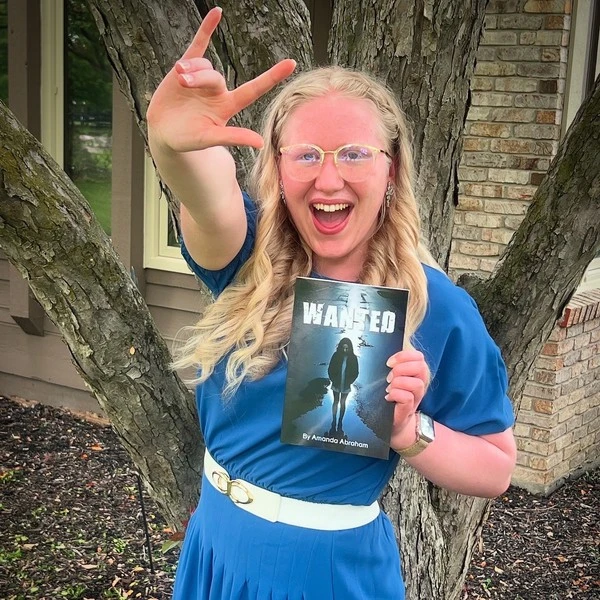
I am a student, author, entrepreneur, researcher, musician, and missionary. My passion is to create a lasting impact on all that I come in contact through healthcare, volunteer work, and my writing. My most recent novel, “Wanted” is available now on Amazon and Barnes & Noble!
Education
University of Toledo
Bachelor's degree programMajors:
- Health Professions and Related Clinical Sciences, Other
Minors:
- Public Health
Allen Park High School
High SchoolMiscellaneous
Desired degree level:
Doctoral degree program (PhD, MD, JD, etc.)
Graduate schools of interest:
Transfer schools of interest:
Majors of interest:
- American Sign Language
- Public Health
- Bible/Biblical Studies
- Health Professions and Related Clinical Sciences, Other
- Bilingual, Multilingual, and Multicultural Education
Career
Dream career field:
Hospital & Health Care
Dream career goals:
I would like to be both an Occupational Therapist and Public Health Practitioner, who specializes in caring for the underserved in all realms.
Writer/Author
Covenant Books2021 – Present5 yearsLiteracy Tutor
Toledo Tomorrow2024 – Present2 years
Sports
Trampolining
Varsity2012 – 202412 years
Awards
- National Co-Champion
- State Champion
- Regional Champion
Research
American Sign Language
University of Toledo — Lead Researcher2024 – 2025
Arts
Downriver Christian Community Church
Music2020 – Present
Public services
Volunteering
Global Medical Brigades — Team member/volunteer (1st year), Vice President of Brigade (2nd year)2024 – PresentVolunteering
Allen Park High School — Tutor2023 – 2024
Future Interests
Advocacy
Politics
Volunteering
Philanthropy
Entrepreneurship
Christina Taylese Singh Memorial Scholarship
My name is Amanda Abraham, and I am studying Occupational Therapy and Public Health at the University of Toledo. I have been a Christ-follower all my life, and above all else, I hope that my life shines His light to others in ALL areas. On top of being a full-time Honors college student, I am a singer, pianist, social media manager, and teacher at my church; a writer of faith-based novels (I’ve recently published one, with another currently in publishing); a mission trip volunteer; and a literacy tutor.
I haven’t always taken interest in my current fields of study. In fact, I began my college journey thinking I wanted to pursue medicine on an MD/PhD track. I also decided to take up American Sign Language, and through learning this language (and independent research conducted as an honors project) I noticed something. We as a society overlook some of the most amazing populations, communities, and cultures-Deaf Culture included. Little things like the ability to communicate are blessings that we take for granted every day. In turn, those who cannot or do not communicate the way we do are outcasted, overlooked, and often ignored. I realized quickly that my passion was no longer rooted in prescriptions and diagnoses, but rather improving health equity for the underserved. Eventually, I changed my major to Occupational Therapy. I hope to work with those who struggle to communicate, helping them to achieve equity particularly in the field of healthcare. I also hope to work with those who struggle with addictions, as interventions like Occupational Therapy could truly change their lives.
While researching and attempting to understand Deaf experiences in healthcare and everyday life, I also found a passion in public health. Public health is a field that was previously rooted in very political and anti-Christian practices and/or attitudes. Ruminants of those ideas remain in the field today; therefore, I’ve accepted the challenge to “take public health back”. I believe that all people deserve not just health equity, but a chance to improve their lives, and therefore their joy, within their families, workplaces, and communities. That being said, my beliefs don’t line up with most public health practitioners. I think my perspectives in the field as a future professional will offer insight into how to improve problems from different angles. I can only hope that my background will touch community members and fellow practitioners as well. I look forward to the challenge, and I believe that-particularly in terms of public health-I was born for such a time as THIS!
Leading Through Humanity & Heart Scholarship
I am severely visually impaired. I truly believe that if I wasn’t born this way, I likely would not be pursuing a career in health. My disability has given me a new “vision” into what it looks like, what it sounds like, and what it feels like to be “underserved”. My example is small, but in the real world, we can find cases of underserved communities, particularly in terms of health, every day. During high school, I decided to take up American Sign Language. During the time I spent learning the language (which I still use today), I recognized just how few resources Deaf communities receive, just how many disparities arise in their healthcare access, and just how little say they have in their own lives. Their voices are, quite literally, drowned out. I noticed a similar phenomenon on a medical mission trip to Panama. How many more populations, at home and afar, face the same problem(s)? As a future public health practitioner and occupational therapist, I hope to give these silenced populations a voice through equitable healthcare, empathy, cultural competence, and respect.
Empathy is so much more than smiling and nodding to someone during a conversation. It’s more than saying “I get how you feel” and walking away. It’s more than pretending to understand even when we don’t. Empathy is respect created from recognizing and attempting to understand the experiences of others. It’s bringing ourselves, no matter how large the gap may be, to their level and viewing the world through their eyes.
Empathy is a powerful cornerstone for both occupational therapy and public health. Without it, I don’t believe many people would be interested in pursuing these fields. Occupational therapy is all about Activities of Daily Living (ADLs); what occupations (these don’t all have to be work-related) a person values, and how to continue performing these activities after an injury, diagnosis, or amputation. It’s not about what the provider wants for a patient, it’s about what the patient wants for themself, with the provider willing to listen and assist in any and all ways possible. Empathy allows OTs to think beyond themselves and ultimately help patients create a better life. As a patient who received OT services once told me, “[The provider] gave me hope. They listened, they did their best to understand, and honestly, they put the stars within my reach.” This quote has stuck with me because I would love nothing more than to be that person, that provider, in someone else’s life. Empathy will allow me to do it.
Public health is another field that requires a great deal of empathy. It’s easy to look down upon those who are less fortunate or experience different health outcomes than we do. However, our judgement is irrelevant in the light of their experiences. Empathy in this context is centered around choosing to listen actively, giving the person a chance to express their experiences, problems, etc., and using those findings to make their community safer, happier, and healthier. As a future public health practitioner, I hope to never overlook a person or population, writing them off for any reason at all. In fact, I want those people who most others choose to ignore, to be the ones that I run to. Through empathy, I want to show all populations-particularly the underserved-that they are loved, respected, beautiful, and wanted.