Hobbies and interests
Art
Science Olympiad
Mathematics
Golf
Movies And Film
Comics
Cooking
Reading
Anthropology
Criticism
I read books daily
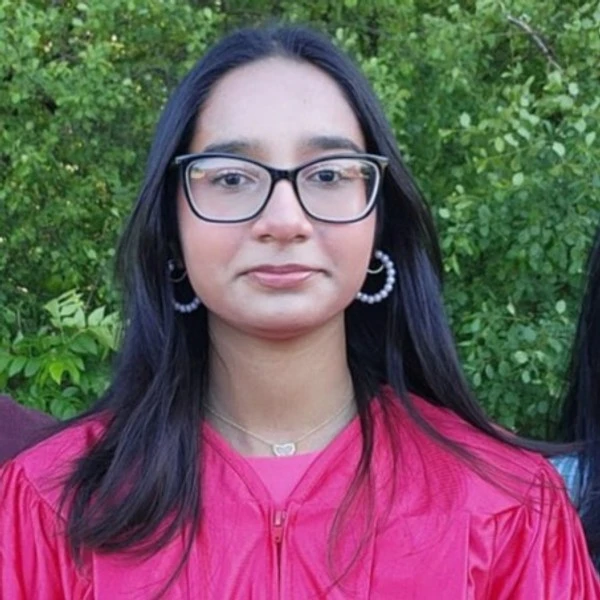
Alina Noman
1x
FinalistAlina Noman
1x
FinalistBio
IL, sophomore, Pakistani golfer
Education
Glenbrook South High School
High SchoolMiscellaneous
Desired degree level:
Bachelor's degree program
Majors of interest:
- Aerospace, Aeronautical, and Astronautical/Space Engineering
- Mechanical Engineering
- Engineering Physics
Career
Dream career field:
Aviation & Aerospace
Dream career goals:
Aerospace Engineer at NASA
Tutor
One on one tutoring2024 – Present2 yearsteacher
Kumon2024 – Present2 years
Sports
Badminton
Club2023 – Present3 years
Golf
Junior Varsity2025 – Present1 year
Research
Agricultural Engineering
Glenbrook South — co-investigator2024 – Present
Arts
Springman
Drawing2024 – 2024
Public services
Volunteering
Glenbrook South — teacher2025 – PresentVolunteering
Glenview public library — social media manager2024 – PresentVolunteering
Glenview public library — volunteer2023 – Present
Future Interests
Advocacy
Volunteering
Philanthropy
Entrepreneurship
Women in STEM and Community Service Scholarship
I was eleven when I translated a medical website into Urdu for my neighbor. Her son was sick. She didn’t know what “inflammation” meant or how to spell “acetaminophen.” Her hands trembled as I spoke, line by line, translating not just words but fear into understanding. When she whispered “shukriya,” I didn’t feel like a child. I felt like a bridge and a vessel. That was the first time I realized what I wanted to be: not just a scientist, but an interpreter, of knowledge, of silence, of stars.
I’ve seen what it looks like to be born brilliant and buried by circumstance. I’ve walked through villages in Pakistan where the sky burns blue above the girls who will never touch it. I remember one girl, sitting on a cracked step, solving math problems in the dirt with a twig because she didn’t have paper. Her wrists were thin. Her mind wasn’t. But brilliance isn’t enough when the world builds its borders from birth.
It haunts me, the idea that my life, my education, my future, was handed to me only because my parents had the chance to leave. I could have been her. She could have been me. That’s why I study the sky. Because it belongs to no one. Because no border can own it. Because it holds questions so vast that even silence sounds like possibility. I’m pursuing a degree in aerospace engineering and astronomy not to build rockets, but to break ceilings. I want to design systems that expand access to space research in low-resource regions. I want to help engineer technologies that bring satellite data to rural farmers in climate-threatened zones. I want to return to those villages, not with pity, but with tools but with maps and stars.
My journey began in small acts: tutoring girls in science, creating space-themed STEM kits for refugee children, teaching elders in my community how to navigate digital health portals. These were not grand gestures, but they were roots. Now, I’m working on a project that uses open-source satellite data to track urban heat islands in underserved communities. Someday, I want to launch a program that trains young girls in South Asia to use orbital data to monitor floods, droughts, or even explore space themselves.
Because service isn't always about giving answers. Sometimes, it’s about helping others ask the questions they were told they weren’t allowed to. My life is a translation, between worlds, between tongues, between possibilities. And my purpose is this: to translate stars into stories for those who were never taught to look up.
All Chemical Transport Empowering Future Excellence Scholarship
Imagine something that never stops moving, but never uses energy, something that breaks the rules of time itself. Time crystals sound like they belong in a fantasy novel, but they are real. A newly discovered state of matter, time crystals keep oscillating endlessly without ever settling down, flipping the very laws of physics on their head. To most, this sounds impossible. To me, it feels like a promise: that what we think are unbreakable limits are actually just the beginning of new possibilities.
I’ve always seen myself in time crystals. Growing up, I was surrounded by people who expected me to slow down, to settle, to accept the rules laid out for me. My family left everything behind with little more than stubborn hope, and I carried that hope forward, not as a whisper, but as a relentless rhythm that refused to stop. Like a time crystal, I kept moving, changing, pushing, even when it felt like no one was watching. I realized leadership isn’t about standing still or waiting your turn; it’s about creating energy that others can’t help but follow.
Chemical engineering gave me the tools to understand transformation, but time crystals showed me that transformation can happen in ways no one even imagined. They taught me that the future isn’t built by repeating old patterns but by inventing new ones that ripple through time and space. This idea fuels my ambition to break into aerospace, to build machines and materials that don’t just work harder, but think differently, move differently, live differently.
Leading means embracing the unknown, stepping into places where most people don’t dare to look. It means holding space for ideas that seem crazy because history has a way of calling the future insane before it becomes obvious. I want to be the leader who not only chases these wild ideas but brings people along, showing that innovation doesn’t happen in silence, it happens in chaos, in movement, in relentless curiosity.
When I think about what it means to lead, I don’t imagine commanding a room or dictating orders. I imagine being the pulse that keeps a team moving forward, the spark that refuses to burn out, the rhythm that others can’t help but follow. Time crystals are the perfect metaphor for that kind of leadership, constant, surprising, and utterly unstoppable.
So, I’m not just aiming to study chemical engineering or aerospace. I’m aiming to shake the foundations of what’s possible, to lead a future that doesn’t settle for what’s comfortable or known. Because like a time crystal, I’m ready to keep moving, breaking rules, bending time, and building something that lasts forever.
Wolf Gustaveson Memorial Scholarship
I’ve always felt like I was supposed to be somewhere, but not here. Not in this body. Not on this side of the world. Not in this life. Sometimes I wonder if I was built from the rusted metal of all the girls who never made it out, girls who dreamed about the sky but were buried in ditches, auctioned like scrap in towns no one maps, used up like stolen parts in a machine that only values speed and silence. Girls who would’ve studied rocket propulsion, or built electric engines, or redesigned the brake system that could’ve saved Wolf Gustaveson’s life. Girls who will never be remembered, because no one wrote a scholarship in their name. I was almost one of them.
My parents immigrated with $17 in a ziplock bag and a five-year-old me clinging to their hands. We didn’t know English. We didn’t know how to dream in this country yet. But what we did know was how to survive. My earliest memory of “engineering” was watching my dad fix our broken heater with a spoon, duct tape, and prayer during a Chicago winter that almost ate us whole. My mother drove a dented Camry with no rearview mirror and told me that “forward is all we can afford.” I thought that was just a metaphor. It wasn’t. That car taught me propulsion, resilience, and blind faith all at once.
I found purpose the day I volunteered at a scrapyard, trying to learn how engines die. What I didn’t expect to find was a human trafficking hotline card shoved in a glove compartment. Someone had tried to escape. Someone had sat in that driver’s seat, knees trembling, thinking a car would save them. That wreck wasn’t just steel, it was a grave. And I realized that every machine I’d ever fix had once carried a life. That every circuit mattered. That every lost girl like me deserved a miracle made of chrome and horsepower. I didn’t just want to repair cars. I wanted to build escape vehicles. Hope machines. Futures.
I’m now a high school student pursuing automotive technology with a concentration in safety engineering. I work weekends at a community center teaching girls how engines work, how to build things that move, how to choose velocity over silence. One told me she thought power only existed in men’s hands. I handed her a wrench. She built her first go-kart. I watched her drive away laughing like she stole her life back.
You asked about drive? Mine comes from the dead girls. From the ones who didn’t make it out. From the future daughter I might have, and from Wolf Gustaveson, who had somewhere to be that morning and never made it. I will honor him not just by getting there, but by making sure no one else has to die before they do.
Somebody Cares About Science - Robert Stockwell Memorial Scholarship
I’ve always felt like I was supposed to be somewhere else. Not in a sad way but just in a way that made Earth feel temporary. I’d look up at the sky, not for comfort, but for answers. Planes, stars, rockets, even birds, I watched anything that moved through the air. Something about flight felt personal, like it carried a message meant only for me: “There’s more out there, and you can get to it.”
What I didn’t realize then was how close I was to never having the chance to reach that “more.” I was almost one of the girls whose dreams don’t make it past the ceiling. Girls in poor parts of the world, just like the one I was born in, grow up with dreams just as big as mine. But they don’t get launchpads. They get silenced. Marriage at fourteen. Labor instead of school. Or worse, sold, trafficked, used, forgotten. I think about them all the time, because I could’ve been one of them. But my parents left everything behind to bring me here. We came to the U.S. with nothing but names we couldn’t pronounce and hopes we couldn’t afford to lose. I owe it to that version of me, the one who could have been lost, to try.
My motivation has never come from trophies or perfect grades. It comes from silence. From being overlooked, underestimated, dismissed, and realizing I never want another girl like me to feel that way. I used to think I was just a quiet girl who liked space. But I’ve learned I’m someone who needs to understand how things move, how they escape, how they survive. Aerospace isn’t just a passion, it feels like survival. A way to prove I exist. A way to prove that girls like me, immigrant girls with too much heart and too many questions, can design the future. I remember the first time I read about Voyager 1 and how it just kept going, out beyond everything, still sending signals back even decades later. That stuck with me. I think part of me wants to be like that, quiet but relentless, carrying messages into the unknown. I want to design propulsion systems that carry more than fuel, I want them to carry hope. I want to show girls trapped in impossible places that we don’t have to be statistics. We can be scientists. Engineers. Builders of galaxies.
My plan is to study aerospace engineering in college, especially propulsion and systems research. But I also want to mentor, teach, and lead. I want to be a mirror for the girls who’ve never seen themselves in this field. I want to ask questions too big for my hands, and try anyway. I don’t think I’ll ever feel finished. And maybe that’s the point. Maybe people who look up at the stars aren’t meant to stay grounded. Somewhere out there is a sky I haven’t touched yet, and I’m building myself a way to reach it.
Learner Math Lover Scholarship
The first time I truly understood the power of math was not in a classroom, but on a rooftop in Pakistan.
I was eight years old, lying on a woven mat under the stars, asking my father how airplanes fly. He explained lift, thrust, and drag, using only words and gestures. I didn’t know it then, but he was describing mathematical principles. Years later, when I learned the equations behind those forces in school, everything clicked. Math wasn’t just numbers on a page. It was the language behind flight, motion, and possibility.
Now, as a high school sophomore dreaming of becoming an aerospace engineer, I see math as my most powerful tool. Every formula I learn opens a new door. Geometry helps me visualize trajectories. Algebra sharpens my problem-solving. Trigonometry connects the dots between angles and forces. And physics, my favorite subject, rests entirely on mathematical logic. What I love about math is how exact and honest it is. There’s no guesswork. It rewards effort and clarity. When I solve a tough equation, it feels like decoding a secret.
But what excites me most is how math connects to everything else I care about. I want to design more efficient rocket propulsion systems and help launch satellites that bring communication and education to underserved areas. That dream would be impossible without math. It’s in every engine model, every simulation, and every structural calculation. Math is not just part of aerospace — it is aerospace.
Outside of class, I tutor younger students in math at my mosque. Many of them struggle with confidence, especially if English is not their first language. I love showing them that math is universal. Numbers don’t care where you’re from or what accent you have. When they start to see patterns and feel that spark of understanding, I see the same joy I felt on that rooftop.
I love math because it gives me the power to build, to solve, and to imagine. It lets me turn childhood curiosity into real, world-changing goals. And as I continue learning, I know math will be the foundation for everything I do.
Elevate Women in Technology Scholarship
I was nine when the lights went out across our village in Pakistan. No warning, no explanation. The air fans died first, then the hum of the fridge, and then our house became a box of darkness and silence. My mother lit a candle. My father checked the neighbors. We waited for hours, sometimes days, for electricity to return.
That was normal. Power outages were common where I grew up. Sometimes we walked miles to charge a phone or waited for running water that depended on electric pumps. And every time it happened, I thought the same thing: why couldn’t anyone fix this?
When we moved to the United States, I carried those blackouts in my mind. One day in science class, my teacher showed us a map of satellite coverage around the world. Some regions had tight grids of signals and data, while others, like parts of Pakistan, had gaps. That was the moment I knew I wanted to become an aerospace engineer.
I started researching satellite technology and launch systems, and that is when I discovered aerospike engines. Unlike traditional rocket engines, which only work efficiently at specific altitudes, aerospikes adjust in real time as the rocket climbs. They provide better fuel efficiency and allow smaller, cheaper launches. That means more access to space and more tools to solve problems on Earth.
Aerospike engines are not just interesting technology, they are a solution. With better propulsion systems, we can launch satellites that help monitor natural disasters, deliver emergency communications, and connect remote communities to the internet. These are tools that could have changed my village’s reality.
I am a high school sophomore currently taking every STEM course available to me. I am part of the robotics club and have started learning how to model rocket nozzles using CAD software. I spend hours studying rocket tests and reading about NASA’s latest propulsion developments. One day, I want to design systems that help people on Earth as much as they help astronauts in space.
A female engineer I met told me, you do not have to be the smartest in the room, you just have to keep showing up. That advice stuck. I now tutor girls at my mosque in math and science. I want to be the person who helps them see their own potential.
Aerospike engines inspire me because they bring real change within reach.
Reach Higher Scholarship
The first book I ever fell in love with was Hidden Figures. I found it tucked away on the corner shelf of our school library, the word “NASA” catching my eye like a whisper. I didn’t know then that the women in those pages, Black female engineers and mathematicians, would change the way I saw myself.
As a Pakistani Muslim immigrant and a high school sophomore who dreams of becoming an aerospace engineer, I had never seen someone like me in those spaces. Women like Katherine Johnson and Mary Jackson made it clear: we don’t wait for a seat at the table. We do the math. We build the rockets. We pull up a chair and make room for more.
Books like Hidden Figures, The Alchemist, and I Am Malala have shaped me. They’ve taught me that even the smallest voices carry power, and that failure is not the end, it’s a turning point. They’ve shown me how to persist, to imagine more, and to turn imagination into motion. Reading hasn’t just informed my goals, it’s built them.
My interest in aerospace was born from curiosity but shaped by reality. I’ve grown up translating doctor appointments and school forms for my parents. I’ve seen my mom give up her own dreams so I could chase mine. That’s why I study hard, stay late for robotics club, and ask questions in math class even when my voice shakes. I want to make it to NASA, not just for me, but for every girl who thinks she has to shrink to belong.
But growth hasn’t been a straight line.
In middle school, I failed my first engineering design project. I was leading a small team to build a bridge out of toothpicks, and our structure collapsed under the weight of a textbook, twice. I felt like I had let everyone down. But my teacher pulled me aside and said, “You didn’t fail. You found one way not to build a bridge. Now go find the right way.”
That moment reframed failure for me. I learned that success isn't always about getting it right the first time, it's about adapting, improving, and trying again. Now, I treat every mistake as a launchpad.
Mentorship has fueled that growth. My science teacher, Ms. Nguyen, is one of the few women in STEM I’ve met in real life. She’s encouraged me to apply to summer engineering programs, connected me with female engineers in the field, and reminded me that confidence doesn’t have to come before action, it comes from it. Without her, I wouldn’t have known where to start.
And now, I’m passing that on. I tutor younger students at my mosque, especially girls who are new to the country and just learning English, girls who remind me of myself when I first arrived. I translate, I explain homework, and I listen. Sometimes, the most powerful thing we can do is say, “You belong here.”
What makes me unique isn’t just my identity, it’s how I use it. I wear a hijab and build robots. I recite Qur’an and sketch rocket engines. I carry my culture like a compass, guiding me toward service, empathy, and purpose.
I want to design aircrafts that reach beyond Earth. But here on the ground, I’ll always stay rooted in community. I plan to launch, and to lift others as I rise.
Ismat's Scholarship for Empowering Muslim Women
The first rocket I ever built was made of cardboard and construction paper. It was the summer after we moved to the U.S. from Pakistan, and I didn’t speak much English yet. But I had a dollar-store poster of the solar system, a stack of paper towel rolls, and enough imagination to launch something beyond the ceiling of our one bedroom apartment.
When I showed it to my mother, she smiled and said, “You’re meant to reach higher than me.”
I didn’t understand the weight of that sentence at the time. I was just a girl with tape on her fingers, pretending she could fly. But now, as a high school sophomore with a slight accent as she pronounces her 'T's and a dream of becoming an aerospace engineer, I realize what she meant. My mother, like Ismat Tariq, gave everything for her children, her country, her comfort, her career. She dreamed of college, but instead, she folded those dreams into my lunchbox every morning and pressed them into my textbooks every night.
Being a Muslim immigrant in America means learning to speak two languages, not just Urdu and English, but hope and survival. At school, I’ve often been “the only one”, the only brown girl in science club, the only one who couldn’t go to the boy-girl party, the only one explaining Ramadan to confused classmates. But I’ve learned to turn those moments into opportunities for connecting with people instead of shame. I’ve learned that my identity isn’t something to hide, it’s rocket fuel.
I want to be an aerospace engineer because I believe in building things that move us forward, machines, ideas, people. I want to work at NASA or SpaceX, yes, but also start STEM workshops at my mosque for girls who are told engineering isn’t “for them.” I want to show them that their brains are just as brilliant, their ideas just as necessary.
I already volunteer at a local STEM program for K-8 girls and tutor ESL students at an organization, kids just like I was, trying to make sense of a new world. One day, I want to create a scholarship for Muslim immigrant girls who dream of building, designing, launching. Girls who speak science in one breath and prayer in the next.
Financially, things have never been easy. My parents stretch every dollar like it’s elastic. A scholarship like this wouldn’t just help me, it would lift the weight off my family’s shoulders. It would tell my mom that her sacrifices mattered, that her daughter really is reaching higher.
Because the truth is, I’m still building rockets but just not out of cardboard anymore. Now, I build with equations and blueprints and books. But the dream is still the same. I want to launch. And I want to take others with me. Because when one brown girl rises, we all rise.
Aktipis Entrepreneurship Fellowship
My curiosity was born the day I realized I was being lied to. It didn’t come from a science fair or a coding camp. It came from sitting at the kitchen table, watching my mother try to explain to a health insurance representative why we couldn’t afford another denial. It came from realizing my parents’ intelligence wasn’t "recognized" because it didn’t come with Ivy League accents or framed diplomas that this country approved of. It came from understanding, at age nine, that there are systems designed to appear neutral, but they are anything but.
That’s where my innovation began. Not with invention, but interrogation.
I display entrepreneurial spirit not because I started a business, but because I’ve always been forced to make something from nothing. That’s the immigrant blueprint: build scaffolding in midair. I've navigated broken bureaucracies like an engineer navigating a failing propulsion system, calculating, recalibrating, refusing to crash. When the internet got cut off, I borrowed it. When I couldn’t afford tutoring, I became my own. I reverse-engineered the life I wanted with no model to follow and no room for error. That is entrepreneurship in its rawest, realest form.
Academia doesn’t impress me unless it’s honest. I pursue scholarship with the urgency of someone who has watched intelligence get ignored because it came with an accent. I don’t read to pass time. I read to survive. I read because knowledge is the one thing I can steal that no one can take back. I approach learning like it’s an act of resistance. Because for me, it is.
And curiosity? Mine is dangerous. I’m curious about why innovation is only praised when it profits the powerful. I’m curious about why underfunded public school students are expected to compete with students trained like Olympic athletes since kindergarten. I’m curious about how to engineer systems that don’t just optimize speed, but justice. I ask questions that make people uncomfortable. That’s how I know they’re good questions.
I don’t want to build apps that solve fake problems. I want to invent things that break real cycles. I want to study aerospace engineering not because I want to escape Earth, but because I want to understand the science of resistance, and what it takes to fight it. I want to launch ideas, people, and institutions that never had a launchpad before.
If you’re looking for someone polished, I’m not it. But if you’re looking for someone relentless, someone who will take a flawed world and dare to redesign it, then I’ve already started. I just do my blueprints in pen.
Eric W. Larson Memorial STEM Scholarship
I was not born into a system. I was born beneath one. A machine was already running before I arrived, a machine engineered by profit, fear, and hierarchy. It was built long before my body hit cold American air, long before I traded Karachi heat for fluorescent cafeteria lights. It is not a machine made of steel or wires, but one built from ZIP codes, last names, subtle glances, and unspoken rules. It's a mechanism that silently scans your background and decides how far you get to go before you even begin. It maps your future based on your parents’ English, on whether you hesitate before answering the phone, on how comfortable you are being invisible.
I didn’t grow up within the walls of that machine. I grew up under its weight. It creaked above me in every classroom where I was the only brown girl who didn’t come from money. It hissed quietly in doctor’s offices where my mother softened her voice to be understood. I saw my father shrink in the face of authority, even when he had done nothing wrong. I watched him nod and smile as if being agreeable could protect him. I watched my mother apologize for asking questions at hospital counters, apologize for needing care, for having an accent, for existing outside the mold. And this is a woman who graduated at the top of her class in microbiology, who once dissected frogs and aced chemistry exams in a school that no one in this country considers “real.”
I watched them come home with tired eyes and empty hands, then wake up the next morning and do it again. I watched them work double shifts and still whisper about how to pay the $30 water bill. I watched as billionaires built recreational rockets and called it innovation, while my parents rationed gas and called it survival. The irony was suffocating.
People assume I chose aerospace engineering because I love space. That’s not the truth. I chose it because I needed to understand the science of pressure, propulsion, resistance, because those aren’t abstract ideas to me. They are the air I’ve been breathing since I could form a thought. I know what it feels like to exist under pressure so constant, it stops feeling like pressure and starts feeling like normal. Every time I saw my parents denied, underestimated, or humiliated, I felt it: a gravitational force holding us down. I want to understand that force scientifically so I can learn how to reverse it. Not as a metaphor. Literally.
We live in a society obsessed with romanticizing adversity. Every scholarship, every college application, every “opportunity” asks me to describe the struggle, but only in a way that makes others feel good. The world wants the digestible version. The highlight reel. Tell us how you turned poverty into passion. Tell us how you made a flower grow from concrete. But don’t get too angry, too specific, or too honest. Keep it inspiring. Keep it palatable.
But I’m not here to make my life story easy to swallow. I’m not writing to be digestible. I’m writing to be disruptive. I’m not your phoenix, your bootstrap fantasy, your sanitized success story. I am not the girl you put in a brochure to prove your diversity metrics. I am the daughter of a system that was never meant to include me, and I am here not to fix that system, but to redesign it entirely.
This is why I’m drawn to engineering. I’m not interested in innovating within broken frameworks. I’m interested in replacing what should never have existed in the first place. I want to build aircraft that don’t exist to patrol borders or drop bombs, but to connect and protect. I want to build satellites that don’t sell our data or track our every move, but monitor ecosystems, climate disasters, and areas most vulnerable to collapse. I want to use engineering not to elevate the few, but to raise the floor for everyone else.
Because the truth is, STEM doesn’t need more genius. It needs more justice. It needs people who have lived at the margins. It needs people who know what it feels like to be left out, locked out, spoken over. I know, because I’ve been all of those things. But I also know what it means to persist anyway. I know what it means to build your own seat when none are offered. And that’s exactly what I plan to keep doing.
I’ve done physics homework in the backseat of a car parked outside a coffee shop just to use their Wi-Fi after ours was shut off. I’ve translated eviction notices before I ever translated a sentence in Spanish class. I’ve worked jobs. I’ve tutored other students. I’ve led boards. I’ve carried the weight of generational sacrifice and still showed up with a 4.0 GPA, a binder full of notes, and a hunger that no AP course could ever grade.
People call it adversity. I call it research. I call it field testing. I call it my blueprint.
This isn’t just my background. It’s my foundation. I’m not interested in just “making it.” I’m interested in redefining what “making it” even means. I’m not content with being a rare exception in a system built to exclude. I want to dismantle the system and help build a new one in its place.
So no, I don’t dream of space because it’s beautiful. I study engineering because it’s the only language I trust to break what needs to be broken and build what needs to exist. I’m here to study propulsion because the world tried to hold me down, and I need to understand exactly what kind of force it takes to lift off.