Hobbies and interests
Foreign Languages
Guitar
Cricket
Basketball
Reading
Politics
Fantasy
Historical
I read books multiple times per week
Ali Arwani
1x
Finalist
Ali Arwani
1x
FinalistBio
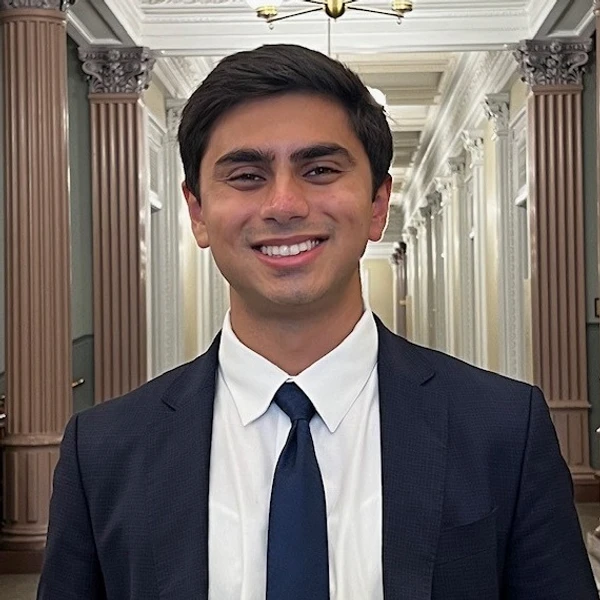
Hi, I’m Ali. I was born in London and raised in Texas, and I recently graduated from King’s College London (I selected Royal Holloway on the platform because my school wasn’t listed) with a degree in Politics. I’ll be starting law school this fall with the goal of pursuing public interest law. I received a 173 on my LSAT.
I’ve worked across government and nonprofit spaces, including at the White House, in the Texas Legislature, and supporting refugee families through Catholic Charities. Those experiences showed me how policy decisions affect real people and strengthened my interest in helping sustain institutions that are both effective and fair.
I care deeply about the role government and community organizations play in creating meaningful change, and I hope to build a legal career that bridges both worlds.
Outside of work, I enjoy cooking, improving my Spanish and Urdu, and spending time playing or watching cricket and basketball. I’ve always been a curious person, and I’m eager to keep learning from new people and perspectives.
Education
The University of Texas at Austin
Doctoral degree program (PhD, MD, JD, etc.)Royal Holloway- University of London
Bachelor's degree programMajors:
- Political Science and Government
Miscellaneous
Desired degree level:
Doctoral degree program (PhD, MD, JD, etc.)
Graduate schools of interest:
Transfer schools of interest:
Majors of interest:
- Law
Career
Dream career field:
Law Practice
Dream career goals:
Committee Aide
Texas House of Representatives2025 – 2025
Sports
Cricket
Intramural2021 – 20232 years
Public services
Volunteering
Debate Mate — Mentor2021 – 2023Volunteering
HERITAGE Donation Drive — Founder2024 – 2024Volunteering
Catholic Charities Dallas — Refugee Services Caseworker2024 – 2024Public Service (Politics)
Texas House of Representatives — DOGE Committee Aide2025 – 2025Public Service (Politics)
The White House — Agency Liason Intern2024 – 2024
Julie Holloway Bryant Memorial Scholarship
When I first asked my mom whether my first language was English or Urdu, I was completely thrown off by her answer: Portuguese. It only made sense in hindsight, when I thought back to how different my early childhood had been. I learned my first words in London, where my mother hired a nanny from Brazil to help care for me while she looked after my infant sister. I would ask for more food in Portuguese, saying “frango” when I wanted chicken.
However, things took a significant turn when my mother fled from my abusive father, taking my sister and me to Pakistan, where she was originally from. There, I began learning Urdu while also being introduced to English. A year later, my family immigrated to the United States, where we faced further instability, including periods of homelessness and an uncertain immigration status. Through each transition, I moved between environments and languages, learning to adapt quickly.
Although I adapted quickly to English, the greatest challenge was not linguistic—it was psychological. After years of displacement and instability, I internalized the belief that I did not belong anywhere. In school, this surfaced as either open defiance or complete withdrawal. Trips to the principal’s office became routine, and I wore indifference as a form of protection.
That began to change in fifth grade, when two teachers asked me to stay after class. I expected another scolding, but instead, they spoke about the curiosity and potential they saw in me. They reframed my experiences not as evidence of failure, but as something that could be shaped into strength. For the first time, with tears streaming down my face, I allowed myself to consider a future in which I belonged somewhere.
That moment sparked a desire in me to seek meaning through service, which was inspired by the people who had chosen to help me. I took on roles working in the Texas Legislature, interning at the White House, and serving as a caseworker at Catholic Charities Dallas. Each experience exposed me to individuals navigating difficult circumstances and reinforced my commitment to helping others feel supported and understood.
When working at Catholic Charities, I often saw how language barriers compounded vulnerability. Many clients struggled not because they lacked ability, but because the systems around them were difficult to navigate. One of my most meaningful experiences was working with a Pakistani refugee and his family, who primarily spoke Urdu. Being able to communicate with him directly allowed me to build trust and guide him through securing welfare benefits, finding employment, and even getting him a car.
These experiences ultimately led me to pursue law. Unlike advocacy alone, law has the power to activate protections that might otherwise remain inaccessible, transforming written rules into enforceable obligations. This is especially important for individuals in vulnerable situations, who often need protection most but have the least ability to navigate legal systems.
It is for this reason that I plan to become a public interest attorney. I will be attending the University of Texas School of Law and am currently exploring interests in civil rights, economic justice, and immigration. Regardless of focus, I intend to advocate for individuals facing circumstances similar to those my family once endured. Many of the clients I hope to serve will face language barriers, and I am committed to using my ability to speak Urdu fluently and Spanish at an advanced level to help bridge those gaps and provide the kind of support that once changed the trajectory of my own life.
Jeffrey J. Douglas First Amendment Scholarship
From an early age, I knew I wanted to advocate for the public good. My passion grew after my family found refuge from domestic abuse. I received immense support from charities and mentors. Their interventions changed my life, inspiring me to give back to society. Still, I did not expect my most fruitful large-scale public service experience to come as an entry-level staffer in the Texas Legislature, where I successfully combated efforts to suppress free expression in the state.
Texas Senate Bill 326, which was created in direct response to pro-Palestine protests at the University of Texas at Austin in 2024, called for the use of the International Holocaust Remembrance Alliance’s (IHRA) working definition and examples of antisemitism in university disciplinary hearings. Many, including Kenneth Stern—the principal author of the definition—have criticized its use, arguing it is an inappropriate guideline for legal and disciplinary enforcement. Parts of the definition conflate criticism of the Israeli government with antisemitism, which meant that if the bill passed as written, it could punish university students for simply criticizing a government.
Since one of my representative’s priorities was protecting individual liberties, he was one of the leading voices against the bill. And due to my previous work as an intern—I helped the representative write multiple Op-Eds, a letter to President Biden, and scripts for social media videos that all focused on bringing attention to the humanitarian crisis in Gaza—I was assigned to work on the bill. I was suddenly responsible for determining how to mobilize enough opposition to stop a proposed law that, so far, had a relatively smooth journey to passage.
In the lead-up to the legislation being voted on, I strategized behind the scenes with offices of other representatives, organizations, and individual constituents who all shared concerns. We applied pressure to undecided representatives by sending voters and organization members to their offices. We were also able to get in contact with Kenneth Stern himself, who agreed to help by speaking directly to multiple representatives over the phone to urge them not to codify his definition.
Ultimately, our efforts resulted in a meaningful victory. The pressure we built forced negotiations, and an agreement was made to have Representative Jon Rosenthal—the sole Jewish member of the House who also shared reservations about the bill—put forward an approved amendment that explicitly stated the intent of the legislation was not to violate freedom of speech protected under the U.S. and Texas Constitutions.
This experience gave me early insight into successfully navigating institutions to protect people’s rights, something that will be increasingly important for me as I pursue becoming a public interest attorney. I am still determining my specialty among my interests in civil rights, worker protection, and immigration, but I know that regardless of whether my daily work involves protecting free expression, I will use the skills I learned from fighting Senate Bill 326 to make myself as effective an advocate as possible.
K-POP Fan No-Essay Scholarship
Miley Cyrus Fan No-Essay Scholarship
Jack Saunders Memorial Scholarship
After passing her driver’s test on the fourth attempt, my mom was finally ready to be on the road. I remember racing my sister out of the dealership, eager to take off. But our journey ended at the first stoplight, where we rear-ended another car. My mom frantically called the salesman, convinced the brakes had failed. He called her crazy and hung up. My sister and I turned to each other with a look we would later describe as wide-eyed confusion mixed with the recognition that we were used to moments like this.
The accident felt symbolic of our lives. We were navigating a new country after surviving domestic abuse, rotating homes and searching for stability. But the greatest challenge I faced was not the upheaval itself, but what it taught me to believe. I internalized the idea that I did not belong. In school, this manifested as open defiance or quiet withdrawal. Trips to the principal’s office became routine, and I felt a strange satisfaction in my defiance.
That began to change when two fifth-grade teachers asked me to stay after class. I walked in prepared to display indifference, expecting another scolding. Instead, they spoke about the flashes of curiosity and ability they saw in me. They urged me to see that my effort could give meaning to what I had endured. Soon, I sat with my face buried in my hands, crying as I listened to words that allowed me to imagine a future in which I belonged.
For the first time, my story felt like a source of strength rather than evidence of exclusion. As I developed a passion for politics and social justice, I began building a sense of worth independent of circumstance.
That belief guided me through the contentious environments that accompany change. Working in the Texas Legislature introduced me to disagreement with higher stakes than I had ever experienced, where I was surrounded by opposing views that shaped policy and affected millions of lives. Yet I approached those spaces with composure, holding my beliefs firmly while engaging opposing perspectives without defensiveness.
I carried that lesson into other forms of service. In my work with refugee families, I learned that case files rarely capture the depth of someone’s experience. I was assigned an Afghan former soldier whose guarded silence led colleagues to warn that he would be difficult to help. I understood that silence not as hostility or defiance, but as the residue of trauma. Drawing from my own experience of feeling powerless in the face of instability, I separated his resistance from his character and continued engaging him with patience. Weeks later, after we secured stable employment and closed his case, he emailed me a string of flower emojis, his quiet bouquet of thanks. I took it as affirmation that meeting people where they are can transform outcomes.
Looking back on my early years in the United States, I see that my greatest challenge was overcoming the belief that I did not belong. I won not by erasing what happened, but by transforming it into resilience and clarity about who I choose to be. Those experiences sharpened my confidence and strengthened my ability to meet conflict with composure and empathy. As I enter law school, ready to engage in rigorous debate and study the institutions that shape opportunity, I carry that steadiness with me and a commitment to use the law thoughtfully in service of communities facing instability and change.
Tandy Law Firm Scholarship
Public service has been central to my life long before I considered pursuing it as a career. When my mother fled with my sister and me to escape an abusive father, we lost our home and immigration status overnight. A human rights initiative guided my family through a self-petition under the Violence Against Women Act and secured our admission to a women’s shelter, despite us falling outside typical eligibility requirements.
In the years that followed, my upbringing was shaped by charities, mentors, and community members. That support made it clear that my outcomes were the result of deliberate action by people and institutions. It instilled a lasting responsibility to contribute to the kind of service that had protected my family. Although legal advocacy had played a decisive role in our stability, I was initially hesitant about committing to years of formal training and procedural fluency, which felt far removed from helping someone in immediate crisis. I gravitated instead toward nonprofit and government roles, where service felt more direct.
That impression was tested when I began working as a resettlement caseworker for refugees and was quickly entrusted with more than a dozen families in a program designed to help them attain self-sufficiency. Clients received three months of rental and financial assistance while we helped them secure employment and access public benefits. Yet I quickly saw that many barriers to stability were beyond the scope of my authority. Home visits were capped, transportation to career fairs was left to clients, and when the initial three months ended, support tapered regardless of readiness. By the end of my time there, over eighty-five percent of participants had not achieved self-sufficiency within the program’s prescribed timeframe.
When I began working in the Texas Legislature, I expected constraint given the weight of creating law. What I did not expect was a system forceful when restricting rights yet paralyzed by gridlock when addressing urgent public needs. I watched legislation codify a strictly biological definition of sex—effectively eliminating legal recognition of transgender individuals—pass swiftly despite opposition, while proposals addressing disaster relief and public school funding moved far more slowly. Across these settings, the pattern was consistent: the urgency of people’s needs rarely aligned with the capacity of the institutions meant to address them.
Taken together, these experiences reshaped my understanding of service and clarified my interest in law. I learned that meaningful impact is not defined by proximity to power or visible need, but by mastering the authority available and using it with precision. In both the legislature and in direct service, that lesson became concrete. Persuading a committee chair to grant hearings required mastering legislative substance and articulating its benefits with precision. In my work with families, it meant handling each case in a way that preserved dignity rather than reducing someone to a file number. What mattered most was not position, but precision.
This shift resolved my earlier hesitancy toward law. I came to see that fluency in formal rules and disciplined reasoning were not obstacles to service, but necessary to make it effective. Law builds on those same skills and applies them with binding force. My family’s stability depended on advocates who converted legal protection into something institutions could not ignore. For that reason, I seek to pursue law to fulfill the responsibility that first shaped my commitment to service. While I remain open to where my legal training will be most effective, I am especially drawn to work closely tied to my family’s experience, including advocacy for survivors of domestic violence, children, and immigrant communities.