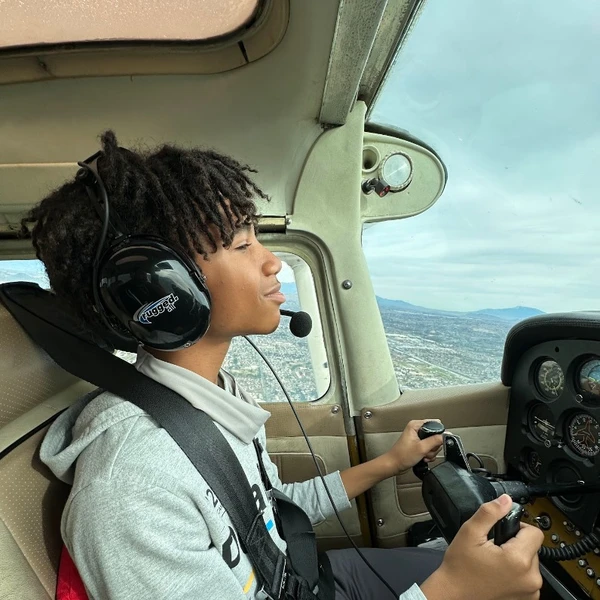
Hobbies and interests
Aerospace
Band
Alfred Richardson
1x
Finalist
Alfred Richardson
1x
FinalistBio
I am Alfred RIchardson II, I have a passion for aviation and am working towards getting a career in the field
Education
Capistrano Connections Academy
High SchoolMiscellaneous
Desired degree level:
Bachelor's degree program
Majors of interest:
- Aerospace, Aeronautical, and Astronautical/Space Engineering
Career
Dream career field:
Airlines/Aviation
Dream career goals:
Sports
Mixed Martial Arts
Intramural2017 – Present9 years
Arts
Palm Desert High School Marching Aztecs
Music2024 – 2025
Tawkify Meaningful Connections Scholarship
The future of human connection, to me, is not about pushing technology away. It is about learning how to use it without losing what makes connection real. As someone who is focused on building a future in aviation, I see both sides clearly. Technology is advancing fast, and it is becoming a bigger part of everyday life. At the same time, I know that real connection still depends on people, not just systems.
I think one of the biggest challenges today is that communication is easier than ever, but real connection is harder to maintain. People can talk instantly, share information quickly, and stay in constant contact, but that does not always mean those interactions are meaningful. It is easy to get caught in quick messages and surface-level conversations. For me, preserving real connection means being intentional. I want to make sure that when I talk to people, I am actually present and engaged, not just responding out of habit.
My interest in aviation has shaped how I see this issue. Aviation is a field built on advanced technology, but it also depends heavily on human communication and trust. Pilots, air traffic controllers, and crews all have to work together, often in high-pressure situations. Even with the most advanced systems, there is no replacement for clear communication and teamwork. That shows me that no matter how advanced the world becomes, people will always be at the center of real connection.
I also believe that strengthening human connection in the future comes down to improving communication skills. Not just talking, but listening and understanding. In a world where so many conversations happen through screens, being able to communicate clearly and genuinely stands out. I want to be someone who can build trust, work well with others, and understand different perspectives. Those are skills that will matter in any career, especially in something as demanding as aviation.
Another thing I think about is how technology can sometimes make people more independent, but also more isolated. It is easy to stay in your own space, interact on your own terms, and avoid deeper engagement. But real connection requires effort. It means stepping outside of comfort zones and actually engaging with people. Whether it is in school, future training, or my career, I know that building strong relationships will be important.
I also think people have a responsibility for how they use technology. Online spaces can either bring people together or push them apart. I try to use technology in a way that adds something positive, whether that is sharing ideas, helping others, or just being respectful in how I communicate. Even small actions can make a difference in how connected people feel.
Looking ahead, I know that technology will keep changing how people interact. There will be new tools, new ways to communicate, and even more advanced systems. But I do not think those things will replace real human connection. They can support it, but they cannot create it on their own. Real connection still comes from effort, understanding, and being present.
For me, the goal is not to reject technology, but to stay in control of how I use it. I want to build strong connections with people while also preparing for a future that depends on advanced systems. In the end, I believe that no matter how much the world changes, human connection will always matter. It is something that has to be maintained, not assumed, and it is what makes progress meaningful in the first place.
Ruthie Brown Scholarship
The idea of student loan debt has always felt very real to me, not just as a future possibility, but as something I actively want to control before it controls me. Growing up, I have seen how financial stress can limit opportunities, and that has shaped the way I approach my education. I am particularly focused on pursuing a degree and career in aviation, which I know is very expensive, so I have been constantly researching and comparing schools to find the best programs at the most affordable prices.
One of the main ways I am addressing future student loan debt is by prioritizing scholarships and financial aid. I understand that every dollar I earn through scholarships is a dollar I will not have to borrow or repay with interest. Because of this, I am consistently searching for opportunities, applying to multiple scholarships, and treating each application seriously. Even smaller awards can add up over time, and I see them as an investment in my future rather than just a one-time effort.
In addition to scholarships, I am being strategic about which aviation program to attend. While it can be tempting to choose a school based solely on reputation or prestige, I am focused on finding a balance between quality education and affordability. This includes looking at both community colleges and universities with strong aviation programs to ensure I can receive the best training without accumulating unmanageable debt.
Another important part of my plan is working while in school. Whether through part-time jobs, internships, or work-study programs, I intend to contribute to my own expenses as much as possible. Not only will this help reduce the amount I need to borrow, but it will also teach me valuable skills such as time management, responsibility, and financial discipline. I believe that earning money while studying will give me a better appreciation of its value and help me make smarter financial decisions.
I am also committed to budgeting and living within my means during college. This means avoiding unnecessary expenses, limiting debt from credit cards, and focusing on needs rather than wants. By creating and sticking to a budget, I can ensure that any money I do have is used efficiently. Developing these habits early will not only help me during college but will also prepare me for managing finances after graduation.
Finally, if I do need to take out student loans, I plan to do so carefully and responsibly. I will only borrow what is absolutely necessary and will fully understand the terms, including interest rates and repayment plans. After graduation, I intend to prioritize paying off my loans as quickly as possible, potentially by making larger payments when I am able or exploring loan repayment assistance programs related to my career field.
Overall, my approach to student loan debt is proactive rather than reactive. By combining scholarships, careful school selection, part-time work, budgeting, and responsible borrowing, I am creating a plan that allows me to pursue my education in aviation without being overwhelmed by debt. I am determined to invest in my future wisely and ensure that my goals are not limited by financial burdens.
Learner Math Lover Scholarship
I love math because it feels like a language that explains the world in a way nothing else can. From a young age, I’ve been drawn to the precision and clarity it offers. Math isn’t about opinion or perspective; it’s about discovering patterns, solving problems, and seeing the logic behind how things work. That certainty is both comforting and exciting.
I’m fascinated by how math connects to so many of my interests. Aviation, for example, relies on physics, aerodynamics, and complex calculations to keep planes in the air safely. Understanding the numbers behind flight makes the invisible rules of the sky tangible. Even in my dual enrollment studies in engineering, math plays a central role, where every equation, formula, or diagram tells you something practical and real about designing, building, or analyzing systems. Completing college algebra at 15 was a milestone that made me realize how much I enjoy tackling challenges and mastering complex concepts early on.
Math also challenges me to think critically and creatively. Some problems, like geometric constructions or paper folding, might seem simple at first glance, but they require patience, strategy, and an ability to visualize solutions in ways that aren’t immediately obvious. It teaches resilience and precision. Making a mistake is not failure; it is part of the process, and finding the right approach feels rewarding in a way that few other things do.
Finally, I love how math is universal. The principles stay the same no matter where you are or who you are. That universality makes it feel like a bridge between ideas, connecting the abstract and the real. Math is not just something I study; it is a lens through which I understand patterns, solve problems, and explore my passions, especially aviation and engineering.
It challenges me, grounds me, and shows me that logic and creativity can coexist. That combination is why math is not just a subject; it is something I genuinely love.
Edna McGrowder Memorial Scholarship
One experience that influenced my decision to pursue a college education was my involvement with the Civil Air Patrol and my volunteer work at community events like the Tour de Palm Springs. As a member of the Civil Air Patrol, I learned the importance of discipline, teamwork, and leadership, but it was during hands-on service that I truly understood the impact of preparation and responsibility. At the Tour de Palm Springs, I helped move and secure bikes in partnership with the Civil Air Patrol. Arranging bikes, ensuring they were safe, and coordinating with fellow volunteers taught me organization, attention to detail, and how small contributions can create meaningful outcomes for the community.
Being the child of an immigrant has also shaped my perspective on education. My father, who is from Antigua, often shared stories about the challenges he faced when moving to a new country. Listening to his experiences taught me the value of hard work, perseverance, and seizing opportunities. His stories inspired me to pursue my goals with determination and helped me understand that education is a powerful tool for creating opportunities. For me, pursuing college is not just a personal goal but a way to honor my family’s journey and build a foundation for a future where I can make a meaningful impact.
Volunteering at the Tour de Palm Springs gave me a deeper sense of community. Working alongside other volunteers, I saw firsthand how coordinated effort can make large events run safely and smoothly. This experience reinforced the connection between careful planning, problem-solving, and tangible results. I realized that the skills I developed through volunteering, such as critical thinking, leadership, and collaboration, are closely linked to academic learning and the opportunities higher education can provide.
My interest in aviation further reinforced my decision to pursue college. Being part of the Civil Air Patrol allowed me to explore aviation firsthand, from learning about aircraft operations to understanding navigation and safety protocols. This exposure sparked curiosity about engineering principles and aerospace technology, and I realized that a college education would let me deepen that knowledge and pursue a career in a field I am passionate about. College became more than a step toward a job; it became a platform where I could combine my interest in aviation with a commitment to service and innovation.
Ultimately, these experiences taught me that learning is not confined to the classroom. It is about applying knowledge, working with others, and striving to make a positive impact. College represents the next step in that journey, offering the resources, mentorship, and opportunities I need to continue growing, serving, and preparing for a future where I can contribute meaningfully to my community, honor my family’s sacrifices, and pursue my passions in aviation and engineering.
Jorge Campos Memorial Scholarship
Before sunrise at the Tour de Palm Springs, the staging area was already filling with cyclists unloading gear and trying to find where they needed to be. I was there as a member of Civil Air Patrol, assigned to help move, organize, and secure bikes so the event could run smoothly. It was not a high visibility role, but it required focus, coordination, and accountability from the moment we started.
Bikes arrived quickly and often in waves, which meant we had to keep things moving without creating confusion or risking damage. I directed riders to drop off points, carried bikes to racks, and made sure each one was placed securely. In a crowded and fast paced environment, even small mistakes could cause problems, so I had to stay aware of everything happening around me. Clear communication and attention to detail were essential, especially when multiple volunteers were working in the same space.
Being part of Civil Air Patrol shaped how I approached the experience. I did not see it as just volunteer hours, but as a responsibility. Riders trusted us with equipment that was often expensive and personally important. That trust meant I needed to be consistent and careful, even when things became busy. I focused on doing each task correctly rather than rushing through it.
What stood out to me most was how much small interactions mattered. Some riders knew exactly what to do, while others were clearly unsure or stressed. When someone seemed confused, I made sure to step in, give clear directions, and keep things simple. I remember one rider who kept asking if their bike would be safe. Instead of dismissing the concern, I explained how the bikes were organized and checked that theirs was secured properly. It only took a moment, but it made them more comfortable starting the event.
This experience reflects the kind of service associated with Jorge Campos, or Don Jorge. It was not about doing something dramatic or being recognized. It was about being reliable, maintaining a steady attitude, and treating people with respect. Even when the pace increased, I avoided cutting corners or rushing people. Staying consistent helped create a more organized and positive environment for both riders and volunteers.
Teamwork also played a major role. Within Civil Air Patrol, everyone had a role, but we adjusted based on what was needed. If one area became crowded, we moved to help without being asked. That flexibility made the operation more effective and showed how much easier things become when people work toward the same goal. It also reinforced the importance of communication and trust.
This experience contributed to my personal growth by strengthening my ability to stay calm under pressure and be dependable in a real world setting. People relied on me to do my part correctly, and that responsibility pushed me to be more disciplined. It also improved my communication skills, especially when giving clear instructions quickly.
As a dual enrollment student working toward a degree in engineering, with a strong interest in aviation, I see clear connections between this experience and my future goals. Both fields require precision, responsibility, and teamwork. Helping at the Tour de Palm Springs showed me that meaningful service does not have to be complex or highly visible. By doing my job well and supporting others, I contributed to something that brought the community together and reinforced my commitment to serving in the future.
Rodney James Pimentel Memorial Scholarship
One of the greatest values of education is the human connection formed along the way. None of us reach our goals alone, and often it is the guidance, support, and perspective of others that shape who we become. Throughout my academic journey, I have come to appreciate how meaningful these connections are, not only in helping us succeed but also in shaping the way we think, make decisions, and support others. If a close friend or loved one came to me for guidance on a major life decision, I would approach the situation with patience, honesty, and a genuine effort to understand their perspective before offering advice.
Rather than immediately telling them what I think they should do, I would begin by listening carefully. Everyone faces different pressures, goals, and fears, and understanding those factors is essential before giving meaningful guidance. For example, if a friend were deciding between pursuing a passion or choosing a more stable path, I would help them explore both options thoughtfully. I would ask questions that encourage reflection, such as what excites them most, what kind of challenges they are willing to face, and what kind of future they envision for themselves. These kinds of questions often help people clarify their own thoughts rather than relying entirely on someone else’s opinion.
At the same time, I believe that being a supportive friend also means being honest. If I see potential risks or opportunities they may not have considered, I would respectfully share my perspective. The goal would not be to make the decision for them, but to provide insight that helps them make a more informed choice. Ultimately, I would remind them that the decision is theirs, and that I will support them regardless of the outcome. Being able to offer both honesty and support reflects the kind of human connection that makes education and personal growth meaningful. It is not just about what we learn academically, but also about how we learn to support and guide others.
As a dual enrollment student currently working toward a degree in engineering, I have had the opportunity to challenge myself academically while preparing for my future career. My interest in engineering is closely connected to my passion for aviation. Aviation represents a field where innovation, precision, and problem solving come together to create technology that connects the world. The idea that engineering principles can be applied to design aircraft, improve safety, and push the boundaries of what is possible has been a strong source of motivation for me.
However, pursuing STEM, especially at an advanced level, has not been without its challenges. One of the most significant challenges I have faced is managing the rigor of college-level coursework while still in high school. Dual enrollment requires balancing multiple responsibilities, including deadlines, exams, and maintaining a strong understanding of complex material. This has been particularly demanding in math-based subjects, where problems often require multiple steps and a deep understanding of underlying concepts rather than simple memorization.
There have been times when I felt overwhelmed by difficult assignments or concepts that did not immediately make sense. Instead of giving up, I learned to approach these challenges in a more structured and disciplined way. I began breaking down complex problems into smaller, more manageable steps, which made them easier to understand and solve. I also made it a priority to review foundational concepts whenever I encountered difficulties, recognizing that gaps in understanding could make more advanced topics harder to grasp.
In addition, I learned the importance of consistency and time management. Rather than waiting until the last minute, I developed a habit of studying regularly and staying ahead of assignments. This helped reduce stress and gave me more time to fully understand the material. I also became more comfortable seeking help when needed, whether through teachers, classmates, or additional resources. Learning to ask for help was an important step in my growth, as it allowed me to overcome obstacles more effectively and gain new perspectives on challenging topics.
Through these experiences, I have developed not only stronger academic skills but also resilience and confidence. I have learned that struggling with difficult material is a natural part of the learning process, especially in STEM fields. Each challenge I faced helped me improve my problem solving abilities and strengthened my determination to succeed. This mindset has been especially important as I continue working toward a degree in engineering, where persistence and adaptability are essential.
My interest in aviation continues to motivate me as I pursue my goals in STEM. Aviation is a field that requires precision, innovation, and a commitment to continuous improvement, qualities that I strive to develop in my own work. Whether it is understanding the physics behind flight or exploring how engineering can improve aircraft design, I am excited about the opportunities to contribute to this field in the future.
Overall, my experiences have shown me that education is not just about individual achievement, but also about the connections we build and the challenges we overcome. By supporting others in their decisions and learning to navigate my own obstacles, I have grown both academically and personally. These experiences have prepared me to continue pursuing my goals in engineering and aviation, while also remaining someone who values collaboration, resilience, and meaningful human connection.
Julia Elizabeth Legacy Scholarship
I noticed it the first time I looked around my physics class and realized I was one of the few people who shared my background. It wasn’t that I didn’t belong there, but it felt like I had to prove that I did. That moment stuck with me because it showed how representation shapes confidence, opportunity, and ultimately, who chooses to stay in STEM.
As I pursue my goal of earning a degree in engineering and plan to specialize in aviation, representation has become even more meaningful to me. The aviation and engineering fields have historically lacked diversity, which makes it even more important for students like me to step forward and be part of that change. I want to contribute not only through my work, but also by showing others that they belong in these spaces too.
Diverse representation in STEM careers is important because it expands who feels welcome to participate. When students see scientists, engineers, and innovators from different backgrounds, it sends a clear message that success in these fields is not limited to one type of person. Without that visibility, many talented individuals may never pursue STEM simply because they do not see a place for themselves. Representation helps break that barrier and encourages more people to explore their potential.
Beyond inspiration, diversity directly improves the quality of work in STEM. People from different cultures, communities, and life experiences approach problems in unique ways. This leads to more creative solutions and better outcomes. In aviation especially, safety and innovation depend on anticipating a wide range of human needs and experiences. A diverse group of engineers is better equipped to design systems that are safer, more efficient, and more inclusive for people around the world.
Diversity in STEM also promotes fairness and equal opportunity. Historically, many groups have been underrepresented or excluded from these careers due to social, economic, or educational barriers. Increasing representation helps correct these inequalities and ensures that access to high-paying, influential careers is more equitable. When opportunities are shared more fairly, it strengthens not only individuals but also entire communities.
Additionally, representation builds trust between STEM professionals and the public. In fields like aviation, where safety and reliability are critical, trust matters. A diverse workforce can better understand and serve global populations, ensuring that advancements benefit everyone, not just a limited group.
In conclusion, diverse representation in STEM is not just about fairness. It is about strengthening innovation, improving outcomes, and creating opportunities for everyone. As I work toward a degree in engineering and a specialization in aviation, I hope to contribute to a more inclusive future in STEM, one where anyone with passion and dedication can see themselves succeeding.
James Diorato Memorial Scholarship
I have always been drawn to the idea of flight. Watching planes glide through the sky sparks a sense of wonder, and learning that members of my family have experience in aviation only deepened my curiosity. The first time I stepped onto an airplane and looked out over the clouds, I was captivated by the feeling of being above the world and seeing everything from a new perspective. That experience made me realize that aviation is not just something to admire from a distance, but a path I am determined to follow. Since then, I have focused on understanding how airplanes work and how pilots navigate the skies, seeking both knowledge and hands-on experience that will prepare me for a career in aviation.
One of the most memorable milestones in my journey came a few years ago when I stepped into the cockpit of a small aircraft, a Cessna 172. Even though it was a relatively simple plane, I was immediately captivated by the complexity and precision of the instruments and controls. That experience made me realize that becoming a pilot would require hard work, dedication, and continual learning. It was the first time I truly understood that aviation is not only about flying, it is about mastering a craft, understanding technology, and constantly improving oneself. Since that moment, I have actively sought out ways to enhance my knowledge and skills, knowing that every small step brings me closer to my dream.
To further develop my understanding of aviation and strengthen my leadership abilities, I recently joined the United States Civil Air Patrol. This program has given me the opportunity to learn about both aviation and the principles of the Air Force, while also fostering qualities such as teamwork, discipline, and problem-solving. Working alongside peers who share the same passion has been incredibly motivating. I have learned that aviation is never a solo endeavor, it requires collaboration, communication, and the ability to make quick, informed decisions under pressure. The lessons I am learning through the Civil Air Patrol are invaluable not only for preparing me for flight school, but also for equipping me with the leadership skills necessary for a successful career in aviation.
In addition to my involvement in Civil Air Patrol, I am currently dual-enrolled in my online high school and my local community college. This unique schedule allows me to dedicate significant time to pursuing my interests in both aviation and engineering. By balancing rigorous academic work with hands-on experiences in aviation and leadership development, I am building a strong foundation for the future. Managing both high school and college studies while actively participating in the Civil Air Patrol program demonstrates my ability to prioritize, manage my time effectively, and take responsibility for my own growth. These qualities, I believe, are essential for anyone pursuing a career in aviation, where precision, focus, and adaptability are key.
Reflecting on my journey so far, I realize that aviation has become much more than a passion, it is a lifelong pursuit that demands dedication, discipline, and a commitment to continuous learning. Each experience, from academic studies to cockpit exploration and leadership training, has reinforced my desire to contribute meaningfully to the field of aviation. I am confident that the skills I am developing now, technical expertise, leadership, and the ability to collaborate effectively, will allow me to reach my ultimate goal, becoming a pilot who not only flies safely and skillfully, but also leads and inspires others in the aviation community. Through all of this, I will become a great pilot one day.
Craig Huffman Memorial Scholarship
Ever since I can remember, I’ve been fascinated by aviation. Learning that I had family members in the field sparked my curiosity even more, and the first time I boarded an airplane(that I can remember), I knew that becoming a pilot was the right path for me. Since then, I have dedicated myself to learning everything I can about flight, from studying aerodynamics to gaining hands-on experience. My goal is not only to become a skilled pilot, but also to make the most of my time in the air. The first time I ever entered the cockpit of a plane was a few years back. Even though it was just a Cessna 172, I was impressed by all of the instruments and controls. From that point onward, I knew I had a lot of work to do if I wanted to become a pilot, and I am hoping that the activities I do now will advance me to that point.
Recently, I joined the United States Civil Air Patrol, not only to learn about aviation and the Air Force, but also to develop leadership qualities by working with like-minded individuals. Through this experience, I am learning how teamwork, discipline, and problem-solving play a crucial role in aviation. These skills will prepare me for both flight school and a future career as a pilot, while also continuing to further my knowledge in the field of aviation and aerospace technology. Along with being in Civil Air Patrol, I am also currently dual-enrolled in both high school and my local community college. Because my high school is online, this gives me time to focus on working towards a degree in Engineering, which I plan on branching out into in the future. Being able to balance both high school and college, while also being enrolled in the Civil Air Patrol program, shows that I am capable of exemplifying leadership in multiple ways.
In total, these experiences have shown me that aviation is not just a passion, but a lifelong pursuit that requires dedication, discipline, and continuous learning. By combining my academic studies, hands-on flight experiences, and leadership development through the Civil Air Patrol, I am preparing myself to make meaningful contributions to the field of aviation. I know that one day, I will finally be able to take to the skies with an aviation career, finally showing how my dedication and leadership qualities help me become the best pilot that I can be.