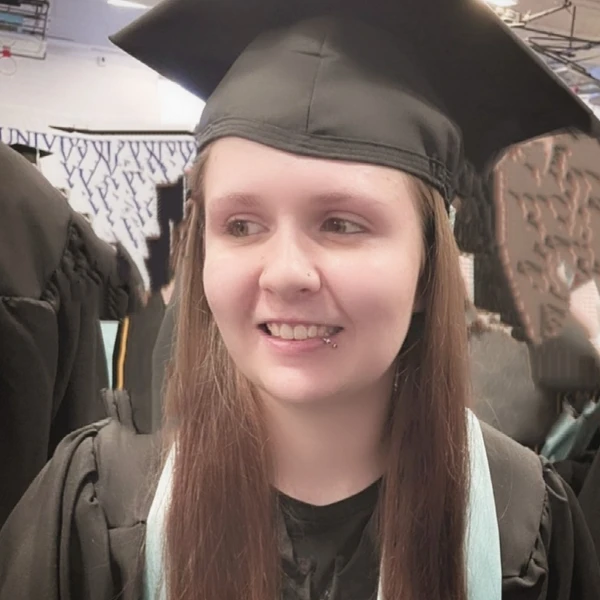
Quasqueton, IA
Age
25
Gender
Female
Hobbies and interests
Advocacy And Activism
Anatomy
Biology
Biomedical Sciences
Human Rights
Reading
Academic
I read books daily
Credit score
US CITIZENSHIP
US Citizen
LOW INCOME STUDENT
Yes
FIRST GENERATION STUDENT
Yes
Alexis Scott
1x
NomineeAlexis Scott
1x
NomineeBio
My name is Alexis Scott, and I am pursuing a career in forensic pathology. The ultimate goal is to perform autopsies for both medical and judicial purposes; I would like to give a voice to those who can no longer speak.
I am passionate about all things medical and hope to further my education in order to practice in the future.
Thank you to those who consider helping me in this journey of education.
LinkedIn: https://www.linkedin.com/in/alexis-scott-1b6822262/
Education
Duquesne University
Master's degree programMajors:
- Biological and Biomedical Sciences, Other
Upper Iowa University
Bachelor's degree programMajors:
- Biological and Physical Sciences
GPA:
3.5
Miscellaneous
Desired degree level:
Doctoral degree program (PhD, MD, JD, etc.)
Graduate schools of interest:
Transfer schools of interest:
Majors of interest:
Career
Dream career field:
Forensic Pathology
Dream career goals:
Screen Technician
Showbiz Screen Printing2022 – Present4 yearsTutor
Upper Iowa University2021 – 20232 years
Research
Biological and Biomedical Sciences, Other
Upper Iowa University — Researcher2022 – 2023
Public services
Volunteering
Be My Eyes — Volunteer2022 – Present
Future Interests
Advocacy
Volunteering
Dounya Discala Scholarship
I've always had a goal in mind regarding my future career and education. I've always wanted to be a medical examiner. Whenever anyone asks me what I plan to do with my education, I tell them just that. Their faces nearly almost become distorted with disgust, followed by comments about it being an unclean, gross profession.
One instance I remember very clearly occurred during my high school education. An individual asked what I planned to do in the future, and I told them I would like to do autopsies for medical and judicial purposes. "That's not a job for a lady," they replied. It shocked me because I never thought a career like that would be considered gender-exclusive, as I've followed many women who are excellent in their profession.
Since then, I've taken more notice of how people react to my future career and life plans. I've also taken notice of how women are treated in the education of science altogether, and it is quite frustrating. For example, in many laboratory settings during my undergraduate studies, I noticed that many of the female students were pushed aside to do detail-oriented work like taking notes or calculating figures. At the same time, the male students would be instructed to do the hands-on work. While female students were seemingly unable to add input to discussions in these courses, male opinions were accepted and encouraged.
Overall, I understand that I will face many challenges going into the scientific field in general just because of my gender. I understand that some future colleagues, bosses, or those of the like may not accept my input because of my gender. However, I know that I am able to prove these people wrong by putting in the effort and keeping my passion for this future career alive and burning. From experiences like these, I've learned that it does not matter what people believe my capabilities are, just so long as I can perform tasks the way they need to be done. I've also learned that I am fully capable of reaching goals that I have set for myself, and the harder experiences help to better individuals. Regardless of other peoples' inputs, I have been able to finish my Bachelor's degree in a scientific field and be accepted into a biomedical Master's program. I keep those thoughts that other people have and use them to my advantage now. However, it's still important to be able to identify gender stereotypes in the workplace and in educational systems, so that the issue can be resolved and other women don't think that they are not good enough to pursue their goals.
Book Lovers Scholarship
Being Mortal: Medicine and What Matters in the End is a book by Atul Gawande. This book delves into the ups and downs of the process of death and dying, which is important for anyone and everyone to understand. Gawande tells anecdotal stories of the places he's been and the people he has met that deal with the dying process. This book is truly eye-opening for anyone going through this inevitable process or anyone going into the medical field. It sheds light on how we view death as a society and how we treat those who are dying. This book is especially important for those going into the medical field because geriatrics and death and dying are not something that is discussed as much as actual medical practices and processes. This book shows how to be human to those who are suffering in a nearly suggestive manner. This book also reflects on the use of modern medicine and how it has made us pretty much calloused to death and its processes. Another important theme that this book offers is patient wishes that are not held during the dying process and after death has occurred. It stresses the importance of comfort in these wishes and the importance of those wishes being upheld by family, friends, and medical staff surrounding the individual who is in the process of dying. Overall, this book can be eye-opening for many different types of people because it addresses the one thing that most feel to be the most uncomfortable topic of all time -- death.