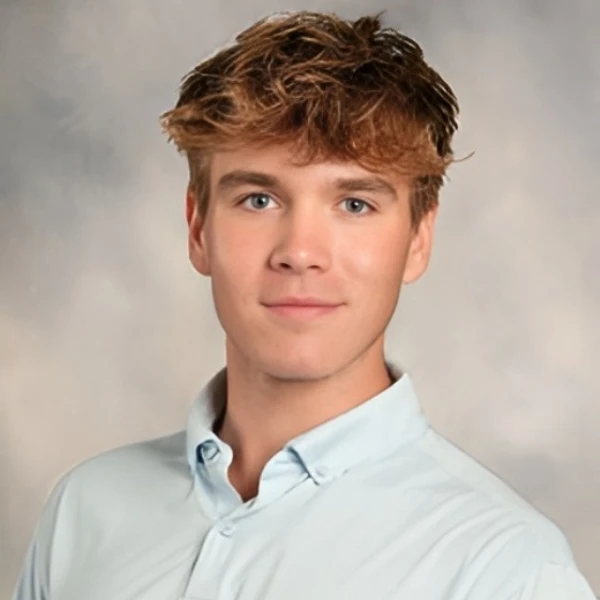
Hobbies and interests
Golf
Pickleball
Basketball
Coding And Computer Science
Piano
Weightlifting
Cooking
Communications
Legos
Polish
Mental Health
Psychology
Neuroscience
Medicine
Alexander Krupa
1x
Finalist
Alexander Krupa
1x
FinalistBio
I believe that my values that I live by adhere to and honor those to which humanity values the most. I value kindness most personally as I have lived on the wrong side of compliments all my life. Instead of using that to fuel me into bullying others, I used it to care for them. I joined classes like Integrated PE at the high school, helping other students with developmental disabilities grow on a peer-to-peer level, as well as helping coworkers understand the interpersonal connections with members at various clubs by making them feel welcome and seen. As a previous wrestler, I heavily value the importance of hard work and dedication. As my parents are both Polish immigrants, I had to learn the American systems alone, not even understanding English until around six years of age. These setbacks only showed me that nothing will be handed to me and I would have to work twice as hard as my peers to achieve my goals. These passions to service and overall betterment of character pulled me outdoors to activities such as golf, cycling, weightlifting, and others. I believe that with the correct mental state anything can be achieved, no matter how grueling or impossible that task may seem, which is why I want to take my skills to the sciences and eventually to the medical field, performing new and innovative surgeries that can save people's lives, discover new cures for diseases or create new methods of practice into that betterment of overall human life.
Education
Lake Zurich High School
High SchoolGPA:
3.7
Miscellaneous
Desired degree level:
Doctoral degree program (PhD, MD, JD, etc.)
Majors of interest:
- Neurobiology and Neurosciences
Career
Dream career field:
anesthesiologist
Dream career goals:
Sports
Golf
Intramural2023 – Present3 years
Track & Field
Varsity2022 – 20264 years
Wrestling
Varsity2021 – 20232 years
Awards
- state
Arts
Iwona Pietrzak Piano
Musicvarious concerts2016 – Present
Public services
Volunteering
Lake Zurich High School — Group leader, advocator, etc2025 – Present
Future Interests
Advocacy
Politics
Volunteering
Philanthropy
Entrepreneurship
Treye Knorr Memorial Scholarship
I used to be scared of my piano teacher. She was intimidating and her expectations towered over me. Her lessons demanded an understanding of theory I did not possess. Over time, my theory developed and my creativity and emotion sparked with it. Piano taught me how creativity and structure coexisted. Switching between Polish at home and English at school taught me the same lesson in a different way. My brain constantly adapted to new rhythms and meanings, finding harmony between two languages. Being first generation, I had to learn how to be on my own. I did not receive much support in my academic or extracurricular endeavors, and had to pave my way for myself and my younger brother. Whether I was moving between keys on the piano or translating for my parents, I became fascinated by how effortlessly the brain shifts between systems of sound and understanding.
That curiosity led me to explore neuroscience. I wanted to understand how neural pathways created thoughts, feelings, and perceptions, and how those same signals control life itself. Watching surgery for the first time at my mom’s hospital changed how I saw medicine. I was mesmerized by how every incision required immense precision to keep someone alive. My hands shook even though I played no part in the outcome. It made me wonder what was happening beneath the surface, how millions of cells were working together to keep a person alive.
One of my transformative challenges began with caddying. I was an extremely shy kid whose social world was confined to videogames. The golf course helped me broaden my horizons and diversify my character, forcing me to develop interpersonal skills in high-stakes environments. Success as a caddy requires the ability to read individuals, anticipate needs, and maintain professional conversations with people from diverse backgrounds for hours at a time. From the extensive assortment of individuals I met, my social anxiety was replaced with curiosity for golf and the people I met, creating a new, flourishing character which can perform in any circumstance. Through this role, I had reached my activation potential, similar to how a neuron reaches its threshold to fire, transforming myself into a confident communicator prepared for the collaborative nature of medical research.
I believe that I should be awarded this scholarship as my values that I live by adhere to and honor those to which Treye Knorr likely valued the most. I value kindness most personally as I have lived on the wrong side of compliments all my life. Instead of using that to fuel me into bullying others, I used it to care for them. I joined classes like Integrated PE at the high school, helping other students with developmental disabilities grow on a peer to peer level, as well as helping coworkers understand the interpersonal connections with members at various clubs by making them feel welcome and seen. As a previous wrestler, I heavily value the importance of hard work and dedication. As my parents are both immigrants, I had to learn the American systems alone, not even understanding English until around six years of age. These setbacks only showed me that nothing will be handed to me and I would have to work twice as hard as my peers to achieve my goals. These passions to service and overall betterment of character pulled me outdoors to activities such as golf, cycling, weightlifting, and others. I believe that with the correct mental state anything can be achieved, no matter how grueling or impossible that task may seem, which is why I want to take my skills to the sciences and eventually to the medical field, performing new and innovative surgeries that can save people's lives, discover new cures for diseases or create new methods of practice into that betterment of overall human life.
Mark Caldwell Memorial STEM/STEAM Scholarship
The setup: When I first started golfing, I scavenged for old, mismatched clubs from neighbors, secondhand stores, and even collectors. In my yard, I hacked at foam balls, chunking the ground and spraying shots in every direction. I was out of control, but I could not get enough. Every day, I would come out and practice, watch videos, and get help from friends on how to better my swing. Still, nothing worked. I was still spraying balls everywhere, but I was obsessed. I had the “Golf Bug” and nothing could shake it. I spent hours watching YouTube videos of professionals, studying their mental, physical, and technical attributes, wanting to be like them. Slowly, I realized my other passions were fading, like gaming or tinkering with computers. I was not building computers or staying up late online anymore. Instead, I felt drawn outside. Golf was pulling me toward nature, psychology, and philosophy, interests I had not touched since I was a kid chasing frogs by my creek, climbing trees, and asking my dad endless questions about people and how they think. After the social isolation of COVID dulled my interests, those sparks of curiosity were reignited and I felt whole again. For the first time in years, my setup for the future felt steady, like I was addressing the ball with the right feel, looking at the fairway straight ahead.
The backswing: With my new foundation, I focused on building myself as a human being. I started learning and engaging more, working out again, and pursuing closer relationships with those around me. I realized that life, like golf, is determined in the setup. Finishing is simple, but starting the future is very difficult. Anyone can swing, but starting with purpose takes patience. Golf taught me that the best things are simple but elegant. The lesson that stuck most was tempo. Tempo is a building block in life and in golf. In golf, when you swing too hard, you lose balance and errant shots ensue. In life, rushing for instant gratification leads to an imbalanced or unfulfilling life. I used to overeat and not move enough, wasting away hours watching TV and playing video games, while munching on ordered pizza or snacks from the pantry, chasing the quick hit of comfort. Golf, and growing up, taught me to slow down, to wait, to value balance. Like a swing with the right rhythm, my life gained flow once I stopped forcing everything. Through tempo, I learned discipline, self-control, and the value of delayed gratification.
The downswing and finish: Tempo sets the downswing, but the finish still matters. High school gave me the opportunity to practice my values and develop my character further. Caddying and sports showed me the grind and importance of discipline and hard work, not for grades, but for people who depended on me. I learned more about belonging in a group or shared space and found meaningful ideas flowing more freely through my mind. I was able to express myself in newer ways, performing elegantly on the piano in front of crowds. My setbacks became more complex—injuries, stress, doubts—but they also felt more manageable. Now, as I look forward to college and beyond, I see golf as more than a sport. It frames my life. My setup taught me to ground myself in values that matter. My backswing showed me how balance and tempo build growth. My downswing taught me to finish strong, even when it gets hard. Life will not be all straight drives and birdie putts, but I know that the swing I built will carry me forward.
HeySunday Green Minds Scholarship
In the future, I envision myself at the forefront of medical research and neuroethics, pursuing an MD/PHD in genetic modification or researching neuroplasticity. I am particularly drawn towards studying neuro-AI at the Beckman Institute, which connects a Neuroscience degree from Illinois that would propel me through this journey, specifically aligning with a bench-to-bedside philosophy where world-class researchers bring innovations never seen before to patients in need. Continuing with the expansive training within the College of Liberal Arts and Sciences: studying Neurobiology of the Senses, Neurobiology of Mental Illness, or Applied Neuroscience will position me at the forefront of neurochemical and physiological studies and aid me in finding my footing for the remainder of my life goals; whether that be to pursue medical school and fulfill my lifelong dream of becoming an anesthesiologist, or potentially step back from the operating room and seek a business degree in order to exceed in a medical sales position, funding research programs similar to the Beckman Institutes'. To solve the mysteries of the brain, I need to understand it on its deepest roots, as well as the person it belongs to. My background in LAS and several internships with both professors and physicians will help me integrate the analysis of complex data and patient care with empathetic and ethical policy. I am committed to ensuring that the scientific work I will one day contribute to will be academically legitimate, as well as morally defensible. "...Higher education is the place where people who had big plans in high school get stuck in fierce rivalries with equally smart peers over conventional careers like management consulting and investment banking. For the privilege of being turned into conformists, students (or their families) pay hundreds of thousands of dollars in skyrocketing tuition that continues to outpace inflation. Why are we doing this to ourselves?” -Peter Thiel. Creating something nonconforming has become outdated, what happened to our childhood dreams of becoming astronauts and firefighters, helping people and discovering new things to pursue the scientific advancement of humanity as a whole. As we age, we begin to conform to corporate jobs rather than create. I believe that my future goals reflect the latter, as I intend to take my higher education from a large research institution to the next level, truly advancing technology and scientific understandings to new levels rather than only leaning towards the flow of money. My potential research at the Beckman Institute will improve humanity's understanding of neural pathways creating thoughts, feelings, and perceptions, and how those same signals control life itself. Exploring how neural plasticity supports the adaptability I have experienced in music and language would aid me in understanding recovery after surgery, which is a connection I hope to deepen through research at Departments of Anesthesiology as I pursue my goal of becoming an anesthesiologist, where studying how anesthetics alter neural signaling and awareness combines science to empathy. Though I will be using artificial intelligence to research in the future, I will be creating a more sustainable world for generations to come as mental, ethical, neural, and physical betterment of humanity will be propelled further than before through the connections I build in research, service, and in every patient I hope to help one day.
Scott A. Ross Memorial Golf Scholarship
The setup: When I first started golfing, I scavenged for old, mismatched clubs from neighbors, secondhand stores, and even collectors. In my yard, I hacked at foam balls, chunking the ground and spraying shots in every direction. I was out of control, but I could not get enough. Every day, I would come out and practice, watch videos, and get help from friends on how to better my swing. Still, nothing worked. I was still spraying balls everywhere, but I was obsessed. I had the “Golf Bug” and nothing could shake it. I spent hours watching YouTube videos of professionals, studying their mental, physical, and technical attributes, wanting to be like them. Slowly, I realized my other passions were fading, like gaming or tinkering with computers. I was not building computers or staying up late online anymore. Instead, I felt drawn outside. Golf was pulling me toward nature, psychology, and philosophy, interests I had not touched since I was a kid chasing frogs by my creek, climbing trees, and asking my dad endless questions about people and how they think. After the social isolation of COVID dulled my interests, those sparks of curiosity were reignited and I felt whole again. For the first time in years, my setup for the future felt steady: I was addressing the ball with the right feel, looking at the fairway straight ahead.
The backswing: With my new foundation, I focused on building myself as a human being. I started learning and engaging more, working out again, and pursuing closer relationships with those around me. I realized that life, like golf, is determined in the setup. Finishing is simple, but starting the future is very difficult. Anyone can swing, but starting with purpose takes patience. Golf taught me that the best things are simple but elegant. The lesson that stuck most was tempo. Tempo is a building block in life and in golf. In golf, when you swing too hard, you lose balance and errant shots ensue. In life, rushing for instant gratification leads to an imbalanced or unfulfilling life. I used to overeat and not move enough, wasting away hours watching TV and playing video games, while munching on ordered pizza or snacks from the pantry, chasing the quick hit of comfort. Golf, and growing up, taught me to slow down, to wait, to value balance. Like a swing with the right rhythm, my life gained flow once I stopped forcing everything. Through tempo, I learned discipline, self-control, and the value of delayed gratification.
The downswing and finish: Tempo sets the downswing, but the finish still matters. High school gave me the opportunity to practice my values and develop my character further. Caddying and sports showed me the grind and importance of discipline and hard work, not for grades, but for people who depended on me. I learned more about belonging in a group or shared space and found meaningful ideas flowing more freely through my mind. I was able to express myself in newer ways, performing elegantly on the piano in front of crowds. My setbacks became more complex—injuries, stress, doubts—but they also felt more manageable. Now, as I look forward to college and beyond, I see golf as more than a sport. It frames my life. My setup taught me to ground myself in values that matter. My backswing showed me how balance and tempo build growth. My downswing taught me to finish strong, even when it gets hard. Life will not be all straight drives and birdie putts, but I know that the swing I have built will carry me forward.
Tom LoCasale Developing Character Through Golf Scholarship
The setup: When I first started golfing, I scavenged for old, mismatched clubs from neighbors, secondhand stores, and even collectors. In my yard, I hacked at foam balls, chunking the ground and spraying shots in every direction. I was out of control, but I could not get enough. Every day, I would come out and practice, watch videos, and get help from friends on how to better my swing. Still, nothing worked. I was still spraying balls everywhere, but I was obsessed. I had the “Golf Bug” and nothing could shake it. I spent hours watching YouTube videos of professionals, studying their mental, physical, and technical attributes, wanting to be like them. Slowly, I realized my other passions were fading, like gaming or tinkering with computers. I was not building computers or staying up late online anymore. Instead, I felt drawn outside. Golf was pulling me toward nature, psychology, and philosophy, interests I had not touched since I was a kid chasing frogs by my creek, climbing trees, and asking my dad endless questions about people and how they think. After the social isolation of COVID dulled my interests, those sparks of curiosity were reignited and I felt whole again. For the first time in years, my setup for the future felt steady: I was addressing the ball with the right feel, looking at the fairway straight ahead.
The backswing: With my new foundation, I focused on building myself as a human being. I started learning and engaging more, working out again, and pursuing closer relationships with those around me. I realized that life, like golf, is determined in the setup. Finishing is simple, but starting the future is very difficult. Anyone can swing, but starting with purpose takes patience. Golf taught me that the best things are simple but elegant. The lesson that stuck most was tempo. Tempo is a building block in life and in golf. In golf, when you swing too hard, you lose balance and errant shots ensue. In life, rushing for instant gratification leads to an imbalanced or unfulfilling life. I used to overeat and not move enough, wasting away hours watching TV and playing video games, while munching on ordered pizza or snacks from the pantry, chasing the quick hit of comfort. Golf, and growing up, taught me to slow down, to wait, to value balance. Like a swing with the right rhythm, my life gained flow once I stopped forcing everything. Through tempo, I learned discipline, self-control, and the value of delayed gratification.
The downswing and finish: Tempo sets the downswing, but the finish still matters. High school gave me the opportunity to practice my values and develop my character further. Caddying and sports showed me the grind and importance of discipline and hard work, not for grades, but for people who depended on me. I learned more about belonging in a group or shared space and found meaningful ideas flowing more freely through my mind. I was able to express myself in newer ways, performing elegantly on the piano in front of crowds. My setbacks became more complex—injuries, stress, doubts—but they also felt more manageable. Now, as I look forward to college and beyond, I see golf as more than a sport. It frames my life. My setup taught me to ground myself in values that matter. My backswing showed me how balance and tempo build growth. My downswing taught me to finish strong, even when it gets hard. Life will not be all straight drives and birdie putts, but I know that the swing I have built will carry me forward.
Tammurra Hamilton Legacy Scholarship
Teens everyday are suffering from unrealistic expectations put onto them by social media and their peers' acceptance of it. Kids nowadays are being deterred from playing sports competitively or even for personal enjoyment as every governing body in place of holding events or competitions solely promotes spending as much money as possible and shaping said children into potential professional athletes. Due to the constant engagement of people in our society today, many have developed an “all or nothing” approach to their hobbies and personal interests as there are millions of other people in the world who are already better than them in said interest, as they could see their small actions for global problems such as the environment are unimportant in the grand scheme of things because they see massive global problems online. For example, for those trying to get outside and play golf, whose influence has been on the rise as of recent; these people are being deterred from playing as they fear they cannot live up to the expectations set by those others to play well. These same circumstances go for the betterment of one's mental or physical state, such as in the gym, or in school.
Online, many only upload and see the best of the best, and if that prestige is not able to be achieved in any of their pastimes, it should not be done at all. The most logical way to combat the feeling of unimportance or insecurity is to disconnect completely from those influences, not allowing yourself to see those on steroids or others who have poured decades into mastering minor techniques. However, this strategy could potentially deteriorate the connections built with others or ruin the mental psyche associated with building up your own personality and character. Connecting with communities honors resilience to those hardships, interacting with others in order to support the individual, potentially using digital tools to build healthier connections with local communities rather than another “all or nothing” approach. Personal growth tracking encourages the mind to build off of its old body, those that track their progress in the gym see more results on average than those who go whenever they feel, and when they build off of their own body once they stay consistent, bettering not only their physical state but their mental psyche as well. While the digital world creates burnout, it also provides the medium through which art and storytelling now reach and heal people.
Even though this connection has its drawbacks as previously stated, it has brought unprecedented growth and human connection in order to create new ideologies and things that have brought people together and bettered the lives of people around the world. The biggest change to the world in my opinion has been art. From the classical views such as painting and sculpting, to storytelling and content like movies and shows that have shown many how to live fulfillingly. Starting from times of unprecedented technological advancements such as during the times of war from the 1930s all the way to today with the advancements in AI, the global competitions and connection have been the sole reason in which we can live in the ways we do today.