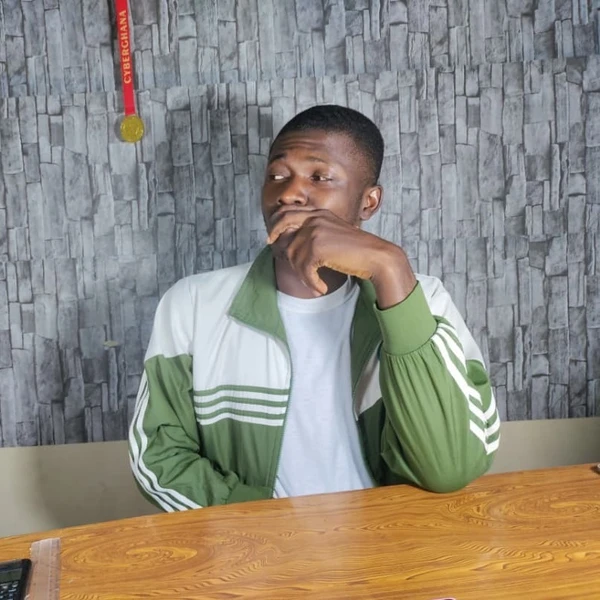
user profile avatar

Alex Nyanteng

1x

Finalist

1x

Winner

General information

Hobbies & Interests

  • Artificial Intelligence

Reading

  • Business

I read books daily.

Bio

CS@Beloit #fall26

Education

Beloit College

Bachelor's degree program

2026 – 2030

Majors:
  • Computer Science

Miscellaneous

Desired degree level:
Bachelor's degree program
Majors of interest:
Computer Science, Engineering Physics
Medical school interest:
No
English as first language:
No
Homeschooled:
No

Career

  • Mill Center Operator

    Agriculture · Time Mills Center

    Jan 2020 – Jan 2025

Miscellaneous

Dream career field:
Computer Software
Work experience:
2 years
Has nursing license:
No
Leadership experience:
Yes
Byte into STEM Scholarship
Growing up as the firstborn in Kwadaso, Kumasi, my journey has been shaped by a blend of quiet resilience, early curiosity, and an unwavering drive to solve problems through technology. From the day my father brought our first computer home when I was seven, the digital screen became my sanctuary, a place where I could experiment, break things, and rebuild them without judgment, especially during moments when physical and academic environments felt overwhelming. My character was rigorously tested during my years at St. Hubert Seminary, where balancing the intense demands of a General Science curriculum, strict seminary routines, and the social hurdles of boarding school pushed me to my limits. Yet, it was also where I found my footing, serving as vice president of the Cybersecurity Club, leading robotics introductions, and learning that setbacks are never permanent stop stones. Whether it was recovering from the quiet failure of my early NSMQ livescore app or pushing through the grueling uncertainty of studying for the SAT and navigating university admissions during a gap year, I learned that true resilience is built by showing up consistently, embracing failure as a debugging phase, and refusing to let your starting point dictate your destination. That resilience directly fuels my passion for computer science and software engineering. Coming from an environment where resources were often tight and navigating academic pathways felt like walking through a maze blindfolded, I experienced firsthand how much brilliant potential gets lost simply due to a lack of guidance. This realization inspired my work on projects like Career Path AI and Lunar AI, platforms designed to use artificial intelligence and web technology to democratize educational access and create structured roadmaps for students. Technology is the most powerful leverage tool we have to bridge opportunity gaps and turn personal struggles into public solutions. Pursuing a Bachelor of Science in Computer Science at Beloit College is the vital next step in transforming that vision into reality. College will provide me with the rigorous academic foundation, architectural depth, and collaborative environment needed to move beyond self taught basics and engineer scalable, production grade systems. I plan to use this education to build intelligent educational technologies and digital infrastructure that act as pocket tutors and career roadmaps for students in underfunded regions. Ultimately, my goal is to dedicate my career to mentorship, innovation, and community upliftment. I want to build software systems that illuminate pathways for others, ensuring that no matter where a student starts, they have the digital tools and guidance they need to reach their highest potential.
Chadwick D. McNab Memorial Scholarship
For a long time, my relationship with technology was purely about exploration, starting from the day my father brought home our first computer back in Kwadaso. In those early years, I discovered a profound sense of safety inside the screen. While sports like football repeatedly brought pressure and awkward failure, computers offered a private sanctuary where I could experiment, break things, and learn without feeling judged. That early curiosity eventually evolved into a serious passion during the COVID-19 lockdown, when I began teaching myself programming languages like Python, HTML, CSS, JavaScript, and PHP, moving from a passive consumer of technology into an active creator. The project that truly captured my heart and tested my limits, however, came after I stepped out of the rigid seminary walls of St. Hubert Seminary. High school had been a grueling trial of balancing General Science coursework, surviving bullying, dealing with strict school rules, and pouring my energy into leading the Cybersecurity Club as vice president. Right after completing my WASSCE, I wanted to solve a problem that felt deeply personal to my peers: tracking the National Science and Math Quiz. I built a dedicated NSMQ live score web and mobile application complete with embedded live streams. Despite my efforts promoting it through Telegram channels, the platform only pulled in about twenty visitors and quietly failed. That defeat stung, but it taught me an invaluable lesson about real-world development and market alignment. Refusing to let that stop me, I teamed up with collaborators like Victoria during my gap year to dive into hackathons. Together, we built **Career Path AI**, a full-stack platform leveraging the Google Gemini API to assess students' interests, strengths, and academics, subsequently generating personalized career roadmaps on a dynamic dashboard. Working virtually across distances to coordinate backend routes, frontend components, and API integrations was an intense exercise in resilience. Seeing the project come together and earn recognition proved that the setbacks of my past projects were merely stepping stones toward building more impactful systems. Working in technology inspires me because it serves as the ultimate equalizer and leverage tool. Coming from an environment where resources were tight and navigating academic pathways felt like moving through a maze blindfolded, I experienced firsthand how much brilliant potential gets lost without guidance. Technology gives a person sitting anywhere in the world the power to engineer solutions that democratize access, illuminate pathways, and solve human problems at scale. It teaches you that failure is never a permanent stop sign, but rather a debugging phase for your mindset. Whether I am writing full stack web applications, exploring AI integrations, or preparing to dive deeper into computer science at Beloit College, I am driven by the belief that code is a medium to turn our hardest struggles into bridges for others.
Dr. Christine Lawther First in the Family Scholarship
For many students, entering higher education is simply the next expected step in a lifelong path. But for me, as the firstborn in my family and the first to step onto a college campus to pursue a degree, it represents something far heavier and more profound: it is the realization of a future built through resilience, sacrifice, and an unyielding refusal to let our starting point dictate our destination. Growing up in a household where my father worked hard away from home and my mother kept our daily lives steady, I watched my family pour everything they had into giving my brothers and me a fighting chance. Earning a college degree means validating every single sacrifice they made. It means breaking cycles, reshaping what is possible for the next generation behind me, and proving that the long, winding road from a small classroom in Kumasi all the way to Beloit College was entirely worth fighting for. At Beloit College, I want to pursue a Bachelor of Science in Computer Science. Technology has been my sanctuary and my greatest lever for change ever since my family brought home our first computer when I was a child. Programming taught me that I didn't have to passively accept the limitations around me, I could build tools, break down complex problems, and create systems from scratch. In college, I want to dive deep into software engineering, artificial intelligence, and data systems, moving far beyond the self-taught basics I relied on while building full-stack applications like Career Path AI and Lunar AI. I want to understand the rigorous architecture behind software so I can transform my ideas into scalable, real-world solutions. Looking toward the long term, my ultimate goal is to bridge the opportunity gap in education and digital infrastructure for underfunded regions. Coming from an environment where resources were scarce and navigating academic pathways felt like moving through a maze blindfolded, I experienced firsthand how much brilliant potential gets lost simply due to a lack of guidance and access. My career goal is to build intelligent educational technologies and digital platforms that act as pocket tutors and roadmaps for students who face those same barriers. Whether through engineering software that transforms messy study notes into interactive learning paths or creating digital tools that empower local communities, I want to spend my life building bridges where there used to be walls. I want my code, my career, and my care for others to leave a lasting, positive footprint on the world.
Kyle Lam Hacker Scholarship
For a long time, my tinkering happened entirely in solitude, quietly breaking and rebuilding lines of code on my first computer or spending hours setting up development environments late into the night. But the moment my technical experimenting truly delighted and surprised others happened during my final year at St Hubert Seminary, when I brought a homegrown robotics build to school and presented the entire project in front of the entire student body and our rector. In an environment defined by rigid daily routines, intense academic pressure, and strict seminary rules, seeing a physical machine come to life and respond to code was a radical shift for everyone watching. I had spent weeks troubleshooting wiring issues, testing microcontrollers, and refining the software during every spare moment I could carve out between classes and chores. When I finally stood before my peers and teachers to demonstrate what the robot could do, the initial skepticism in the room instantly turned into genuine awe and excitement. Classmates who had previously only known me as the quiet computer guy suddenly crowded around to see how it worked, asking questions, testing the controls themselves, and looking at technology through a completely new lens. Even our rector was deeply impressed, pulling me aside afterward to tell me that if I kept working at that level, I could go far. That experience changed how I viewed my tinkering. Up until that point, programming and building hardware had simply been my personal sanctuary—a safe space where I could experiment without social pressure or fear of failure. But standing in front of that school assembly showed me that technical skills carry an entirely different kind of power when shared. Technology has the unique ability to break through monotony, spark sudden curiosity, and make people believe that complex things are suddenly within their reach. That joy of watching others light up when code and hardware come alive is what continues to drive my projects today. Whether I am building full stack web applications like Career Path AI, developing tools like Lunar AI to help students generate practice quizzes from messy notes, or brainstorming digital solutions for local communities, I always carry that lesson with me. Tinkering is not just about personal satisfaction or solving isolated technical puzzles. It is about building bridges that connect people to new possibilities, turning abstract concepts into tangible reality, and using what you create to bring a sense of wonder into the lives of the people around you.
Bulkthreads.com's "Let's Aim Higher" Scholarship
For a long time, my relationship with technology was purely about exploration—typing lines of code, breaking systems, and rebuilding them just to see how they worked. But as I grew older and navigated the complexities of life, my definition of building shifted from tinkering with software to engineering solutions that directly impact human lives. What I want to build more than anything is a comprehensive, AI powered educational infrastructure designed to bridge the opportunity gap for students in underfunded regions. Coming from an environment where resources were tight, textbooks were scarce, and navigating complex academic pathways often felt like walking through a maze blindfolded, I experienced firsthand how much potential is lost simply due to a lack of access. Talented students everywhere possess brilliant minds, but without personalized guidance, structured roadmaps, or accessible mentors, their aspirations often stall before they truly begin. This reality is what fueled my work developing applications like Career Path AI and Lunar AI, and it is the driving force behind my vision for the future. The platform I aim to build is an intelligent digital ecosystem that transforms raw educational content—such as lecture notes, textbook chapters, and syllabus outlines—into dynamic, interactive learning paths, customized practice quizzes, and real time mentorship frameworks. By leveraging modern web technologies and AI integration, this system will function as a pocket tutor for students who cannot afford private coaching, adapting to their unique learning paces and illuminating pathways toward higher education and technical careers. Building this future will fundamentally transform both my own life and my community. Personally, it gives my technical skills a deeper purpose, anchoring my career in a mission far larger than writing code for its own sake. It turns my past struggles with educational navigation into a blueprint for others. Communally, the positive impact is scalable and generational. When you equip a student with the tools to master complex subjects, understand career options, and access global opportunities, you do not just change an individual trajectory , you uplift entire families and local economies. Ultimately, building this future is my way of honoring every closed door I once faced. I want to spend my life engineering bridges where there used to be barriers, ensuring that no matter where a student starts, they have the digital infrastructure and guidance they need to reach their highest potential.
Aaron B. O’Reggio - Young, Gifted, & Black Scholarship
Integrity means doing what is right even when nobody is watching, and letting your actions match your words when the pressure is highest. To me, it is the invisible foundation beneath every meaningful choice, keeping you anchored when circumstances push you to take shortcuts or compromise your principles. It is about honoring commitments to yourself and others, remaining honest when facing failure, and refusing to sacrifice your character for convenience or temporary ease. My core values of resilience, curiosity, and responsibility have been the compass guiding me through some of the most difficult chapters of my life. Growing up as the firstborn in a household where my father spent years working away in Israel while my mother held down the center taught me early on that stability is something you build through consistent effort rather than something you are simply given. When family life grew complicated, when resources were tight, and when navigating school felt like an uphill battle, those values kept me moving forward. They played a defining role when I faced grueling semesters at St. Hubert Seminary, where balancing strict routines, rigorous coursework, and self-taught software development tested my limits. Instead of giving up when academic pressure mounted, my sense of responsibility pushed me to keep showing up, mentor others in tech, and build tools like full stack applications that could genuinely help people. That same resilience carried me through the grueling uncertainty of studying for the SAT, weathering university rejections, and fighting for a way forward when the path to studying abroad seemed completely blocked. Maintaining personal integrity meant holding onto my ambition and refusing to let discouraging circumstances dilute my drive to learn and grow. In my journey with technology and content creation, integrity has meant taking full responsibility for the code I write, the projects I build, and the communities I engage with. Whether I was leading the Cybersecurity Club, developing Career Path AI, or organizing my daily studies, I learned that cutting corners ultimately leaves you with fragile systems. Real progress requires the discipline to do things the right way, even when no one is grading your process. Ultimately, my core values have taught me that challenges are not stop signs, but tests of character. By holding fast to honesty, grit, and a deep desire to use my technical skills to uplift others, I have been able to turn setbacks into stepping stones. I carry those values into everything I build today, knowing that true success is measured not just by what you achieve, but by the integrity you maintain while getting there. Character is forged in the quiet moments of struggle, and the choices we make when the lights are off ultimately define who we become when we finally step into the light.
Jessica's Journey Brain Tumor Survivor Scholarship
Growing up, I never imagined that my biggest battle would be fought inside my own mind. At eighteen, right when I was stepping out of the rigid walls of boarding school and looking forward to university, everything stopped. Doctors discovered a brain tumor. Hearing that diagnosis felt like the ground instantly vanishing beneath my feet. In an instant, the plans I had made for my future, the coding projects I was building, and the quiet dreams I held close became entirely secondary to the fundamental question of whether I would survive. The most defining and terrifying moment of my journey came the night before surgery. Lying in the hospital room, staring up at the white ceiling with the scent of antiseptic hanging heavy in the air, the fear was paralyzing. I realized then that my life could be cut short before I ever really got to build the things I dreamed of. But in that absolute stillness, a quiet resilience took root. I decided right then that if I woke up from the operating table, I would not waste a single day. Surviving that surgery did not just mean beating a disease; it meant waking up with an unshakeable urgency to live purposefully, to create, and to leave something meaningful behind in the world. That survival shaped every ambition I hold today. As I step onto the campus of Beloit College to pursue my education, my goals are deeply rooted in using technology to solve human problems and empower others who face steep barriers. I want to build software systems and educational tools that bridge gaps, making resources accessible to people who might otherwise be left behind. Having faced mortality at such a young age, I know how precious time is, and I want to dedicate mine to engineering solutions that genuinely help people. This scholarship would be a profound lifeline in making those goals a reality. Navigating the financial realities of higher education after enduring significant medical challenges has placed a heavy burden on my family. With your support, the financial weight would lift, allowing me to pour all my energy into my coursework, my development projects, and my studies at Beloit rather than worrying about how to make ends meet. This award would not just fund my tuition; it would honor the second chance I was given, empowering a survivor to turn his scars into software that uplifts others.
Raise Me Up to DO GOOD Scholarship
Growing up as the firstborn in a household where my father spent years working away in Israel while my mother held down the center taught me early on that stability is something you build, not something you are simply given. When my father traveled abroad for work around 2016, our family dynamic shifted. My mother balanced the daily rhythms of running our home in Kwadaso, while my younger brothers, Obed and Simon, looked to me to help steady the house. Those years of managing school, helping out at my fathers corn mill center during vacations, and navigating the friction of a crowded, changing home environment stripped away any illusion that success happens by accident. It takes intentional effort, resilience, and an unflinching willingness to keep showing up even when the path ahead is unclear. That early exposure to responsibility directly shaped how I approach technology and problemsolving today. When my family bought our first computer, I didnt just consume media; I took it apart, typed until my fingers memorized the layout, and eventually taught myself how to build software. Programming became my personal sanctuary, a place where failures didnt carry social penalties, and where I could experiment, break things, and rebuild them better. Whether I was studying Python and JavaScript during COVID-19, leading the Cybersecurity Club at St. Hubert Seminary, or developing full-stack applications like Career Path AI, I realized that technology is the most powerful leverage tool we have to solve human problems at scale. Looking toward the future, I don't have every job title mapped out, but I know the exact kind of impact I want to make. I envision a future where I use my technical talents to build systems that democratize access to education, mentorship, and economic opportunity for students in developing regions who face the exact same barriers I did. Coming from a background where resources were tight and navigating opportunities felt like navigating a maze, I want to engineer platforms that illuminate the path for others. Whether through building intelligent educational tools that make learning accessible to underfunded schools or creating digital infrastructure that empowers local businesses, my goal is to turn my technical skills into practical, everyday relief for people. Ultimately, the long way I've traveled—from a small classroom in Kumasi and grueling semesters at a seminary to earning scholarships and building software—has taught me that resilience is a renewable resource. I carry the lessons of my family's grit into everything I build. I want to spend my life proving that where you start does not dictate how far your code, your ideas, and your care for others can reach.
Sherman S. Howard Legacy Foundation Scholarship
For three years at St. Hubert Seminary, I served as an altar server. Some weeks we had Mass once a day. Other weeks, especially during feast days or special observances, it was two or three times. I would put on the cassock, carry the candles, ring the bell at the right moment, and stand close to the altar knowing that if I moved too early or too late, the whole rhythm of the Mass would feel off. It sounds like a small job. In many ways it was. But doing it, over and over, for three years, changed something in how I understand what it means to serve people. The first thing altar service teaches you is that showing up does not depend on how you feel. There were mornings I walked into chapel exhausted, worried about an exam, or carrying something heavy from home that I had not told anyone about. None of that mattered once I stepped up to serve. The people in the pews had come to pray, and my job was to make sure the service moved the way it was supposed to, without anyone noticing me at all. I was never the center of attention. I was the one making sure everything else worked. Learning to find purpose in a role nobody is watching is one of the harder lessons a teenager can learn, and I learned it slowly, Mass by Mass. That lesson followed me outside the chapel walls. I began to notice the same instinct showing up in ordinary parts of my life at school. When a classmate was stuck on an assignment, I helped without expecting anything back. When people needed something fixed on a computer, or typed, or figured out, I was the one they came to, and I did it because it needed doing, not because I wanted credit for it. I did not think of these as acts of service at the time. Looking back now, I can see they came from the same place the altar had built in me: be useful, be present, and do not wait around to be thanked for it. Serving Mass also taught me something about consistency that I did not appreciate until much later. You do not get to serve well only on the days you feel like it. You show up because the moment is not about you, and other people are depending on the routine holding steady. That kind of consistency is exactly what real service to a community requires. It is rarely dramatic. Nobody claps for the person who shows up quietly, week after week, doing the same unglamorous work. But that steady, unnoticed effort is often what actually holds a community together. I want to be honest here. My relationship with faith has not always stayed strong. As I got older and life became heavier, with school pressure, family responsibility, and the long fight to build a future for myself, there were seasons where I struggled to feel as close to God as I did back when I was a boy standing next to the altar. But even in those harder seasons, the things that serving planted in me never fully disappeared. The habit of helping without needing recognition. The patience to keep showing up even when nobody is watching. The belief that real strength often looks quiet, not loud. Looking back, serving at the altar wasn't really about the candles or the bell. It shaped who I am today: someone who shows up for others reliably and humbly, without needing to be seen.
Champions Of A New Path Scholarship
From young age I feel I am different from other students. I always believe I can achieve big things if I work hard. This strong feeling inside me push me to lead and win in coding. That is why I think I deserve this scholarship more than others. In my school I face many challenges. My family have money problems and my parents work very hard every day. They never get chance for higher education. But they always tell me to study well. I keep my GPA above 3.0 even when I feel tired. Many students stop their college dream because of high cost. I do not want to be like that. I want to continue my education in technology field. What give me advantage against everyone else is my leadership and real achievements in coding. I was the president of coding club at my school. I organize meetings every week and teach other students how to code. I help them solve problems and build small projects together. Under my leadership the club grow bigger and many members win small competitions. Also I become cyber champ medallist. I compete against hundreds of students and win medal because of my skills in cybersecurity. These experiences teach me how to work hard and help others at the same time. I know many applicants have good grades. But I have something more. I already show ambition and drive through my actions. I use coding to solve problems in my community. For example I create simple programs to help track school attendance and I teach younger kids basic computer skills. I believe technology can open new path for students from poor families like mine. My dream is to study more in college and create tools that make education easier for everyone. I want to become a leader who bring positive change. If I receive this scholarship it will help me a lot. It will reduce my financial stress so I can focus on my studies and continue my coding work. I will not worry too much about money and I can join more projects in college. This support will allow me to keep my path strong and achieve my goals. I am determined to make my family proud and inspire other students. I am not the best yet but every day I work to become better. Receiving this scholarship will prove that my efforts are noticed. It will give me chance to continue learning and create impact in the world. Thank you for reading my essay. I hope you choose me.
Chris Jackson Computer Science Education Scholarship
My interest in Computer Science started during my time at St. Hubert Seminary Senior High School in Kumasi, Ghana. As the President of the Coding Club, I saw how difficult it was for students to check their exam results. We had to queue for hours under the hot sun just to see our WASSCE(West African Senior School Certificate Examination) mock or end-of-term results because the school only posted papers on notice boards. This problem frustrated everyone. Instead of just complaining, I decided to do something about it. I taught myself to code and built a simple web application using ReactJS and a basic backend. Students could now login with their index number and check their results privately on their phones. Seeing my classmates use the system and feel relieved gave me real joy. That moment made me realize the power of technology to solve everyday problems, especially in places like Ghana where resources are limited. This experience pushed me to pursue a Computer Science degree so I can build more useful tools that help my community and beyond. My admission to Beloit College with the Eaton Scholarship has now given me the perfect opportunity to turn this passion into a real career. After getting my Computer Science degree from Beloit College, my dream is to become a Software Engineer who creates technology solutions for education and development in Africa. I want to build affordable digital platforms that solve real problems like better school management systems, online learning tools for students in rural areas, or mobile apps that help small businesses in Ghana. My long-term goal is to return to Ghana (or work across Africa) and start a tech company that focuses on education technology. I want to help reduce the gap between urban and rural students by making information and opportunities more accessible. Ultimately, I hope to become someone who uses technology to create jobs and improve lives in my country, just like how my small results-checking system helped my schoolmates. I believe I am a strong candidate for this scholarship because I have already shown that I can identify problems and create solutions with very limited resources. As Coding Club President in Ghana, I didn’t wait for anyone to solve the results-checking proble. I built the system myself. This shows my determination, leadership, and practical skills. I am also an incoming student at Beloit College on the competitive Eaton Scholarship, which proves my academic ability. Coming from Ghana, I bring a unique international perspective and a strong desire to use technology for social good. I am hardworking, I don’t give up easily, and I am ready to make the most of every opportunity. This scholarship will help reduce my financial burden so I can fully focus on my studies and continue building impactful projects. I am committed to using whatever support I receive to grow and give back to my community.
S3G Advisors NextGen Scholarship
Winner
As the Coding Club President at St. Hubert Seminary Senior High School in Kumasi, Ghana, I faced one big problem that was affecting all of us students every term. After we finish major exams like the WASSCE(West African Senior School Ceritifcate Examination) mocks or end-of-term tests, students had to go and queue for long hours at the administration block just to check their results. The school office will print the results on big papers and paste them on the notice board. But many times the lists were not complete, they come late, or the rain will spoil the paper. Some students even travel from far hostels only to reach there and the results are not yet ready. We used to miss our meals and afternoon classes because of this. Standing in the hot sun for hours was really frustrating and it made us feel anxious. It was hard to know how we were doing in our studies. I wanted to change this situation. Since I was the president of the coding club, I decided to build a simple web application for students to check their results easily. I used ReactJS for the front end and a basic backend. Students could just login with their index number and see their results private on their phone. I started small. First I made a prototype during our club meetings and tested it with some of my close friends. After that I went to the ICT teacher and begged him to allow me demonstrate it to the administration. What worked well was the speed and convenience. Once the data was uploaded, students could check their results instantly without any queuing. Many of my classmates started using it and they gave me positive feedback. Some even told me it saved them a lot of time and stress. But what didn’t work at first was that the school administration was scared to give me the full results database because of privacy. So I had to enter sample data manually at the beginning. Also, not every student had good internet or smartphones, so some people still couldn’t use it properly. If I get the chance to do it again or improve it, I will work closely with the school to make it an official and secure platform that connect directly with their system. I will add new features like result trend tracking and send notifications to students when results are ready. This whole experience taught me that technology can really solve real problems especially in places like Ghana where resources are limited. It has made me even more determined to study Computer Science at Beloit College so I can create more useful tools that help people in my community and beyond.
Alex Nyanteng Student Profile | Bold.org