
Hobbies and interests
Athletic Training
Alejandro Colón Dávila
1x
Finalist1x
Winner
Alejandro Colón Dávila
1x
Finalist1x
WinnerBio
My name is Alejandro Colón Dávila, a third-year Microbiology and Pre-Med student at the University of Puerto Rico at Arecibo, maintaining a 4.0 GPA while pursuing a path toward neurosurgery. Beyond the classroom, I’m driven by a conviction that excellence requires building systems whether in academics or athletics. As captain of my university Olympic Weightlifting Team, I lead both by example and through intentional mentorship.
I tutor mathematics in my campus with the same rigor I bring to my own studies, having helped dozens of students master concepts they thought were impossible. My work extends into undergraduate research, where I collaborate with neurosurgeons in Puerto Rico on projects examining neurological systems and surgical approaches. I’ve also conducted significant academic research using metapopulation modeling and have been accepted to international internships in the United States and Europe.
I do volunteering work with the Korean Foundation of Puerto Rico, investing in communities beyond my own. I’m currently preparing intensively for my MCAT exam and building custom educational tools, like an interactive mathematics study portal I created specifically for student success.
I believe that becoming a neurosurgeon means more than technical skill, it requires deep intellectual curiosity, cultural humility, and an unwavering commitment to lifting others up. That’s the person I’m building and that’s the doctor I intend to be.
Education
University of Puerto Rico-Arecibo
Bachelor's degree programMajors:
- Microbiological Sciences and Immunology
Brigida Alvarez Rodriguez
High SchoolMiscellaneous
Desired degree level:
Doctoral degree program (PhD, MD, JD, etc.)
Graduate schools of interest:
- University of Puerto Rico-Medical Sciences
Transfer schools of interest:
Majors of interest:
Career
Dream career field:
- Medicine
Dream career goals:
Calculus Tutor
University of Puerto Rico in Arecibo2024 – Present2 years
Sports
Weightlifting
Varsity2021 – Present5 years
Awards
- MVP of the weightlifting team 2025-2026 award May 2026 UPRA Athlete with best GPA recognition April 2026 Three silver medals at the national Luigi Memorial weightlifting tournament April 2026 One gold medal at the national youth weightlifting tournament September 2025 Two bronze medals at the national Luigi Memorial weightlifting tournament April 2025 Gold medal at the Cacique Sports Games August 2023
Research
Biomathematics, Bioinformatics, and Computational Biology
University of Puerto Rico in Arecibo in collaboration with University of Puerto Rico in Mayagüez and University Espíritu Santo in Ecuador — Interpretation of statistical results, assessment of clinical data and construction of differential equations2025 – PresentMathematics and Statistics, Other
University of Puerto Rico in Arecibo in collaboration with University of Puerto Rico Medical Sciences — Providing statistical results and generating colorimetric maps programming in R studios2026 – PresentBiomathematics, Bioinformatics, and Computational Biology
University of Puerto Rico in Arecibo — Assessing the original data set, provide statistical data programming in R studios and interpretation of results2026 – PresentMathematics and Statistics, Other
University of Puerto Rico in Arecibo in collaboration with University of Puerto Rico Medical Sciences — Interpreting and providing statistical data programming in R studios2026 – Present
Public services
Volunteering
KFPR Foundation — Scholarship Recipient2024 – Present
Future Interests
Advocacy
Volunteering
Philanthropy
Entrepreneurship
Learner Calculus Scholarship
I will be honest: for a long time, I did not think calculus mattered. I was good at it, but I treated it like a set of rules to memorize, derivatives here, integrals there, without ever asking what it was actually for. It felt like abstract machinery with no connection to the real world I cared about. That changed completely, and it changed because I started teaching it.
As a university-hired and private math tutor, I had to explain calculus to students who asked the exact question I had never bothered to answer: "When am I ever going to use this?" The first time I taught optimization, something clicked. I was showing a student how to optimize a pool with some specifications, and suddenly I saw it everywhere, in how a company minimizes cost, how a body regulates itself, and how nature settles into the most efficient path. Calculus was not a set of rules. It was the mathematics of change and the mathematics of finding the best possible outcome, and almost every problem worth solving in science is a problem of change or optimization. Explaining it to someone else forced me to finally understand it myself.
But the moment calculus became undeniable for me was in the laboratory. As part of my research, my team built a mathematical model of MRSA transmission in hospital settings, studying how this dangerous bacterium spreads between patients and healthcare workers. To do it, we had to construct a system of differential equations describing how the infection moves through a population over time. When I first saw those equations, I did not panic, because the foundation calculus had given me let me read them, understand what each rate of change represented, and interpret what the model was telling us. Without calculus, those equations would have been meaningless symbols. With it, they became a tool that could predict outbreaks and test interventions before a single patient was ever put at risk.
That is why I believe calculus is essential to STEM: it is the language we use to describe a world that never stops changing. Biology, epidemiology, engineering, physics, economics, none of them are static. They are all systems in motion, and calculus is how we capture that motion with precision. A differential equation can model the spread of a disease, the growth of a tumor, the trajectory of a spacecraft, or the flow of current through a circuit. Beyond the applications, calculus trains the mind. Working through limits, continuity, and the logic behind each theorem taught me to think critically and to break impossible-looking problems into solvable pieces, a habit that serves me in every field I touch.
I am a microbiology and pre-med student on a path toward neurosurgery and medical research, and I used to think calculus belonged to engineers and physicists, not to me. I was wrong. The same mathematics that models an epidemic will one day help me understand the systems of the human body I hope to treat. Calculus is not a hurdle to clear on the way to a STEM career; it is the foundation that the entire structure stands on. I learned to respect it the hard way, and now I cannot imagine doing science without it.
Henry Respert Alzheimer's and Dementia Awareness Scholarship
WinnerThe first time my grandfather forgot my name, I didn't imagine that he would become a child just like me. Alzheimer's disease was already taking him, and over the months that followed, I watched it take everything: his memories, his words, and finally his recognition of me. I watched him forget who I was. I watched myself stop being a child in his eyes as he slowly became one himself. Loving someone with Alzheimer's means grieving them twice: once as their mind leaves, and again when their body finally does.
For a long time, I didn't understand clearly what was happening to him. As a family, we noticed the small things first, the repeated questions, the misplaced objects, the stories of the old days. We made excuses for each one because admitting the truth felt like surrendering him prematurely. But Alzheimer's does not wait for a family to be ready. It advances quietly and then all at once, and by the time we fully accepted the diagnosis, the man who had helped raise me was already slipping beyond our reach. I saw him die; he forgot how to breathe on his own, and there I stood, watching him agonize while I was trying to call 911.
That experience changed the direction of my life. When he passed away, I made a promise to study the brain to the fullest of my ability, so that other families might be spared the slow, helpless loss that mine endured. For me, that promise points directly toward a career in neurosurgery and toward research into Alzheimer's disease. I do not want other grandchildren to sit across from someone they love and realize they have become a stranger. I do not want other families to feel as powerless as we did, watching, waiting, and hoping for answers that medicine could not yet give us.
What Alzheimer's taught me, above all, is that this disease is not only a medical problem, it is a human one, and it is far larger than any single family. In Puerto Rico, where our population is aging rapidly, and access to specialized neurological care is limited, families like mine often confront dementia with too little support and too few answers. Many caregivers are relatives with no medical training, doing their best out of love while the healthcare system around them struggles to keep pace. Seeing that reality up close convinced me that awareness and research are not abstract academic goals; they are urgent, personal needs. There is still so much we do not understand about what causes Alzheimer's, how it progresses, and how it might one day be slowed or stopped, and every gap in that knowledge is measured in families like mine.
I have tried to turn that conviction into action rather than let it remain a wish. I am currently a junior at the University of Puerto Rico at Arecibo, pursuing a bachelor's degree in microbiology while maintaining a 4.0 GPA. To push myself further, I am taking an immuno-oncology course through Harvard Medical School, a demanding class that has taught me how diseases operate at the cellular and molecular level, and how researchers translate that understanding into treatments. That framework is exactly what fields like Alzheimer's research demand: patience with complexity, comfort with uncertainty, and a willingness to chase questions that do not yet have answers.
Beyond the classroom, I am part of four research projects, several of them in collaboration with hospitals and neurosurgery departments, all aimed at producing work that genuinely helps the people of my island. My love of mathematics led me to combine biostatistics and computational modeling with the applied sciences connected to my major, because I believe the future of medicine will be built at the intersection of biology, data, and human insight. Each of these projects is, in its own quiet way, a continuation of the promise I made at my grandfather's bedside. When I analyze data late at night or troubleshoot a model that will not converge, I am not only chasing a publication, I am chasing the possibility that research like this might one day spare another family the grief mine lived through.
Alzheimer's also taught me lessons that no laboratory or textbook ever could. I learned that caring for someone is not always about fixing them; sometimes it is about staying, listening, and preserving their dignity when the disease tries to strip it away. I learned patience, because rushing him only deepened his confusion and fear. I learned presence, because the moments when I simply sat with him mattered more than anything I could say. And I learned that medicine, at its core, is as much about compassion as it is about cures. A physician who understands the science but forgets the person has only done half the job. My grandfather made sure I would never forget the other half.
There is a particular clarity that comes from watching a disease take someone you love and being unable to stop it. It removes any doubt about why the work matters. I have met classmates who are still searching for their reason to endure the long, punishing road toward medicine. I am fortunate, in a painful way, to already know mine. My reason has a face, a voice I still remember, and a name I will carry into every operating room and every research lab I ever enter.
My grandfather did not live to see who I am becoming, and he never will. But every exam I study for, every research project I pursue, and every step I take toward neurosurgery is shaped by his memory. I am not a waiter, I am a doer, and I refuse to let his suffering be meaningless. No one believed I could accomplish much of what I have already done, yet I have learned that determination turns grief into purpose and obstacles into direction. If I can spend my career advancing our understanding of Alzheimer's, treating the patients this disease and others like it produce, and raising awareness in a community that desperately needs it, then the loss my family endured will have planted something that outlives it. That is the difference I intend to make. It began with him, and I intend to honor him with everything I build.
Maxwell Tuan Nguyen Memorial Scholarship
What inspired me to pursue medicine did not come from a textbook. It came from watching my grandfather disappear.
I witnessed his death from Alzheimer's disease. I watched him forget who I was, and I watched myself stop being a child in his eyes as he slowly became one himself. When he passed away, I made a promise: I would dedicate myself to studying the brain to the fullest of my ability. For me, that promise points directly toward a career in neurosurgery and research into Alzheimer's disease. I want to understand the organ that took my grandfather long before his body was gone, and I want to spare other families from that same slow loss.
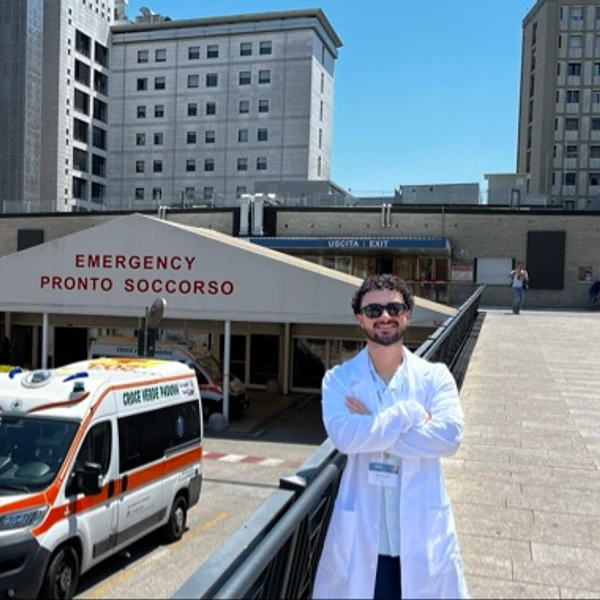
I am currently a rising senior at the University of Puerto Rico at Arecibo, pursuing a bachelor's degree in microbiology while maintaining a 4.0 GPA. I am also taking an immuno-oncology course through Harvard Medical School, an extremely demanding class that I intend to pass with honors, because challenging work today is what prepares me for the responsibility of caring for patients tomorrow. Alongside my studies, I am working on four research projects that I hope to publish soon, in collaboration with hospitals and neurosurgery departments, so that our work has a real impact on the people of Puerto Rico. This past summer, I completed a clinical shadowing internship in Padua, Italy, through the JoinAtlantis Program, where I rotated through several specialties and learned firsthand about medicine in a different culture. Each of these experiences has only deepened my conviction that medicine is where I belong.
Service has been just as formative as science. I volunteer with the Korean Foundation of Puerto Rico, where I tutor underprivileged children on the island in mathematics. Sitting with a child who believes they are "bad at math" and watching that belief dissolve has taught me the same lesson that medicine demands: people heal and grow when someone takes the time to understand them and refuses to give up on them. That same conviction drives my long-term goals. As both a university-hired tutor and a private tutor, I have seen the difficulties students on my island face, and I refuse to accept that talent should go to waste for lack of guidance. That is why I am building an online platform to connect with the many students who need help. I am only one tutor, but the right tool could multiply my impact enormously, and I have already begun creating it.
My long-term goal is to graduate from medical school, complete a neurosurgery residency, and become a proficient neurosurgeon for my country, Puerto Rico. I plan to make a difference in three ways: as a surgeon who treats the patients in front of me, as a researcher who fights diseases like Alzheimer's that steal people from their families, and as a mentor who opens doors for the next generation of Puerto Rican students. To me, these are not separate dreams; they are one mission seen from three angles.
I am not a waiter, I am a doer. No one believed I could start my university's weightlifting team from nothing, yet we did, and today I lead it as captain. My research once seemed beyond my reach, and now it is close to publication. I only need time and opportunity, and I treat every opportunity I am given as something to pass on to others. Investing in my education is an investment in every future patient I will treat and every student I will lift along the way.
Christian Fitness Association General Scholarship
I am a driven student who is constantly seeking new challenges. I have a talent for generating ideas from scratch, and over the years, I have learned never to place limits on my imagination. I have been a competitive weightlifter since 2021, and although several universities offered me athletic scholarships, I chose the University of Puerto Rico at Arecibo because of its outstanding bachelor's program in microbiology. The only obstacle was that the university did not have a weightlifting team, but for me, obstacles like this are simply opportunities in disguise.
I decided to build a team from the ground up, a feat that would not have been possible without the guidance of my coach. Together, we convinced the institution's athletic director to support us, and despite the initial skepticism and the many setbacks we encountered, the University of Puerto Rico at Arecibo weightlifting team has since become one of the most decorated programs on campus. The team has earned multiple medals at both the national and collegiate levels. Today, I serve as team captain, and I have had the privilege of witnessing the impact we have had on students who once doubted their own abilities and have since become medal-winning athletes. On a personal level, I have earned several medals and accolades, most notably the team's Most Valuable Player award in 2026 and the distinction of being the athlete with the highest academic average in the entire institution, maintaining a 4.0 GPA.
My commitment to excellence extends well beyond athletics. My creativity and my ability to develop ideas spontaneously help me stand out in my research. I have always loved mathematics, so I set out to combine biostatistics and computational mathematics to conduct research in the applied sciences connected to microbiology, my major. One of my professors believed in me early on, and today we are involved in four research projects, several of which include collaborations with other universities both nationally and internationally. We work alongside hospitals and neurosurgery departments to ensure that our efforts have a tangible, positive impact on the people of Puerto Rico and on the broader scientific community. Among these projects are studies on the impact of Hurricane Maria on the bacterial communities of livestock-farm soils, the geolocation of primary central nervous system tumors in Puerto Rico, and the mathematical modeling of MRSA transmission in hospital settings, work that sits at the intersection of medicine, mathematics, and public health.
I also use these gifts to serve others. I volunteer at the Korean Foundation of Puerto Rico, where I tutor underprivileged children on the island in mathematics, and I work as a tutor hired by the University of Puerto Rico at Arecibo. Teaching has taught me that knowledge is most valuable when it is shared, and I take pride in helping students realize that they are far more capable than they believe.
My willingness to take risks has opened doors I once thought were out of reach. During my freshman year, I was accepted into my first summer internship, the Summer Health Professions Education Program (SHPEP). I lived in Omaha, Nebraska, for four weeks, where I met people from many different backgrounds and explored a range of healthcare professions, including medicine, which remains my greatest interest. Later, in the summer of my junior year, I completed a clinical rotation program in Padua, Italy, through the Atlantis Program. During this experience, I rotated through several medical specialties and shared unforgettable adventures with my peers across Europe, an unparalleled chapter of my education.
I am an adventurous and ambitious student who pursues his dreams no matter how unlikely they may seem. No one believed I could start a university team from nothing, yet we did it. My research projects once seemed like far-fetched ideas, well beyond my reach, and today they are close to publication. Everyone assumed I would not be accepted into a summer internship as a freshman, but I believed in myself and was accepted. I was afraid of spending weeks in Europe rotating through an unfamiliar hospital on the other side of the world, but I ignored the doubt, and the experience proved to be one of the most rewarding of my life. Each of these milestones has reinforced a simple truth: adversity is not a wall, but a doorway.
You should not merely consider me for this scholarship; you should choose me for it. Investing in my future is an investment in the futures of many other students, because when I grow, those around me grow as well. With every opportunity I am given, I make a deliberate effort to pass it on, whether by mentoring my classmates or by showing them, through my own example, that if I can do it, so can they. I am a student who turns adversity into opportunity and who always finds a way forward, even when others try to convince me it cannot be done. Choosing me for this scholarship is an investment with guaranteed returns; my track record speaks for itself, and if I am given this opportunity, I will spend my career creating opportunities for others.