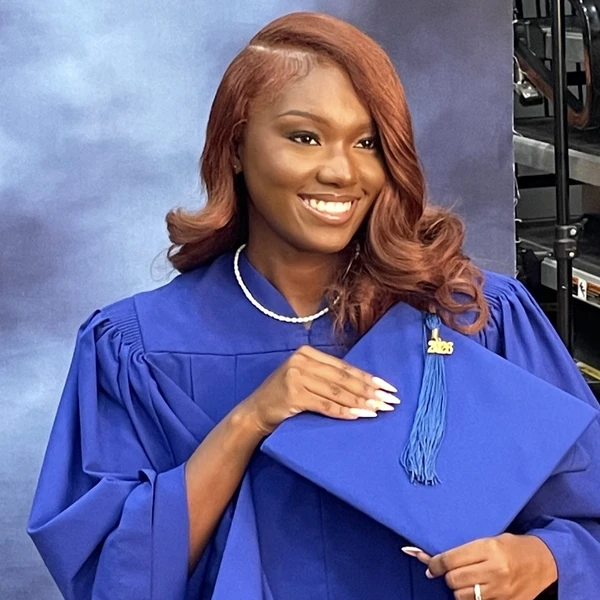
Alauni Billingslea
1x
FinalistAlauni Billingslea
1x
FinalistBio
“Strive as young attorney, my goal is to become a skilled advocate who not only excels in the courtroom but also uplifts the communities I serve. I want to use the law as a tool for equity, empower others through mentorship, and build a career that reflects both excellence and empathy.”
Education
Benjamin Banneker Hs
High SchoolMiscellaneous
Desired degree level:
Bachelor's degree program
Majors of interest:
- Law
Career
Dream career field:
Law Practice
Dream career goals:
Sports
Volleyball
Club2025 – 2025
Awards
- no
Public services
Volunteering
Court of Appeals - District of Columbia — Listen to various criminal cases2025 – 2025
Future Interests
Advocacy
Politics
Volunteering
Entrepreneurship
RonranGlee Literary Scholarship
“And when he remembered his old habitation, and the wisdom of the den and his fellow-prisoners, do you not suppose that he would felicitate himself on the change, and pity them? And if they were in the habit of conferring honours among themselves on those who were quickest to observe the shadows which passed, and to value the shadows more than the objects, would he not be astonished at their folly, and would he not count himself happier than any of them?”
—Plato, Republic, Book VII (Jowett translation)
Plato’s freed prisoner embodies the philosopher’s painful transformation from ignorance to knowledge and underscores the moral imperative to guide others toward enlightenment, even when that task brings misunderstanding and resistance.
The passage dramatizes the moment of recognition when the freed prisoner, now exposed to reality, recalls the false comforts of the cave. His felicitation—his profound relief and joy at no longer mistaking shadows for truth—illustrates that genuine knowledge is not neutral information but a deeply personal metamorphosis. Plato insists that intellectual awakening carries emotional weight; it is a release from self-deception that generates both elation and sorrow for those left behind.
This emotional duality reveals the philosopher’s plight: intellectual liberation breeds a sense of responsibility. In celebrating his newfound vision, the prisoner also pities his former companions, whose understanding remains chained. The pity he feels is not mere condescension but the recognition that others are trapped in the same illusions he once inhabited. Plato suggests that true wisdom is inseparable from compassion: to know reality is to feel compelled to relieve ignorance in others. Plato shifts from internal reflection to social duty by imagining the freed prisoner’s reaction to the honoured shadows. In the cave, prisoners reward those best at interpreting illusions—mistaking silhouettes for substance. The freed prisoner’s astonishment at this folly illustrates the moral chasm between appearance and truth. He cannot help but pity and oppose a system that prizes mere simulation over reality.
Here, Plato argues that philosophers must return to the cave despite discomfort and derision. The passage implies that leaving the cave does not absolve one of social bonds. On the contrary, emerging into the light intensifies the philosopher’s moral obligation: the knowledge that truth is transformative mandates sharing it, even when society rejects or ridicules such messengers. Plato’s underlying assertion is clear: intellectual virtue demands civic engagement.
This tension unveils the paradox at the heart of moral education. Real progress depends on breaking collective delusions—but collective delusions are defended by those who benefit from them. Plato’s freed prisoner must therefore accept alienation. His pity and astonishment are inseparable from a sense of loneliness. From this portrait emerges Plato’s warning: those committed to truth must endure misunderstanding and even hostility. Although Plato wrote over two millennia ago, his depiction of the liberated thinker resonates today. Social media and political rhetoric trap many in “caves” of tailored information and echo chambers. Those who break free—through critical thinking or inconvenient truths—often face backlash. Plato’s lesson reminds us that the pathway to meaningful discourse requires both intellectual rigor and empathetic outreach. The philosopher’s return to the cave parallels the challenge of honest public dialogue in the face of entrenched misconceptions.
Plato’s freed prisoner exemplifies the dual nature of enlightenment: personal joy tinged with sorrow for the unenlightened and a moral imperative to return and guide others. The passage underscores that knowledge divorced from compassion and civic responsibility is incomplete. By portraying the philosopher as both visionary and outcast, Plato crystallizes his central claim: true wisdom transforms the individual and obliges them to brave misunderstanding in the service of communal awakening for all.
Kalia D. Davis Memorial Scholarship
As a senior at Benjamin Banneker Academic High School from Lake Arbor, Maryland, and an aspiring attorney driven by a simple conviction: justice is strongest when everyone has a voice. Growing up, I saw how legal and economic systems could either support or sideline families like mine. That understanding fueled my dedication to academic excellence, community service, and mentorship—even when balancing rigorous coursework with part-time jobs to help cover household expenses.
Throughout high school, I channeled my passion for law into tangible action. I interned at the District of Columbia Court of Appeals, where I researched criminal appeals, observed oral arguments, and learned how appellate rulings cascade into everyday courtroom practice. Back home, I led “Know Your Rights” workshops at our community center, translating complex legal procedures into interactive lessons so neighbors could advocate for themselves. I also coached mock-trial teams and organized anti-bullying campaigns both in person and online. These experiences taught me that knowledge empowers individuals—and that real change begins with listening, teaching, and collaborating.
Financial challenges have been a constant backdrop to my story. Yet scholarship applications have underscored how fragile opportunity can be when you lack resources. Receiving this scholarship would relieve a significant portion of my tuition burden, allowing me to focus fully on pre-law coursework, clinical experiences, and pro bono projects—rather than splitting time between studies and part-time work.
With that support, I plan to major in political science and join my college’s legal aid clinic, where I’ll provide direct assistance to low-income clients. I’ll continue leading civic workshops, this time partnering with local nonprofits and university faculty to expand outreach. Long term, I aspire to become an appellate attorney who not only argues cases but shapes policies that ensure equitable access to justice. This scholarship won’t just fund my education—it will fuel my ability to mentor peers, serve communities, and build a legal career rooted in empathy and impact. With fewer financial worries, I can devote myself fully to a campus legal aid clinic, taking on real client cases and honing my advocacy skills under seasoned attorneys’ guidance. In short, this scholarship isn’t just about covering tuition—it’s an investment in my capacity to learn deeply, serve broadly, and lead effectively. With this support, I can channel every hour saved and every dollar granted into building a legal career rooted in empathy, integrity, and measurable impact. I can pursue leadership roles in student government, service organizations, and policy fellowships that shape criminal justice reform.
Sloane Stephens Doc & Glo Scholarship
I grew up in Lake Arbor, Maryland, raised by a family that taught me the value of hard work, community, and standing up for what’s right. At Benjamin Banneker Academic High School, I balanced a rigorous academic load with community service work, and I discovered early on that challenges can fuel growth. Seeing neighbors struggle with issues like housing problems and limited access to legal assistance inspired me to learn how systems impact real lives.
Passions love diving into complex cases, hunting down precedent, and then translating those legal principles into plain language workshops for my peers. Mentoring students in mock trials, organizing “Know Your Rights” panels at our community center, and standing up against bullying—both online and in person—remind me that knowledge is power and connection is strength.
I aspire to become a skilled appellate attorney who uses the law as a tool for equity. My goal isn’t just to win cases but to ensure every person, regardless of background or bank account, has access to fair representation. Down the road, I hope to lead nonprofit legal clinics, shape policy through meaningful reform, and mentor the next generation of advocates—especially young people of color who don’t always see themselves in courtrooms or boardrooms.
* Internship at the D.C. Court of Appeals: Assisting judges with research and sitting in on oral arguments showed me how every word in a brief can sway justice.
* “Know Your Rights” Workshops: Translating arrest procedures and bail hearings into interactive lessons transformed fear into confidence for dozens of community members.
*Peer Mentoring & Anti-Bullying Initiatives: Whether guiding student writers or intervening when a classmate faced harassment, I learned that speaking up builds safer, more inclusive spaces.
*Fundraising for Local Food Pantries: Co-hosting a benefit concert that raised thousands of dollars highlighted the power of collaboration and creativity in giving back.
Each chapter of my journey has reinforced a single truth: purpose grows when you show up for others. As I head to college and beyond, I carry with me the lessons of resilience, empathy, and action—ready to turn passion into impact. I’m eager to immerse myself in new communities, pursue rigorous academic challenges, and continue translating what I learn into meaningful service. With a foundation built on mentorship, advocacy, and real‐world experience, I’m committed to using every opportunity—whether inside a courtroom, a classroom, or a community center—to uplift others and drive positive change in the world.
Patrick Roberts Scholarship for Aspiring Criminal Justice Professionals
One of the most pressing challenges in our criminal justice system is the disparity in legal representation and pretrial detention. Defendants who cannot afford private counsel often rely on overburdened public defenders, leading to rushed case preparation and an increased likelihood of accepting harsh plea deals. Meanwhile, the cash bail system keeps low-income individuals jailed simply because they lack funds, regardless of flight risk or public safety. This cycle not only erodes trust in the justice system but also perpetuates poverty and destabilizes families. Work with legislators and nonprofit coalitions to push for risk-assessment tools that prioritize public safety over wealth. Partner with local courts to pilot supervised release programs, demonstrating that non-monetary conditions can ensure court appearance. In private practice or a public defender’s office, I devote a portion of my caseload to indigent defense and mentor junior attorneys in best practices. Collaborate with law school clinics to integrate clinical experience into the curriculum, exposing more students to the realities of underfunded defense work. Serve on advisory boards for criminal justice reform organizations, ensuring policy proposals reflect both data and lived experiences.
My Hands-On Experience So Far
* Assisted with appellate research on criminal cases, observed oral arguments, and drafted summaries that clarified judges’ reasoning. This taught me how appellate rulings shape trial court practices and highlighted the importance of well-prepared defense briefs.
*Partnered with local community centers to demystify arrest procedures and bail hearings for residents. By role-playing courtroom scenarios, I empowered participants to advocate for themselves if detained.
*Guided high school students through criminal trial simulations, emphasizing the role of defense counsel and the ethical obligation to zealous advocacy. Seeing their confidence grow reinforced my belief in early legal education as a tool for systemic change.
These experiences have given me:
*A deep appreciation for how appellate decisions trickle down to everyday practice.
*Teaching and public-speaking skills are essential for community outreach and legislative advocacy.
*A network of judges, public defenders, and reform advocates who will mentor and collaborate with me in law school and beyond.
*By building on this foundation—through targeted internships, clinical programs, and policy fellowships—I’ll be uniquely positioned to drive meaningful reform in bail practices and public defense funding. My ultimate goal is to ensure that the right to counsel and the presumption of liberty aren’t privileges of wealth, but guarantees for all.
Outside the courtroom, I’ve worked to empower my community through education. I partnered with local centers to lead “Know Your Rights” workshops, where we demystified arrest procedures and bail hearings. By role-playing courtroom scenarios, I helped participants understand how to advocate for themselves if detained—turning fear into agency.
I also served as a peer mentor and mock trial coach, guiding high school students through criminal trial simulations. We focus on the role of defense counsel and the ethical obligation to zealous advocacy. Watching students gain confidence and voice through these exercises has reaffirmed my belief that early legal education is a powerful tool for systemic change. This experience taught me how appellate decisions shape trial court practices and underscored the critical role of well-prepared defense briefs in protecting constitutional rights.
Sammy Meckley Memorial Scholarship
I’m a driven and community-minded individual with a strong interest in law, advocacy, and social justice. I believe in using my voice and skills to uplift others, especially those who feel unheard or unseen. Whether in the classroom, the courtroom, or online, I strive to lead with empathy, integrity, and purpose. Working with the District of Columbia Court of Appeals has been one of the most transformative extracurricular experiences of my academic journey. I’m passionate about this work because it allows me to engage directly with the legal system—not just in theory, but in practice. I’ve had the opportunity to assist with legal research, observe oral arguments, and contribute to the behind-the-scenes work that shapes appellate decisions. This experience has deepened my understanding of justice, sharpened my analytical skills, and affirmed my commitment to public service.
My work at the Court of Appeals doesn’t just benefit me—it benefits my community by helping build a pipeline of informed, ethical, and engaged legal professionals. I bring what I learn back to my peers, whether it’s through mentoring younger students interested in law or organizing civic education workshops that demystify the court system. By promoting legal literacy and encouraging others to see the law as a tool for equity, I help foster a more empowered and informed community.
My work at the Court of Appeals doesn’t stay within the marble walls of the courtroom—it radiates outward into my neighborhood and school. I translate what I learn into hands-on workshops for local high schoolers, breaking down complex judicial opinions into relatable stories about everyday justice. I lead peer mentoring sessions where we practice drafting simple legal memos and simulate oral arguments, so that my classmates see the law as an accessible tool, not an intimidating barrier. By demystifying the courts, I help neighbors feel empowered to navigate disputes or advocate for policy changes. In every conversation I spark—whether brainstorming with a middle schooler about moot court or advising a friend on their rights—I’m building a pipeline of informed, confident voices ready to hold our institutions accountable.
Moreover, my presence in these spaces matters. As a young Black woman from Lake Arbor, Maryland, I understand the importance of representation in the legal field. My involvement signals to others that they, too, belong in rooms where decisions are made and justice is shaped. Representation matters, and I carry that responsibility with pride. When I walk into the courthouse, I know I’m not just there for myself—I’m there for every kid who’s ever wondered if they belong in spaces of influence. Through my work, I hope to build bridges between institutions and communities, and to inspire others to pursue justice with both heart and intellect.
Matthew E. Minor Memorial Scholarship
I’m a driven and community-minded individual with a strong interest in law, advocacy, and social justice. I believe in using my voice and skills to uplift others, especially those who feel unheard or unseen. Whether in the classroom, the courtroom, or online, I strive to lead with empathy, integrity, and purpose. I’ve been actively involved in my local community in Lake Arbor, Maryland, through volunteer work, mentorship, and civic engagement. I’ve participated in voter registration drives, supported youth leadership programs, and helped organize neighborhood cleanups. I also serve as a peer mentor at school, where I guide younger students through academic challenges and personal growth. These experiences have taught me the power of collective action and the importance of showing up for others. I believe that bullying—whether face-to-face or behind a screen—thrives in silence. That’s why I speak up. I’ve intervened in situations where classmates were being targeted, and I’ve worked with school staff to promote anti-bullying initiatives. Online, I report harmful content, support victims, and encourage respectful dialogue. I also educate peers about digital responsibility and the emotional impact of cyberbullying. My goal is to foster environments where everyone feels safe, valued, and empowered to be themselves.I am a dedicated and community-oriented individual with a strong interest in law, advocacy, and social justice. I believe in using my voice and skills to uplift others, especially those who feel unheard or unseen. Whether in the classroom, courthouse, or online, I strive to lead with empathy, integrity, and purpose.
In my local community of Lake Arbor, Maryland, I have been actively involved through volunteer work, mentorship, and civic engagement. I have participated in voter registration drives, supported youth leadership programs, and helped organize neighborhood cleanups. As a peer mentor at my school, I guide younger students through academic challenges and personal growth. My family has faced financial challenges that have shaped my perspective and fueled my determination. We’ve had to make sacrifices to prioritize education. These circumstances have taught me resilience, budgeting skills, and the value of hard work. I don’t take opportunities for granted, and I’m committed to making the most of every resource available to me.
These experiences have taught me the power of collective action and the importance of showing up for others. I believe that bullying—whether it occurs face-to-face or online—thrives in silence, which is why I take a stand. I have intervened in situations where classmates were being targeted and have worked with school staff to promote anti-bullying initiatives.
Online, I report harmful content, support victims, and encourage respectful dialogue. I also educate my peers about digital responsibility and the emotional impact of cyberbullying. My goal is to foster environments where everyone feels safe, valued, and empowered to be themselves.