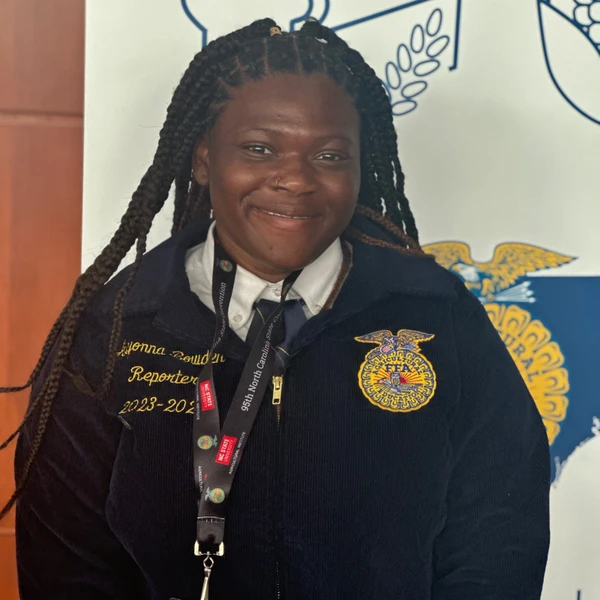
Hobbies and interests
FFA
Agriculture
Volleyball
Reading
Academic
Biography
Drama
Fantasy
I read books multiple times per week
Aiyonna Bowden
1x
Finalist1x
WinnerAiyonna Bowden
1x
Finalist1x
WinnerBio
I am an undergraduate business student from North Carolina pursuing a degree in business administration with an interest in finance. As a Pell Grant recipient, I have experienced firsthand the financial barriers that many students face in accessing higher education. These challenges have strengthened my resilience and motivated me to remain committed to my academic and professional goals.
My long-term objective is to build a career in business that allows me to achieve financial independence and create opportunities for others. I am dedicated to continuous self-improvement, responsible decision-making, and making the most of every opportunity that supports my education and future career.
Education
North American University
Bachelor's degree programMajors:
- Business, Management, Marketing, and Related Support Services, Other
Minors:
- Accounting and Related Services
Eastern Wayne High
High SchoolMiscellaneous
Desired degree level:
Bachelor's degree program
Graduate schools of interest:
Transfer schools of interest:
Majors of interest:
- Accounting and Related Services
- Business, Management, Marketing, and Related Support Services, Other
Career
Dream career field:
Accounting
Dream career goals:
cashier
food lion2023 – 20241 yearassistant manager
J and J martin produce2018 – 20257 years
Sports
Volleyball
Club2022 – 20253 years
Awards
- MVP
Future Interests
Entrepreneurship
Lippey Family Scholarship
When I started my first year of college, I knew it would be hard. I did not expect the hardest part to be managing my own mind.
I have ADHD, and although I understood that about myself before college, I did not fully realize how much it would affect me until I was on my own. In high school, there was more structure and more reminders. In college, everything depends on you. You decide when to start assignments, how to pace yourself, and how to manage your time. That freedom has been one of my biggest challenges.
The moment I realized it was harder for me than for other people happened during a conversation with a friend. She was taking six courses and completing about fourteen assignments in one week. She told me that when she needs to get work done, she just decides to open her computer and start. That stuck with me. For her, starting was a simple decision. For me, it feels like a battle.
In that same week, I only had five assignments. Even so, it could take me three to five days to finish tasks that should have taken a few hours. It is not because I am not trying. In fact, I am trying harder than I ever have before. I know how important this opportunity is. As a low-income student who moved twenty hours away from my family to attend a four-year university, I understand what is at stake. I did not come this far to waste this chance.
The hardest part is the constant noise in my head. When I sit down to work, my mind jumps from one random thought to another. I think about things that have nothing to do with my assignment. Even when I want to focus, it feels like I cannot turn that noise off. Watching other students complete their work so easily made me question myself at first.
Over time, though, I realized that comparing myself to others was only making things worse. Instead of seeing my ADHD as a reason to doubt myself, I started learning how to manage it better. I began breaking assignments into smaller parts so they felt less overwhelming. I started using timers to help me focus for short periods of time. I also looked into campus resources and strategies designed for students with ADHD.
Most importantly, I remind myself every single day why I am here. I remind myself why I chose to leave my family and move twenty hours away. I remind myself that I came to college to build a better future for myself. When focusing feels impossible, my “why” is what pushes me to keep going. It is what makes me open my laptop even when my mind wants to do anything else.
This challenge has forced me to grow. I have become more disciplined, more self-aware, and more determined. While my path may look different from others, I am proud of the effort I put in each day. ADHD has not stopped me. It has taught me resilience and strengthened my drive to succeed.
Enders Scholarship
My story begins with a loss I was too young to understand. My father passed away due to violence when I was only one year old. Because of my age, I have no memories of him, but his absence shaped my life in profound and lasting ways. As a child, I often noticed that other children had their fathers present at school events, celebrations, and everyday moments, while mine never was. At the time, I didn’t know how to express what I felt—only that there was a quiet emptiness I couldn’t explain. That absence became something I carried with me as I grew older.
Throughout my childhood, my mother became my foundation and my shield. She worked tirelessly to protect my siblings and me from the reality of our circumstances. While I was growing up feeling supported and cared for, she was working double shifts, making difficult financial and personal decisions, and carrying responsibilities that no one should have to face alone. She made sure we had everything we needed and often everything we asked for, even when it meant sacrificing her own comfort, rest, and peace of mind. She never allowed her struggles to overshadow our childhood, and because of her, I grew up feeling secure rather than deprived.
As I matured, I began to understand the magnitude of what my mother had done for us. She didn’t just provide—she protected. She chose stability over ease and long hours over personal comfort so that we would not have to experience the violence or instability that had taken my father away. Watching her persevere taught me resilience, discipline, and the value of hard work. Her example showed me that strength is not about avoiding hardship, but about rising above it with intention and grace.
As I grew older, my curiosity about my identity and roots deepened. I longed to understand my father’s side of the family and where I came from. I searched for connection through ancestry research and social media, discovering relatives I had never known. While these discoveries helped answer some questions, they also reminded me of what I had missed. That sense of absence remains, but it has shaped my appreciation for family, perseverance, and the importance of creating meaningful connections.
To process these emotions, I turned to meditation and walking as tools for healing and self-reflection. Walking gave me clarity and space to think, while meditation helped me learn how to sit with difficult emotions instead of avoiding them. These practices taught me patience, emotional awareness, and inner balance—skills that have helped me grow both personally and academically. They reinforced my belief that healing is not about erasing pain, but learning how to move forward with purpose.
These experiences are the reason I am committed to pursuing higher education. College represents opportunity, stability, and the chance to honor my mother’s sacrifices by building a future grounded in intention and achievement. I am motivated to break cycles, create lasting impact, and prove that adversity does not determine one’s outcome. The greatest influence in my life is my mother, whose resilience continues to inspire me daily, along with individuals who have transformed hardship into success. Through loss, perseverance, and self-discovery, I have developed the determination and drive that I will carry with me throughout my academic journey and beyond.
Future Green Leaders Scholarship
Sustainability should be a priority in the field of business because business decisions directly influence how land, water, and natural resources are used. Growing up with a background in agriculture gave me an early understanding of this connection. In farming, sustainability is not an abstract idea or a marketing tool. It is a necessity. When land is overused or resources are mismanaged, the consequences are immediate and long-lasting. Those early experiences shaped how I view responsibility, long-term planning, and the importance of protecting the systems that sustain us.
My agricultural background taught me that every decision creates lasting effects. Farmers must think beyond one growing season and consider how today’s actions will affect future production. This perspective strongly influences my belief that sustainability must be central to business practices. Many modern businesses prioritize short-term profits without fully accounting for long-term environmental costs. Agriculture shows that ignoring sustainability eventually leads to loss, including reduced productivity, instability, and diminished trust. Business functions in much the same way.
As I grew older, I began to recognize how environmental challenges often stem from business decisions made far removed from the land itself. Large-scale production systems, extended supply chains, and cost-focused strategies can place significant strain on natural resources, especially in agricultural communities. These impacts may not be visible to consumers, but they are deeply felt by those who depend on the land for their livelihoods. This realization encouraged me to pursue a business degree so I could better understand how business decisions can either harm or protect the environment.
In my future career, I hope to help reduce environmental impact by applying a sustainability-focused approach to business decision-making. Whether I work in finance, management, or entrepreneurship, I want to support practices that balance profitability with environmental responsibility. This may include promoting sustainable sourcing, improving efficiency, or investing in methods that protect land and water resources. My background in agriculture allows me to evaluate these decisions not only from a financial perspective, but also from a human and environmental one.
I am particularly interested in how financial planning and investment choices can support sustainability. In agriculture, resources are limited and must be managed carefully, and this principle applies equally to business. Understanding budgeting, risk assessment, and long-term returns will help me support strategies that reduce waste and encourage responsible growth. To me, sustainability means making decisions that consider their full impact, including effects on the environment and future generations.
Ultimately, sustainability should be a priority in business because economic success depends on a healthy environment. My background in agriculture taught me that stewardship is essential, not optional. As I move forward in my career, I hope to apply these lessons by contributing to business practices that respect natural resources, support communities, and promote long-term stability. By combining my agricultural experience with my business education, I aim to help create solutions that protect both environmental and economic futures.
Built for Business Scholarship
WinnerEarning my degree in business represents far more than completing a set of academic requirements; it represents a chance to change the direction of my life. Growing up with limited financial resources meant that stability was never guaranteed. Financial stress influenced many of our everyday decisions in the household, from what we could afford to how far into the future we could plan. Those experiences made me aware, at a young age, of how deeply money and access to opportunity influence a person’s life. They also planted the seed for why I chose to pursue a business degree.
For much of my life, financial systems felt distant and confusing, something that affected me but was never explained to me. I saw the consequences of not having access to financial knowledge, and I knew I wanted something different for my future. Studying business has given me language for experiences I lived through but did not fully understand. Courses in finance, management, and strategy have helped me see how decisions are made, how resources are allocated, and how planning can turn uncertainty into possibility. With each class, I feel more confident navigating systems that once felt overwhelming.
This degree is opening the door to a career that offers financial empowerment and growth. More importantly, it is giving me the ability to make informed decisions in my own life. Whether it is budgeting responsibly, working effectively within a team, or planning for long-term goals, my education is equipping me with tools that extend far beyond the classroom. I hope one day to start a business of my own, and this degree is helping me build the foundation necessary to do that thoughtfully and responsibly. To me, this education is a way out of financial unpredictability and a step toward creating lasting security for myself and my family.
My motivation is not limited to personal success. I want my education to have meaning beyond my own advancement. Having witnessed how financial barriers can limit potential, I feel a responsibility to use what I learn to support others facing similar challenges. A business degree gives me the opportunity to contribute to my community through ethical leadership, responsible financial practices, and initiatives that prioritize access and opportunity. I believe that business, when done with integrity, can be a powerful force for positive change.
Pursuing higher education while managing financial pressure has required resilience and determination. There have been moments of doubt, setbacks, and exhaustion, but each challenge has strengthened my commitment to finishing what I started. This journey has taught me that growth is not always linear, and success is often built through persistence rather than perfection. My degree represents the effort it took to keep moving forward, even when the path felt uncertain.
Ultimately, obtaining my business degree is not just about earning a credential, it is about transforming my circumstances and building a future grounded in knowledge, stability, and purpose. It reflects my determination to break cycles of financial insecurity and create opportunities where there once were limitations. Through this degree, I am not only investing in my own future, but also in the possibility of making a meaningful difference in the lives of others.
Sgt. Albert Dono Ware Memorial Scholarship
The value of service, sacrifice, and bravery that lies in the legacy of Sgt. Albert Dono Ware is not limited to the history of the military but reverberates throughout the generations as the values of civic duty and mutual advancement. All these values have influenced my life experience because they have made me conceptualize success not simply in the personal successes of a particular person, but in a sense of obligation to bring other people to great heights. They also shape my complex of how I am going to resolve the ongoing issues in the current African diaspora in the United States today, specifically, the disparity in education, financial access, and political participation.
In my life, service has involved enduring hardship and going the extra mile to grow over time despite the conditions. I can attest to this as a learner in higher education with limited financial means that service is a phenomenon, which can be facilitated by service beginning with self-discipline, staying dedicated, and getting ready to play a significant role in my community in the future. It has been an inevitable aspect of the journey that includes sacrifice. Social pressure on finance, college obligations, and long-term aspirations have made hard decisions to strike a balance between academic demands, financial commitments, and future objectives. In my case, bravery can be attributed to being willing to keep going in the face of uncertainty,y as well as to having a life vision beyond my own situation.
These values are traditionally embedded in my family history. My background is also a product of service to this nation, with my grandfather serving in the Union Army during the Civil War. He was not just doing what he was doing because he had been entangled in a historic war; it embodies a duty to the principles of unity, justice,e and helping to save human dignity when those principles were more strongly opposed. These facts remind me of the fact that my own family helped to make the nation more just, when I am convinced that only with courage and continuous work, people may get what they want, at the moment when the result is not sure or in the future.
The African diaspora in the United States is still struggling with systemic issues, which require this same advocacy of service and courage. Among other issues, educational inequity is still burning. The disadvantaged access to education, along with underfunded schools and unequal distribution of resources and opportunities to higher education target African American communities disproportionately. To overcome this issue, there is a necessity to implement policy change that focuses on unbiased school funding, enhanced access to need-based financial assistance, and robust support mechanisms for first-generation and low-income pupils. Education is not merely a means to personal development; it also provides a basis for community empowerment andthe sustainability of an economy in the long-run.
Another problem of vital concern is economic inequality. Most of the African diaspora also have obstacles to wealth-building processes, such as inaccessibility to capital, discriminatory lending processes, and pay inequalities. There should be policies that facilitate the development of small businesses, fair lending, and training programs to educate the workforce. Local programs that may be used to transform the community into a less fortunate area include community-based programs to encourage financial literacy and entrepreneurship about which people may be given the instruments to make self-sufficient economic expectations for themselves and their households.
Community engagement is important in addition to policy reform. The African American communities have had a long history of being pillars that were made up of grassroots organizations, faith-based organizations, and local nonprofits. These stakeholders have to be actively used in formulating and instigating reforms because they have firsthand information on community requirements and challenges. Institutions of education are also not left behind since they create inclusive settings, facilitate mentorship services, and collaborate with local agencies to provide more opportunities outside the classroom.
It is the responsibility of the government leaders and policymakers to deal in tandem with the community stakeholders such that reforms become not only intended but effective and sustainable. This would involve engaging with marginalized voices, gathering and assessing information to make decisions, and holding institutions responsible for achieving fair results. The participation of the private sector, especially the business able to invest in the community, to establish fair employment policies, and contribute to the causes of social impact, is also of utmost importance.
The partnership with Sgt. Albert Dono Ware is an indicator that significant progress can hardly be quick and always painless. Service demands business dedication over and above convenience, sacrifice needs stamina, and courage requires action even amidst opposition. These values have influenced my life as it has helped me to have a sense of purpose, based on the responsibility to other people. They have given me the dream of one day when the African diaspora will experience the benefits of just systems, empowerment, and leadership that can take necessary actions of integrity and courage.
We should also do the same to finish what was started by previous generations, like my grandfather, when he was serving in the Union Army, who responded to the call of enriching a more just society. We can use education, policy change, and locally based action to pay tribute to these legacies by creating a pathway to opportunity and making sure we don’t just stay on the path but continue and make progress.