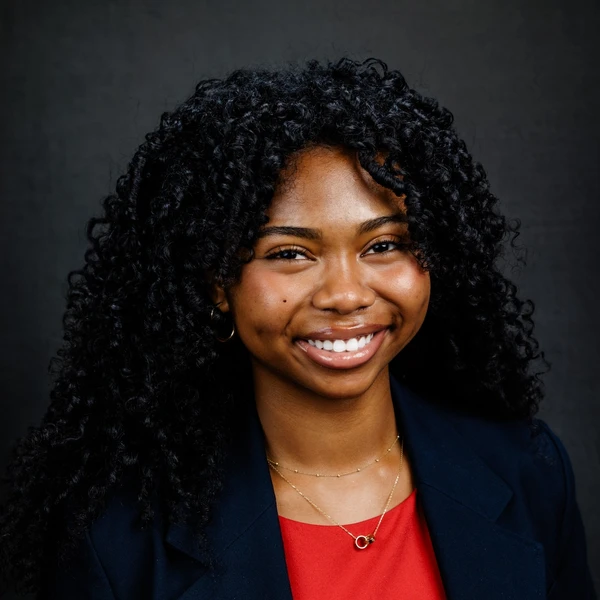
Education has been the bridge between the life my parents built through sheer determination and the future I'm creating through strategic preparation. As the daughter of Nigerian immigrants who came to America with nothing and built a pharmacy and car dealership from scratch, I grew up watching my parents succeed despite lacking formal business education. They learned everything through trial and error, paying tuition to the school of hard knocks when proper education could have saved them years of struggle and costly mistakes. Their journey taught me that while grit and hustle can take you far, education gives you frameworks, networks, and credibility that exponentially accelerate impact.
My educational journey began unconventionally. At nine years old, I started working in our family businesses, learning accounting, customer service, and operations before most kids learned long division. I hated it. I wrote resignation letters citing Florida labor statutes, desperately trying to escape while other kids played outside. But that early, unwanted education in real world business fundamentals became the foundation for everything that followed. When other students were reading about supply chains in textbooks, I was managing pharmacy inventory. When they were solving hypothetical business case studies, I was navigating actual customer conflicts and financial decisions.
Education shaped my goals by showing me the gap between what exists and what's possible. In school, I learned about systemic inequities in education access globally. That knowledge contextualized an encounter during a family trip to the Philippines where I met Ramil, a student who walked miles daily to attend a school with barely any books. Understanding the broader systems creating his reality, not just his individual circumstances, motivated me to found TalaNgAklat. That nonprofit has now collected over 15,000 books for Philippine schools and orphanages, earning recognition from the Filipino House of Representatives.
Similarly, learning about automation and AI sparked my interest in using technology to democratize access. I became the first high school student to achieve UiPath Student Champion status, building automation solutions for organizations that lack expensive consultant resources. I recently won the STEM Innovation Award through Samsung Solve for Tomorrow, placing top 400 of 2,600 schools, and I'm developing an AI powered grocery tracker helping low income families maximize food budgets. Education gave me technical knowledge to build these solutions and vision to recognize that technology could solve problems I witnessed in my community.
The biggest challenge I've overcome is navigating systems designed for people who already understand the rules. As a first generation college student attending Armwood High School's Collegiate Academy, a Title I school, I've had to figure out everything alone. My parents stress education's importance constantly but can't guide me through college applications or explain financial aid processes because they never experienced it themselves. When choosing between programs at Wharton or MIT, I'm researching frantically, cold emailing strangers for advice, and making high stakes decisions without the family expertise my peers access at dinner.
I've also overcome the assumption that students from schools like mine aren't elite college material. When I told people I was applying to top institutions, I got skeptical looks and suggestions to apply somewhere "more realistic." Counselors encouraged community college not because they doubted my abilities but because they'd seen talented students from our school get rejected and wanted to protect me from disappointment.
I overcame these challenges through relentless resourcefulness and refusing to internalize others' limited expectations. When my school lacked resources, I found them elsewhere, applying for free programs, joining Morgan Stanley's Finance Academy, teaching myself coding through YouTube when we didn't have computer science clubs. As Executive President of Florida DECA managing 18,000 students statewide, I demonstrated leadership capabilities transcending my school's resource constraints. Through TalaNgAklat and my automation work, I proved I could build organizations despite having no formal training or connections.
I hope to use my education to create a better future by building a fintech social enterprise transforming how underserved communities globally access financial services. Education in computer science will give me technical skills to build secure platforms. Business education will teach me sustainable, scalable models. Understanding economics and policy will help me navigate regulatory environments across borders.
Beyond building one company, I want to use my education to create pathways for others. I want to invest in the next generation of entrepreneurs, particularly young Black women who need to see that business and tech leadership are accessible. I want to fund startups solving real problems, mentor aspiring entrepreneurs, teach at Title I schools, and create scholarships reducing barriers for first generation students.
Education transforms how you approach the world. My parents built success through determination alone. I'm building on their foundation with education as my force multiplier, using their sacrifice as motivation and formal learning as acceleration toward impact they dreamed of but couldn't quite reach.