user profile avatar

Addison Malone

1x

Finalist

1x

Winner

Bio

I am a high school senior with a deep passion for nuclear forensics and scientific discovery. I have completed two research internships at Oak Ridge National Laboratory, where my work contributed to publications in The Journal of Solid State Chemistry and American Mineralogist. Beyond the lab, I’m dedicated to inspiring others in STEM through my volunteer work with Oak Ridge Computer Science Girls, where I teach coding to young students. As captain of the Knoxville Ambassadors varsity soccer team, I lead with teamwork, discipline, and determination—values I bring to both science and sport. After high school, I plan to major in chemistry and ultimately pursue a Ph.D. in nuclear forensics, combining my love for chemistry with a commitment to advancing national security and scientific innovation.

Education

Christian Academy of Knoxville, Homeschool Homestudy Program

High School
2022 - 2026
  • GPA:
    4

Miscellaneous

  • Desired degree level:

    Doctoral degree program (PhD, MD, JD, etc.)

  • Majors of interest:

    • Chemistry
    • Nuclear Engineering
    • Physics
  • Not planning to go to medical school
  • Test scores:

    • 34
      ACT

    Career

    • Dream career field:

      Chemicals

    • Dream career goals:

      Nuclear Security Scientist

    • Instructor

      iCode
      2025 – Present1 year
    • Assistant Teacher

      Oak Grove Homeschool Cooperative
      2021 – Present5 years

    Sports

    Soccer

    Varsity
    2013 – Present13 years

    Research

    • Materials Engineering

      Oak Ridge National Laboratory — Lead Researcher
      2025 – 2025
    • Chemistry

      Oak Ridge National Laboratory — Co-author and researcher for - Syntheses and crystal structures of four new d0 transition metal tellurites (DOI:https://doi.org/10.1016/j.jssc.2024.125143)
      2024 – Present
    • Mining and Mineral Engineering

      Oak Ridge National Laboratory — Co-author and leading researcher for - Raman spectroscopic investigation of ianthinite [U24+(UO2)4O6(OH)4(H2O)4]·5H2O, a rare mixed–valence uranium oxide hydrate (DOI:https://doi.org/10.2138/am-2025-9759)
      2024 – Present
    • Chemistry

      Oak Ridge National Laboratory — Lead Researcher
      2024 – 2024

    Public services

    • Volunteering

      Teens Teach Tech — Volunteer
      2025 – Present
    • Volunteering

      Oak Ridge Computer Science Girls — Teacher's Assistant
      2023 – Present

    Future Interests

    Advocacy

    Volunteering

    Dr. John C. Cate IV STEM Scholarship
    Winner
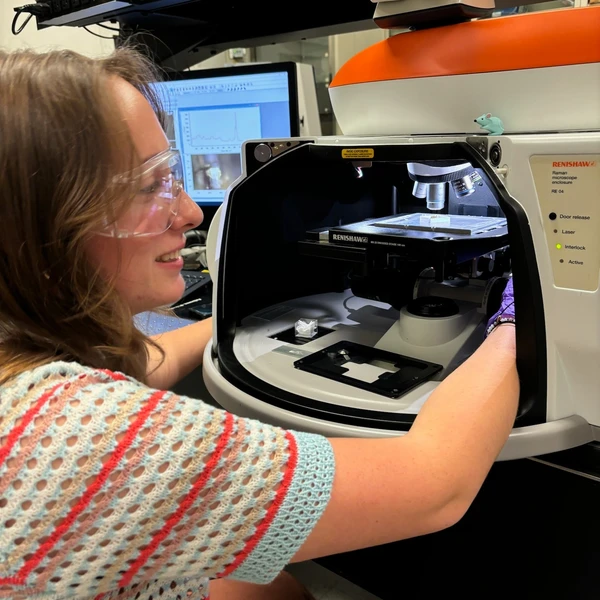
    Sitting on the floor of my seventh grade physics class, my eyes were glued to the screen as it displayed scenes of the Chernobyl disaster. I was captivated by the deserted reactors, the city frozen in time, and the invisible threat of radiation. This was my first time learning about radiation, and it ultimately guided my life’s purpose. Since childhood, I have been greatly captivated by the beauty of scientific discovery. However, my passion to follow it didn’t fully bloom until that day in seventh grade. After learning about radiation for the first time, I learned about Marie Curie, the story of the Radium Girls, and the Manhattan Project. From here, my fascination with radiation only grew, leading to a stack of books dedicated to nuclear science in the corner of my room, a vast collection of uranium glass, and a replica of Curie’s dark black dress that she wore to hide stains from her lab work. It became a non-negotiable to work with radioactive materials. However, I knew I wanted my work to benefit society. During the summer following my freshman year, I met Dr. Tyler Spano, a nuclear security scientist, during a cloud chamber experiment at the Science Accelerating Growth and Engagement summer camp at Oak Ridge National Laboratory. I joined Dr. Spano at the lab as a nuclear non-proliferation intern. During this time, I employed Raman spectroscopy to examine five unknown uranium compounds and mixtures to identify differences in their Raman spectra. I demonstrated that Raman spectroscopy was successful for quick analysis and identification of nuclear materials. This was the first time I saw myself contributing to a field I had fallen in love with, and I am eager to continue to conduct research at a higher level. Since witnessing the destruction of Chernobyl, I saw radiation as a force that could either devastate or benefit communities. The threat of nuclear proliferation remains an ongoing global concern and monitoring of nuclear programs continues to be a challenge as recent events pertaining to Iran have signified. These risks must be combated with rapid responses. I would be beyond honored to carry on Dr. John C. Cate’s legacy as I dedicate my career to nuclear forensics by improving analysis techniques to identify radioactive materials as rapidly as possible. By improving speed and accuracy of material identification, cleanup after incidents can occur more efficiently, protecting communities and expediting environmental recovery.
    Women in STEM and Community Service Scholarship
    An issue that matters deeply to me is the underrepresentation of girls in STEM fields. Far too often, young girls are discouraged from pursuing science, technology, engineering, and mathematics because those are “boys’ fields.” Many lack access to mentors who can guide, encourage, and show them that women belong in these fields. This gap limits opportunity not only for individual girls but for the world, which loses out on diverse perspectives in solving scientific challenges. My journey in STEM began in seventh grade, when I watched a documentary on the Chernobyl disaster. I was captivated by the abandoned reactor, the city frozen in time, and the invisible threat of radiation. Though I didn’t fully understand the science, I knew I wanted to understand it, to explore it, and to contribute to preventing such disasters. A year later, discovering Marie Curie further cemented my fascination. She was brilliant, fearless, and unafraid to explore unknown territory in a field dominated by men, inspiring me to pursue a path in nuclear science. Mentorship played a pivotal role in transforming my interest into action. I was fortunate to intern twice at Oak Ridge National Laboratory (ORNL) under two remarkable female scientists: Dr. Tyler Spano and Dr. Hassina Bilheux. Under Dr. Spano, I contributed to the Mapping of Isotopic, Chemical, and Elemental Analysis (MICE) project, analyzing uranium compounds with Raman spectroscopy and presenting my findings at the lab and the University of Tennessee. This work led to two publications, one in The Journal of Solid State Chemistry and another in American Mineralogist, where I provided the first Raman spectra of ianthinite, a uranium-bearing mineral (DOI:https://doi.org/10.1016/j.jssc.2024.125143 & https://doi.org/10.2138/am-2025-9759 ). Later, with Dr. Bilheux, I helped develop a new technique for 3D reconstruction of Apollo 14 lunar rock datasets using neutron imaging. Their guidance showed me what’s possible when women lead in STEM and inspired me to become a mentor myself. Since then, I’ve worked to pay it forward. I volunteer with ORCSGirls, teaching coding and computational thinking to young girls in the Oak Ridge community. Watching their eyes light up when they create a program or solve a problem reminds me how powerful early encouragement can be. Through these experiences, I’ve seen that exposure, hands-on learning, and mentorship can inspire confidence and a sense of belonging in STEM. Looking forward, I plan to pursue an education in chemistry at university and earn a PhD in nuclear forensics—the science of tracing and identifying radioactive materials to prevent their misuse and strengthen global security. It combines my love of science with a mission that truly matters, protecting people and the environment from harm. I want to use my experience to mentor young girls, just as Dr. Spano and Dr. Bilheux mentored me. I want to create opportunities for girls to see themselves in laboratories, at conferences, and in leadership roles, empowering them to pursue science without hesitation or fear. By combining my professional expertise, research experience, and commitment to service, I hope to cultivate both innovation and inclusivity, helping girls recognize that their contributions can shape not only the scientific community but the world at large. The same curiosity that once made me sit wide-eyed before a Chernobyl documentary now drives me to inspire and uplift other young girls. Through mentorship, volunteer work, and a dedication to advancing science responsibly, I aspire to create a world where girls in STEM feel not only welcome but unstoppable.