Age
18
Gender
Male
Ethnicity
Asian
Hobbies and interests
Badminton
Artificial Intelligence
Band
Biking And Cycling
Chess
Coding And Computer Science
Computer Science
Cricket
Data Science
Driving
Drums
Cooking
Engineering
Information Technology (IT)
Machine Learning
Mathematics
Music
Philanthropy
STEM
Table Tennis
Reading
Academic
Adventure
Humor
Science Fiction
I read books multiple times per week
Abhishai Ganta
1x
Finalist1x
Winner
Abhishai Ganta
1x
Finalist1x
WinnerBio
I’m passionate about using technology to make a meaningful difference in people’s lives. My goal is to build a CS-based Healthcare company that predicts and prevents illnesses, helping to reduce the impact of preventable diseases. I’m curious, driven, and always eager to learn and find innovative solutions to important problems.
Education
University of California-San Diego
Bachelor's degree programMajors:
- Biomathematics, Bioinformatics, and Computational Biology
- Data Science
GPA:
3.9
Aliso Niguel High School
High SchoolGPA:
4
Oak Park School
High SchoolGPA:
3.9
Miscellaneous
Desired degree level:
Bachelor's degree program
Graduate schools of interest:
Transfer schools of interest:
Majors of interest:
- Computer Science
- Mathematics and Computer Science
- Biotechnology
- Biomedical/Medical Engineering
- Biomathematics, Bioinformatics, and Computational Biology
- Data Science
Test scores:
1510
SAT
Career
Dream career field:
- Computer Software
Dream career goals:
Quality Assurance Tester
TeachTap2024 – 20251 yearLead Developer
Triton NeuroTech2026 – Present8 monthsSoftware Engineer
Triton Prosthetics Society2025 – Present1 yearStudent Intern
Elite Tech Info2022 – 2022Artificial Intelligence Intern
CEO Leadership Alliance Orange County2024 – 2024
Sports
Badminton
Club2018 – Present8 years
Table Tennis
Club2022 – Present4 years
Research
Data Science
Eclipse Analytics — Researcher2026 – 2026Biological and Biomedical Sciences, Other
MOSAIC Lab — Research Assistant2026 – Present
Public services
Volunteering
Artificial Intelligence 101 Club — President2024 – PresentVolunteering
East West Community Church San Fernando Valley (EWCCSF) — Multimedia Coordinator2021 – 2022Volunteering
Web Development Club — President2023 – PresentVolunteering
Caring for Our Community Club — President2022 – PresentVolunteering
African Library Project — President of the African Library Project Chapter at my school2022 – PresentVolunteering
Agoura Math Circle — Assistant Vice President and a Math/Data Science Tutor2021 – Present
Future Interests
Volunteering
Philanthropy
Entrepreneurship
Sloane Stephens Doc & Glo Scholarship
The people who inspire me the most are my parents. My father immigrated from the Philippines with very little, relying on the support of his community to build a stable life for our family. Growing up, I saw the sacrifices he made so that I could pursue a higher education. His journey taught me that true success is not measured by personal wealth but by how much you give back to the community that supported you. I want to honor his legacy by using my education to solve a massive problem in healthcare accessibility.
My vision is to build a future where life-saving medical technology is affordable for everyone. Right now, advanced assistive devices like bionic limbs and neurally controlled wheelchairs cost tens of thousands of dollars. This completely prices out the low-income patients who need them the most. I want to make an impact by replacing expensive proprietary hardware with intelligent software. By using data science and low-cost sensors, we can drastically lower the manufacturing costs of these devices and restore independence to people facing physical and mental health challenges.
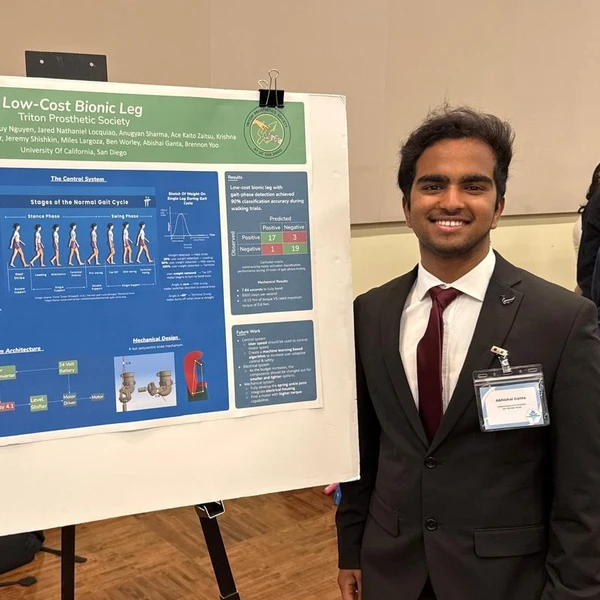
I am currently working toward this goal as a Data Science student at the University of California, San Diego. I dedicate my time outside of class to research projects that directly help people. With the Triton Prosthetics Society, I help engineer the software for an affordable bionic leg. I wrote embedded C++ code for an Arduino that fuses data from basic load cells and movement sensors to recognize complex walking patterns in real time.
I am also a Lead Developer at Triton Neuro Tech, where we are building a wheelchair navigation system controlled by brain and muscle signals. My role on this project is strictly focused on biosignal processing. Instead of designing the human-machine interface, I build the backend pipelines that filter high-frequency time-series data. My code cleans up the noisy signals so the system can accurately decode the user's movement intent.
Additionally, I work as a research assistant at the MOSAIC Lab. We are developing a mobile platform that uses everyday commercial EEG headsets to capture neural data and track mood and psychosis spectrum disorders. All of these projects share the same core mission. I am using my education to build tools that bring isolated people back into the community.
When someone loses their mobility or struggles with their mental health, the world often shrinks around them. My goal is to change that. I plan to spend my career designing accessible assistive devices for patients who cannot afford expensive traditional care.
The Sloane Stephens Doc and Glo Scholarship would be a tremendous help in achieving this vision. Because my family covers the entire cost of my education and since my sister will soon start college, the financial strain is a growing issue. This scholarship would lift a massive weight off my parents' shoulders and allow me to stay fully invested in my lab work and research. I am determined to use my technical skills to shape a better and more accessible future for healthcare.
Kyle Lam Hacker Scholarship
I have always believed that the best part of writing code or building hardware is the moment it makes someone smile. Hacking and tinkering are fun on their own, but using those skills to solve a real physical problem is what makes all the frustrating late nights worth it.
I am a Data Science major at the University of California, San Diego. When I got to college, I wanted to find a way to use my technical skills to actually help people. That curiosity led me to join the Triton Prosthetics Society as a software engineer. We had a massive goal. We wanted to engineer a bionic leg. High-end prosthetics can cost tens of thousands of dollars, making them completely impossible for many people to afford. We wanted to hack together an affordable alternative.
My specific job was to make the leg understand how the user was moving. I decided to build the brain of the device using C++ and an Arduino. To figure out the physical movements, I needed to fuse data from an Inertial Measurement Unit and several load cells. At first, the testing phase was a complete mess. The sensors picked up every tiny vibration, and the raw data was incredibly noisy. If the leg could not accurately read the user's movement, it would be useless.
I spent weeks in the lab tinkering with the code and testing different mathematical approaches. I applied embedded digital signal processing techniques to clean up the messy data. I wrote moving-average filters and figured out how to use asynchronous multi-rate sampling so the high-frequency data streams would finally synchronize properly. After a lot of trial and error, I managed to create a system capable of real-time 8-gait-phase recognition. This meant our cheap Arduino setup could instantly classify complex dynamic human movement states and know exactly where the user was in their walking stride.
The day we finally tested the fully integrated prototype was amazing. We strapped the bionic leg to a testing rig and had a volunteer walk with it. Watching the mechanical knee respond perfectly in real time to their natural gait was incredible. My teammates and I were cheering, but the absolute best part was the reaction from the volunteer testing it. They were shocked that a group of college students using basic sensors and an Arduino could build something that felt so responsive. Seeing their surprise and genuine excitement was the most rewarding experience of my college career.
That project taught me what the hacker spirit is really about. It is not just about playing with the latest gadgets or writing complex algorithms for the sake of it. It is about curiosity and looking at a massive problem like the high cost of medical devices and asking how we can use everyday technology to fix it. I want to keep using my tinkering skills to build accessible tools that delight people and improve their lives.
American Dream Scholarship
Growing up on an H4 visa, I learned early on that the traditional version of the American Dream is incomplete. People often view the American Dream as a formula where hard work automatically leads to financial success. But for students like me, that equation isn’t so simple. Hard work only counts if the visa paperwork allows it to. Many scholarships, federal financial aid, and paid internships turn me away before anyone even evaluates my effort and passion for my field of study. To me, the American Dream is not a guarantee of wealth or an easy ride. It is the determined choice to continue improving myself and build something meaningful anyway, using knowledge and persistence to create opportunities for myself in ways that can benefit other people.
I brought that mindset with me to UC San Diego, where I major in Data Science. I realized quickly that the best way to handle the frustration of legal limitations was to put all my focus into areas that were still accessible: research and projects. Specifically, I aimed to focus on research that directly improves human health. In the MOSAIC Lab under Prof. Tauhidur Rahman, I work on a mobile EEG research platform designed to capture passive neural biomarkers for mood and psychosis disorders. Using the MW75 Neuro Headset, we aim to develop the functionality to make it a ubiquitous device that can be used for listening to music and analyzing any signs of early-stage mental health disorders. At Triton Neuro Tech, my work centers on biosignal processing. I built pipelines that clean and decode high-frequency muscle signals to help create an EEG + EMG based wheelchair. Alongside that, with the Triton Prosthetics Society, I helped engineer real-time gait-phase recognition in C++ to create a low-cost Bionic Leg prototype to show that accessibility to such necessities doesn’t have to be restricted based on one’s income.
There is a deep connection between the barriers I face as a non-citizen and the work I do in assistive tech. When someone loses their mobility or struggles with a psychiatric condition, the world often shrinks around them and treats them as an afterthought. Sitting at my desk debugging filtering algorithms or analyzing thousands of rows of noisy sensor data, I am driven by the belief that technology should restore independence. That is where community service lives for me. Regardless of the late nights spent in the lab, the motivation to create real-world use cases that give someone back their voice or their movement is a rewarding experience.
During the rest of my time at UCSD, I plan to bridge data science with bioinformatics and assistive robotics. I want to pursue advanced research in machine learning, neural signal decoding, collaborate across clinical labs, and eventually help design accessible assistive devices for patients who cannot afford expensive proprietary care. Achieving that takes focus, but financial strain is an ongoing reality. Because of my H4 status, I cannot apply for federal aid or standard work-study. My family carries the entire cost of my education on their own, making heavy sacrifices every quarter. This scholarship would lift a tremendous financial burden off my parents and give me the stability to remain fully invested in research. The American Dream is about proving that your impact is measured by what you give back, not by the stamp in your passport. With the help of this scholarship, I will keep working to make that dream real.
Learner Math Lover Scholarship
I sat in my Algebra class, listening intently as Ms. Kelly explained a concept I had struggled to grasp for days. For the first time, it all made sense. Yet, instead of simply feeling relieved that my doubts were finally cleared, I found myself captivated by her ability to transform such a complicated idea into something so simple. I wanted to understand her magic and, most importantly, to help others feel the same excitement I first felt.
I knew many students in my community who felt math was out of their reach, so I decided to step in. I joined as a tutor in Agoura Math Circle (AMC), a nonprofit organization providing free educational resources to middle/high schoolers. Inspired by Ms. Kelly’s methods, I began preparing my own lectures consisting of food analogies and drawings to create a similar engaging start to each lesson. Then, through workshops and Kahoots, I slowly chipped their fear of approaching complex problems. With each meeting, I intentionally approached each concept as a story rather than a lesson. As they gained their confidence, I furthered this momentum through group challenges, connecting concepts to real-life applications, and making each lesson interactive and memorable. Through these strategies, the students who feared math now examined every problem with confidence. Math, once thought of as memorizing formulas, had now become their playground for creativity as they explored patterns and discovered multiple ways to approach solutions.
Seeing each student return to AMC for more advanced concepts brings me immense joy, knowing I passed on the amazement that I once felt. With the huge success of the math tutoring program, I became the Assistant Vice President of AMC and started leading the Data Science class as well. I realized that tutoring did more than just empower the students – it instilled a passion in me. No matter the path I take, I’ve learned that pursuing something I am truly passionate about will always lead to excellence. Even small acts, like tutoring, can have a profound impact when done with dedication. Passion transforms effort into perfection, no matter the scale of the contribution.
Bright Lights Scholarship
As I saw my grandfather struggle with his tumor, I kept wondering one thing: if only I had known earlier. His prolonged agony really shook me, and since we detected the tumor in its last stages, it was too late for any viable treatment. Grieved by such a painful loss, I began looking for ways this outcome could have been changed. I learned that, through AI, it is possible to detect occurrences of tumors through scans that doctors might overlook. At that moment, I knew Computer Science was the path that I wanted to pursue.
Determined to explore this further, I interned at Elite Tech Info – a company that develops economical AI solutions in Healthcare. I worked on creating an AI model that detects abnormalities in ECG patterns. I began immersing myself in the training sessions, understanding the meaning behind those ECG lines. What once appeared as random spikes and dips began unfolding into potentially life-saving clues. As I learned to preprocess data by excluding noise and extracting features like Heart Rate Variability (HRV) and R-R intervals, the data became more than just numbers. With each parameter adjustment and trial we made, I knew we were taking steps to prevent others from losing a loved one too soon.
Wanting to deepen my knowledge, I joined my school’s Biotechnology class, where I explored modern gene editing technologies like CRISPR and TALE that modify DNA to treat diseases. I began to see the potential of integrating Computer Science into Biology to not only detect illnesses but also revolutionize our approach toward treatment. As I become more curious to research AI innovations in Healthcare, I started learning about Generative AI and LLMs in Salesforce CRM applications to integrate AI into Health Cloud. I then became a Salesforce Certified AI Specialist after mastering the capabilities of the Salesforce Einstein AI platform.
Now, as a first-year Data Science major at UC San Diego, planning to double major in Bioinformatics, my goals for the rest of my undergraduate years are to build my foundation in Artificial Intelligence, Machine Learning, and Computational Biology. As a member of the Undergraduate Bioinformatics Club (UBIC), I’m attending workshops and seminars on Alignment Algorithms, Gene Regulation Networks, and Biomedical Imaging to understand how to work with real medical data. Through this knowledge, I hope to join HDSI’s research programs and UCSD Health’s AI initiatives, learning how to implement algorithms in clinical environments. As I continue to take higher-level deep learning and genetic engineering classes, I hope to join more organizations like the Health Data Analytics Club to collaborate with peers who share the same goal and develop tangible products with real-world applications.
Losing my grandfather was one of my most painful experiences; however, it gave me an ambition: to save people with preventable illnesses. Each goal I’ve set is directed toward developing affordable CS solutions in the medical field. By receiving this scholarship, it will provide an important financial assistance in paying my tuition, allowing me to work fewer part-time jobs and dedicate my free time to being involved in more research and
lab positions to deepen and expand my knowledge, so I could ultimately create a future where fewer families are left wondering: if only we had known earlier.
Bulkthreads.com's "Let's Aim Higher" Scholarship
As I saw my grandfather struggle with his tumor, I kept wondering one thing: if only I had known earlier. His prolonged agony really shook me, and since we detected the tumor in its last stages, it was too late for any viable treatment. Grieved by such a painful loss, I began looking for ways this outcome could have been changed. I learned that, through AI, it is possible to detect occurrences of tumors through scans that doctors might overlook. At that moment, I knew Computer Science was the path that I wanted to pursue.
Determined to explore this further, I interned at Elite Tech Info – a company that develops economical AI solutions in Healthcare. I worked on creating an AI model that detects abnormalities in ECG patterns. I began immersing myself in the training sessions, understanding the meaning behind those ECG lines. What once appeared as random spikes and dips began unfolding into potentially life-saving clues. As I learned to preprocess data by excluding noise and extracting features like Heart Rate Variability (HRV) and R-R intervals, the data became more than just numbers. With each parameter adjustment and trial we made, I knew we were taking steps to prevent others from losing a loved one too soon.
Wanting to deepen my knowledge, I joined my school’s Biotechnology class, where I explored modern gene editing technologies like CRISPR and TALE that modify DNA to treat diseases. I began to see the potential of integrating Computer Science into Biology to not only detect illnesses but also revolutionize our approach toward treatment. As I become more curious to research AI innovations in Healthcare, I started learning about Generative AI and LLMs in Salesforce CRM applications to integrate AI into Health Cloud. I then became a Salesforce Certified AI Specialist after mastering the capabilities of the Salesforce Einstein AI platform.
Now, as a first-year Data Science major at UC San Diego, planning to double major in Bioinformatics, my goals for the rest of my undergraduate years are to build my foundation in Artificial Intelligence, Machine Learning, and Computational Biology. As a member of the Undergraduate Bioinformatics Club (UBIC), I’m attending workshops and seminars on Alignment Algorithms, Gene Regulation Networks, and Biomedical Imaging to understand how to work with real medical data. Through this knowledge, I hope to join HDSI’s research programs and UCSD Health’s AI initiatives, learning how to implement algorithms in clinical environments. As I continue to take higher-level deep learning and genetic engineering classes, I hope to join more organizations like the Health Data Analytics Club to collaborate with peers who share the same goal and develop tangible products with real-world applications.
Losing my grandfather was one of my most painful experiences; however, it gave me an ambition: to save people with preventable illnesses. Each goal I’ve set is directed toward developing affordable CS solutions in the medical field, and ultimately, I want to create a future where fewer families are left wondering: if only we had known earlier.
Brooks Martin Memorial Scholarship
As I saw my grandfather struggle with his tumor, I kept wondering one thing: if only I had known earlier. Since we detected the tumor in its last stages, it was too late for any viable treatment. I learned that, through AI, it is possible to detect occurrences of tumors through scans that doctors might overlook. At that moment, I knew Computer Science was the path that I wanted to pursue.
Determined to explore this further, I interned at Elite Tech Info – a company that develops economical AI solutions in Healthcare. I worked on creating an AI model that detects abnormalities in ECG patterns. I began immersing myself in the training sessions, understanding the meaning behind those ECG lines. What once appeared as random spikes and dips began unfolding into potentially life-saving clues. As I learned to preprocess data by excluding noise and extracting features like Heart Rate Variability (HRV) and R-R intervals, the data became more than just numbers. With each parameter adjustment and trial we made, I knew we were taking steps to prevent others from losing a loved one too soon.
Wanting to deepen my knowledge, I joined my school’s Biotechnology class, where I explored modern gene editing technologies like CRISPR and TALE that modify DNA to treat diseases. I began to see the potential of integrating Computer Science into Biology to not only detect illnesses but also revolutionize our approach toward treatment. As I become more curious to research AI innovations in Healthcare, I started learning about Generative AI and LLMs in Salesforce CRM applications to integrate AI into Health Cloud. I then became a Salesforce Certified AI Specialist after mastering the capabilities of the Salesforce Einstein AI platform.
Now, as a first-year Data Science major at UC San Diego, planning to double major in Bioinformatics, my goals for the rest of my undergraduate years are to build my foundation in Artificial Intelligence, Machine Learning, and Computational Biology. As a member of the Undergraduate Bioinformatics Club (UBIC), I’m attending workshops and seminars on Alignment Algorithms, Gene Regulation Networks, and Biomedical Imaging to understand how to work with real medical data. Through this knowledge, I hope to join Halıcıoğlu Data Science Institute’s research fellowship program and UCSD Health’s AI initiatives, learning how to implement algorithms in clinical environments and understanding their challenges. As I continue to take higher-level deep learning, computer vision, and genetic engineering classes, I hope to join more organizations like the Health Data Analytics Club to collaborate with peers who share the same goal and develop tangible products with real-world applications.
Losing my grandfather was one of my most painful experiences; however, it gave me an ambition: to save people with preventable illnesses. Each goal I’ve set is directed toward developing affordable CS solutions in the medical field, and ultimately, I want to create a future where fewer families are left wondering: if only we had known earlier.
Shanique Gravely Scholarship
As I saw my grandfather struggle with his tumor, I kept wondering one thing: if only I had known earlier. Since we detected the tumor in its last stages, it was too late for any viable treatment. I learned that, through AI, it is possible to detect occurrences of tumors through scans that doctors might overlook. At that moment, I knew Computer Science was the path that I wanted to pursue.
Determined to explore this further, I interned at Elite Tech Info – a company that develops economical AI solutions in Healthcare. I worked on creating an AI model that detects abnormalities in ECG patterns. I began immersing myself in the training sessions, understanding the meaning behind those ECG lines. What once appeared as random spikes and dips began unfolding into potentially life-saving clues. As I learned to preprocess data by excluding noise and extracting features like Heart Rate Variability (HRV) and R-R intervals, the data became more than just numbers. With each parameter adjustment and trial we made, I knew we were taking steps to prevent others from losing a loved one too soon.
Wanting to deepen my knowledge, I joined my school’s Biotechnology class, where I explored modern gene editing technologies like CRISPR and TALE that modify DNA to treat diseases. I began to see the potential of integrating Computer Science into Biology to not only detect illnesses but also revolutionize our approach toward treatment. As I become more curious to research AI innovations in Healthcare, I started learning about Generative AI and LLMs in Salesforce CRM applications to integrate AI into Health Cloud. I then became a Salesforce Certified AI Specialist after mastering the capabilities of the Salesforce Einstein AI platform.
Now, as a first-year Data Science major at UC San Diego, planning to double major in Bioinformatics, my goals for the rest of my undergraduate years are to build my foundation in Artificial Intelligence, Machine Learning, and Computational Biology. As a member of the Undergraduate Bioinformatics Club (UBIC), I’m attending workshops and seminars on Alignment Algorithms, Gene Regulation Networks, and Biomedical Imaging to understand how to work with real medical data. Through this knowledge, I hope to join Halıcıoğlu Data Science Institute’s research fellowship program and UCSD Health’s AI initiatives, learning how to implement algorithms in clinical environments and understanding their challenges. As I continue to take higher-level deep learning, computer vision, and genetic engineering classes, I hope to join more organizations like the Health Data Analytics Club to collaborate with peers who share the same goal and develop tangible products with real-world applications.
Losing my grandfather was one of my most painful experiences; however, it gave me an ambition: to save people with preventable illnesses. Each goal I’ve set is directed toward developing affordable CS solutions in the medical field, and ultimately, I want to create a future where fewer families are left wondering: if only we had known earlier.
Chi Changemaker Scholarship
Books have played a significant role in shaping my worldview in many aspects. It wasn’t until I learned how limited educational opportunities are for many kids worldwide that I fully understood the importance of books. Malala Yousafzai once said, “One child, one teacher, one pen, and one book can change the world.” No better quote captures the beauty in books as great tools that can change people’s lives and close the gap between inequality and opportunity.
I started my mission by partnering with the African Library Project and establishing a club at my school. Our first goal was to gather 2000 books using the motto Changing Lives. Book by book. We approached our neighborhood and asked them for donations. But, despite our efforts, we struggled to collect books. Realizing we needed a broader approach, I organized book donation drives in churches, town centers, and marketplaces. I divided responsibilities among club members to focus on outreach, book collection, fundraising, and shipping. After two months, we shipped the collected books to Botswana. Shortly after, I received videos of children eagerly flipping each page, expressing heartfelt gratitude for the opportunity to explore each story. Their joy was contagious and made all of our efforts worth it.
Knowing that I couldn’t leave this mission here, I wanted to extend the scope of my project in all possible ways. I collaborated with government hostel authorities in Andhra Pradesh, India, to convert unused hostel rooms into dedicated library spaces and donated books to support these libraries. As students in government hostels face economic inequalities, education would free them from poverty and enable them to create a brighter future.
By providing books to children, I realized that I wasn’t just teaching them how to read; I was training them on how to dream, how to learn, and how to break free from their struggles. Although I only established a few libraries in Botswana and India, I hope our efforts will inspire more people to support the cause of providing educational resources, driven by the belief that we can make an impact – one book at a time.
Eleven Scholarship
Could a quarterback’s perfect throw be related to some random lines of code? At first, this connection seemed impossible. However, I found my answer at CEO Leadership Alliance Orange County (CLAOC) where I got to work with professors Dr. Linstead and Dr. German on their startup Athletics in Silico. Our goal was to combine the worlds of Computer Science (CS) and Sports by developing an advanced player-tracking system for football teams. This project was the perfect fit – combining my passion for CS with my love for sports.
The early stages of the project were overwhelming. The complexity of the model we aimed to build, coupled with the massive amount of data we had to process, made progress slow. After countless nights spent re-labeling game footage and dealing with the challenge of distinguishing players on the field, the model’s accuracy was still far from where we wanted it to be. The setbacks felt discouraging, but I knew that persistence was key.
To overcome these challenges, I had to "turn it up to 11." With the guidance of my professors, I pushed myself to think creatively and work harder. We worked on redesigning our approach by integrating each of our three components – YOLO, CVAT, and Google Colab – in real-time. Our major breakthrough came when we designed a new birds-eye-view template using yard lines as reference points, giving the model a better framework for tracking. Slowly, the chaos of the football game now began to function in harmony. Our data labeling tool, game displaying mechanism, and model training playground, all worked seamlessly together like clockwork.
Through this project, not only did I improve the model’s accuracy and my knowledge but also discovered the true value of persistence and collaboration. The countless hours I spent understanding the issues helped me learn the need to be determined to find solutions. I also uncovered a fascinating connection between the two distinct worlds of computer science and football. While separated by their driving force of instinct vs logic, both are connected by patterns and strategies to resolve problems. This project taught me that innovation emerges from tackling greater challenges and through constant persistence and dedication, nothing is impossible.
In addition, I would definitely participate in a mentorship program with Inspire11. Their guidance would be incredibly valuable as I work to combine technology and healthcare. My time at CLAOC, where I helped develop an AI-powered player-tracking system, opened my eyes to the potential of AI beyond sports. This curiosity led me to my current work at Elite Tech, where I’m diving deeper into how AI can be used in healthcare, especially to predict and prevent diseases.
On a personal level, my grandpa’s battle with a tumor has motivated me to explore how AI can make a difference in biology, particularly in detecting illnesses early. Through Inspire11, I hope to connect with mentors who can help me learn more about the intersection of AI and healthcare, guiding me to create solutions that could truly make a difference. With their support, I can continue to "turn it up to 11" by pushing the limits of what AI can do and working toward my goal of improving lives and making a real impact.
Learner Math Lover Scholarship
I sat in my Algebra class, listening intently as Ms. Kelly explained a concept I had struggled to grasp for days. For the first time, it all made sense. Yet, instead of simply feeling relieved that my doubts were finally cleared, I found myself captivated by her ability to transform such a complicated idea into something so simple. I wanted to understand her magic and, most importantly, to help others feel the same excitement I first felt.
I knew many students in my community who felt math was out of their reach, so I decided to step in. I joined as a tutor in Agoura Math Circle (AMC), a nonprofit organization providing free educational resources to middle/high schoolers. Inspired by Ms. Kelly’s methods, I began preparing my own lectures consisting of food analogies and drawings to create a similar engaging start to each lesson. Then, through workshops and Kahoots, I slowly chipped their fear of approaching complex problems. With each meeting, I intentionally approached each concept as a story rather than a lesson. As they gained their confidence, I furthered this momentum through group challenges connecting concepts to real-life applications, making each lesson interactive and memorable. Through these strategies, the students who feared math now examined every problem with confidence. Math once thought of as memorizing formulas, now became their playground for creativity as they explored patterns and discovered multiple ways to approach solutions.
Seeing each student return to AMC for more advanced concepts brings me immense joy, knowing I passed on the amazement that I once felt. With the huge success of the math tutoring program, I became the Assistant Vice President of AMC and started leading the Data Science class as well. I realized that tutoring did more than just empower the students – it instilled a passion in me. No matter the path I take, I’ve learned that pursuing something I am truly passionate about will always lead to excellence. Even small acts, like tutoring, can have a profound impact when done with dedication. Passion transforms effort into perfection, no matter the scale of the contribution.
Lyndsey Scott Coding+ Scholarship
WinnerIf only I had known earlier. These were the 6 words that plagued my thoughts for months. Although my grandpa went for yearly checkups, the symptoms of his tumor went unnoticed. It was only when he suffered from severe headaches we found out the tumor was in its last stages. I felt helpless knowing it was too late for any viable treatment. However, I was motivated to research and explore alternative options for better outcomes. I learned how AI could detect occurrences of tumors through scans that even doctors might overlook. More importantly, I realized Computer Science was my calling and set my passion for unwavering commitment to using technology and innovation to address real-world problems, particularly in Healthcare.
Determined to explore this further, I interned at Elite Tech Info where I worked on creating an AI model that detects abnormalities in ECG scans. As I began immersing myself in the training sessions, I learned to preprocess data, excluding noise and extracting features like Heart Rate Variability and R-R intervals. Even with the countless errors we ran into when running the model and multiple inaccuracy detections, working in this collaborative environment taught me how diverse perspectives allow for unique approaches, implementing new strategies to tackle each hurdle and convert any roadblock as a stepping stone for success.
After building these novel models, I wondered how we could go further. This eagerness led me to join my school’s Biotechnology class, where I explored modern gene editing technologies like CRISPR and TALE, which modify DNA to treat diseases. I uncovered their DNA splicing mechanisms to excise parts of bacterial DNA to implant genetically encoded features, providing unique characteristics to cells. I began to see the potential of integrating CS into Biology to revolutionize our approach toward treatment. Computer Science which once appeared only to detect diseases, now has become the source for finding cures as well.
However, this initial interest in exploring the intersections of Computer Science and Biology developed into devotion as I worked on establishing new library rooms in government hostels in India. Seeing their joy in getting the opportunity to explore new stories through the books we delivered displayed the extent of their lack of resources. This experience, combined with a deeper understanding of disparities in healthcare access and the absence of preventative measures in underserved communities, fueled my determination to create solutions that are both effective and accessible to all.
Losing my grandfather was one of my most painful experiences; however, it gave me an ambition: save people with avertible illnesses. Therefore, by following the philosophy of “Do It or Die Trying,” I want to push myself to the limits and remain dedicated to addressing some of the world’s most pressing issues. By dedicating my college years to researching and developing novel innovations in AI, I hope to eventually establish an AI-focused health-tech company, producing impactful and affordable products that solve life-threatening diseases and creating a future where fewer families are left wondering if only we had known earlier.