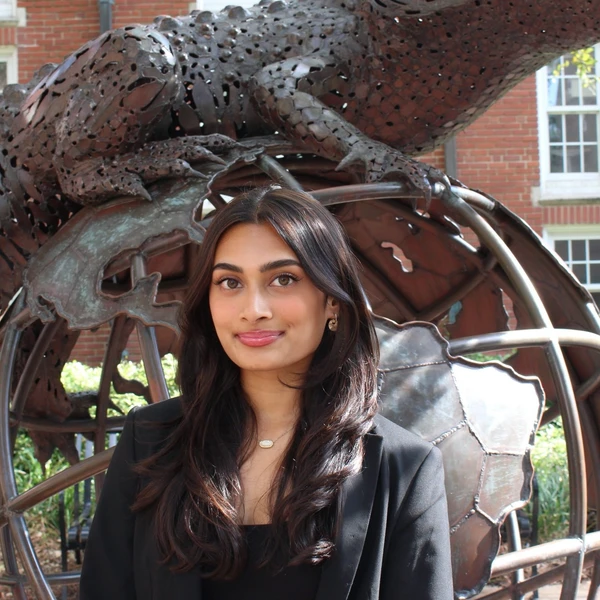
My name is Aanya Patel, and I am a third-year pre-medical student at the University of Florida majoring in Public Health and minoring in Women’s Studies. At the heart of everything I do is a deep commitment to health equity and community service. I hope to become a primary care physician serving rural and underserved communities, where gaps in access to care are greatest and where an understanding of social determinants of health can make a profound difference.
My path to medicine began when I was fourteen and learned about period poverty. I had heard stories of my mother’s experience growing up in India, but I was shocked to discover that one in four girls in the United States misses school because they lack menstrual products. Determined to help, I started a small drive to collect 1,000 products for my school. That effort grew into Global Girls Initiative (GGI), a 501(c)(3) nonprofit that has since donated over 500,000 products, developed a menstrual health curriculum used in 300+ workshops, and designed cost-effective dispensers installed in over 100 academic institutions, directly impacting more than 75,000 girls. I also worked with Florida legislators to help pass HB 389, which ensures free menstrual products for 1.4 million K–12 students statewide.
Leading GGI has been both challenging and formative. I learned to fundraise, build partnerships with organizations such as Procter & Gamble and AstraZeneca, and create sustainable health interventions that move beyond temporary fixes. Just as important, I learned to listen to the needs of the community (students, parents, and educators) and to design solutions that fit their reality. This experience revealed how closely health and education are linked, and how access to basic resources determines whether young people can succeed.
Through clinical research, hospital volunteering, and physician shadowing, I have seen similar patterns: patients’ health outcomes are shaped as much by their environment and daily challenges as by their biology. I have met patients with chronic illnesses like type 2 diabetes whose biggest barrier wasn’t medication, but the inability to buy healthy food, find safe spaces for exercise, or take time off work for appointments. These encounters convinced me that I want to practice primary care medicine in underserved areas, where I can build long-term relationships with patients, address social determinants of health, and advocate for systemic change.
Outside of academics and service, volleyball and music are central to who I am. I have played competitive volleyball for eight years, including four years on my high school varsity team, which instilled discipline, resilience, and a love of teamwork. I have also played the flute since middle school, serving as first chair in my high school wind ensemble, where I learned focus, creativity, and the importance of harmony, skills that will serve me well in medicine.
With your support, I can continue combining my passion for health, service, and human connection into a career that provides compassionate, equitable care. I am excited to bring the same energy I have devoted to Global Girls Initiative, volleyball, and music to medical school and to a lifelong mission of improving health for communities most in need.