High school senior, undergraduate, or graduate student
Background:
English is a second language
Education Level:
Background:
High school senior, undergraduate, or graduate student
English is a second language
People who speak multiple languages are skilled and talented, holding significant knowledge not just about linguistic rules but also the intricacies within how each language conceptualizes life.
Unfortunately, students whose first language isn’t English often face difficulties in their youth as they work to overcome language barriers, often being forced to act as a translator for friends and family and having to go through their education using their second language.
This scholarship aims to recognize the skill and strength of multilingual individuals as they pursue their higher education goals.
Any high school senior, undergraduate, or graduate student whose first language is not English may apply for this scholarship.
To apply, tell us about yourself, your post-graduation plans, what your first language is, and what the challenges and benefits of being bilingual/multilingual are.
One day, everything changed. I woke up not from the sound of the alarm, but from the sound of sirens and, sadly, the rockets. It was an invasion of my country, Ukraine. The place where I was born and grew up, where I spent all my childhood. My family made a decision that for my mother and me, it would be safer and provide more opportunities to start a completely new life, in a completely new country, across the ocean. When I came to the United States of America from Ukraine, my first freshman year was totally new. Life in the U.S appeared not sweet, as it is always shown in Hollywood movies. I didn't speak English, and I felt entirely lost in a new world, where I had to start from the beginning, experiencing a deep existential vacuum.
My first challenge was English; I knew it only from the textbooks and school lessons, where we were just learning: "London is the capital of Great Britain". When I went on my first day to the American High School, it was a completely new world for me. Every time, I was feeling ashamed that I was different than my peers. But at Northeast High School, with the help of a great ESOL and AOF teachers, I decided to face these massive obstacles head-on. I realized that my future is only in my hands. I treated academics as my first job, working tirelessly to break through the language barrier.
There was a bilingual assistant named Natasha who took me from the diapers in the 9th grade when I just came. She showed me that if there is an obstacle, you may fall, but you get up and move forward. I was a volunteer member of English Speakers of Other Languages (ESOL) and had experience in volunteering at school and in churches/charities. I helped foreign students in successful entering High School (translation services). When you go through a hard path and achieve the most desirable goal, it's satisfying to help others, so they don't have to go through the same difficulties as I did.
The last thing that started to attract me was air. I have understood that I will never become an office worker, that freedom and adventure are what I live for. For me, becoming a commercial pilot, being part of the wind, brings the feeling that I am in this energy. Now, just a few years later, I am graduating with a 4.47 GPA, Honor Awards, and an acceptance to ERAU. When I become a commercial pilot, the first thing I'll do is show my family the world I never had. Helping other people, creating new foundations, clubs, and charity organizations would be my calling. I am most proud that I survived the darkest vacuum of my life, persevered through the silence of a new language, and accomplished my dream.
Being bilingual is an exciting skill but for me, being multilingual is most fulfilling. My name is Ivan and I am a senior attending Sun Prairie West High School. Currently, I have been applying to colleges in Wisconsin. My post-graduation plan is to attend University in Wisconsin. My current interests for majors are computer science and political science.
My first language is Vietnamese. I was born in Vietnam and moved to the United States with my family when I was four years old. Learning Vietnamese was easy because the language was spoken around me since I was growing up. During my first few years in the United States, I lived with my cousins for a while. During this time, their parents would teach me easy English words. I learned “Hello”, “Bye”, and the ABCs.
What I found a challenge was when I started elementary school. It was increasingly difficult for me to make friends because of the language barrier. I had a teacher who was with me each day to help teach me English while I was in school. I would finish part of my classes and then have a study session with her to go through simple English phrases such as, “Hello my name is…” and “How are you doing today?” As I progressed through these lessons, I started talking to my classmates and slowly made friends, which was challenging in the beginning but gradually got better.
A benefit to being bilingual is the connections I have been able to make throughout the years using my English from elementary and middle school. I’ve met many great people who I still am friends with now in high school. Along with people in my community who are now close friends. Another benefit to being bilingual is being able to translate for my parents when they need help like at a doctor's visit or paperwork. I translated English to Vietnamese often for my parents when they took me to the doctors for a visit and to fill out school papers or bills. Being bilingual has shown me how I can help people with this skill.
During middle school, I took a multicultural class learning different languages and cultures of Spanish, Chinese, and French. When I started my freshman year of high school, I decided to take Spanish as a language class. Taking Spanish helped me learn more about how different languages can be intertwined like Spanish and English. Learning Spanish was challenging because the two languages I knew kept interfering with Spanish and I would get them mixed up sometimes. This created a barrier of confusion for me between all three languages but I kept studying and got better.
For me, the benefit of being multilingual now is still the connections I can make with people in my community. For example, when I volunteered for my school’s parent and teacher conferences, I was able to help parents who spoke only English and parents who only spoke Spanish. While learning Spanish, I forgot a little of my Vietnamese. This was a realization for me because being multilingual is an incredible skill to have but forgetting my native language is hard to take in. While studying Spanish, I also am studying more Vietnamese.
Currently, I am in Spanish 4 in my senior year of high school. Throughout my years of learning Vietnamese, English and Spanish, I learned many valuable skills from being multilingual such as communication in different languages to help others and ambition to learn multiple languages.
Explore All Kinds of Scholarships for All Kinds of Students
The application deadline is May 1, 2026. Winners will be announced on Jun 1, 2026.
How will scholarship application information be used?
Your privacy is a top priority on the Bold.org platform, and you can find our privacy policy in full here. You may opt out of communications from Bold.org at any time, and unless we’ve first notified you and gotten your consent, you’ll never receive communication from any third parties related to personal information you give us.
What is the scholarship award?
Award amounts per winner are designated by the donor. Check the award amount for a detailed breakdown.
When will the scholarship winner be chosen? How will they be notified?
The winner will be publicly announced on Jun 1, 2026. Prior to the announcement date, we may contact finalists with additional questions about their application. We will work with donors to review all applications according to the scholarship criteria. Winners will be chosen based on the merit of their application.
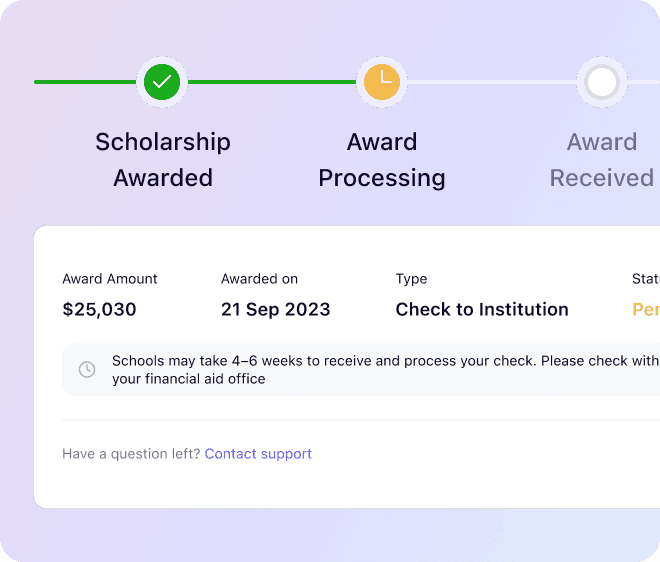
How will the scholarship award be paid?
Award checks will be sent to the financial aid office of the winner's academic institution or future academic institution in their name to be applied to their tuition, and in the name of their institution (depending on the school's requirements). If the award is for a qualified educational non-tuition expense, we will work with the winner directly to distribute the award and make sure it goes towards qualified expenses.
How will my scholarship application be verified?
Before we award the scholarship, the winner will be required to confirm their academic enrollment status. Depending on the circumstances, verification of Student ID and/or their most recent transcript will be required.
How should I get in touch with questions?
If you have any questions about this scholarship or the Bold.org platform, just email contact@bold.org and we’ll get back to you as quickly as we can.
Does the scholarship have terms and conditions?
Yes. The terms and conditions for this scholarship can be found here.
97% of students don't win scholarships. We’re here to change that.