Impacted by ALS (personally, through a family member, etc.)
Education Level:
High school student, high school graduate, or current undergraduate student
Background:
Education Level:
Impacted by ALS (personally, through a family member, etc.)
High school student, high school graduate, or current undergraduate student
Joseph A. Terbrack was a beloved son, brother, husband and father who passed away from ALS in 2023.
ALS, Amyotrophic Lateral Sclerosis, claims thousands of lives each year, leaving a hole in many families. ALS changes the fabric of many relationships, making an impact on the friends, family, and loved ones of those who are afflicted while being a traumatizing and ultimately fatal experience for the person who is diagnosed.
This scholarship aims to uplift and support students who have been impacted by ALS, so they have the strength and resources necessary to continue pursuing their dreams.
Any high school student, high school graduate, or current undergraduate who is/will be pursuing a college education and has been affected by ALS may apply for this scholarship.
To apply, tell us how ALS has impacted your life, what you’ve learned from your experience, and how you hope to move forward to help other people.
Selection Criteria:
Ambition, Drive, Impact
Essay Topic Requirements
How has ALS impacted your life? What have you learned from your experience and how do you want to move forward in life to help others?
400–600 words
$1,000
2 winners, $500 each
Awarded
Application Deadline
May 2, 2026
Winners Announced
Jun 2, 2026
Education Level
High School
Share
Explore All Kinds of Scholarships for All Kinds of Students
ALS has impacted my life in ways that are both deeply personal and transformative. For the past four and a half years, my father has been living with the disease, and during that time I have watched our family adapt to constant change. Everyday routines require more intention, more planning, and more patience. I have learned not to take time for granted and to value moments that once felt ordinary. Living alongside ALS has brought emotional challenges, but it has also strengthened me. It has reshaped my priorities, deepened my sense of responsibility, and given me a clearer understanding of what truly matters.
One of the most significant lessons I have learned is the meaning of resilience. I see it daily in my father’s determination to continue engaging with life despite physical limitations. Strength, I’ve realized, is not just physical ability; it is the willingness to keep moving forward even when circumstances are difficult. That example has changed how I approach obstacles in my own life. Academic stress, demanding coursework, and future uncertainties feel more manageable because I have witnessed what true perseverance looks like. ALS has taught me to confront challenges directly rather than avoid them.
I have also developed a strong sense of empathy. Living with ALS in my family has made me more aware of accessibility, communication, and the importance of independence. I have learned to listen more carefully and to be more patient, understanding that small adjustments can make a significant difference in someone’s daily life. This awareness extends beyond my home. It has shaped how I treat others, encouraging me to approach people with compassion and understanding because I know that many are facing battles that are not immediately visible.
Most importantly, ALS has given me direction for my future. I am pursuing mechanical engineering with the goal of contributing to advancements in medical and assistive technology. Experiencing ALS firsthand has shown me how critical innovation is in improving quality of life for patients and families. I want to be part of developing devices and systems that enhance mobility, comfort, and independence for individuals living with neuromuscular diseases. My motivation is not abstract; it comes from personal experience and a desire to make meaningful improvements where they are needed most.
Moving forward, I plan to help others both through my career and through continued community involvement. I want to use my education to design practical solutions that address real human challenges. At the same time, I hope to remain active in ALS advocacy and support networks, raising awareness and standing alongside families navigating similar journeys. ALS has changed my life, but it has also given me purpose. I want to move forward with that purpose, combining skill, compassion, and determination to help improve the lives of others.
When I was twelve years old, my life changed in ways most children my age could not imagine. My dad was battling ALS, also known as Lou Gehrig’s disease, a progressive illness that slowly takes away a person’s ability to move, speak, and eventually breathe. While many kids my age were focused on school, friends, and activities, my family was learning how to live with a disease that was taking our dad away from us piece by piece.
As the oldest daughter, I had to mature quickly. I stepped into responsibilities that many children never experience. I helped crush my dad’s medications, helped prepare his meals, and learned how to put together the equipment he needed just to eat. I also helped empty his catheter bag, and even woke up in the middle of the night to scratch his back because my mom finally fell asleep. These were things no 8 - 12 year olds expect to learn, but when someone you love needs help, you step up.
My mom was my dad’s primary caregiver, and she carried an incredible amount of responsibility every single day. She was exhausted almost all the time, trying to take care of him while also being there for our family. Watching her strength made me realize how much our family depended on each other. I also helped take care of my two younger siblings, doing my best to be strong for them and make things feel as normal as possible.
Even with everything happening at home, I continued to stay involved in school and activities. I played sports, danced, and worked hard in my classes. Those activities became an outlet for me and a reminder that life could still have moments of joy. No matter how hard things were at home, I didn’t want to lose sight of my future.
In 2019, my dad passed away. Losing him was one of the most painful experiences of my life. The grief that comes from losing a parent at a young age does not simply go away. It stays with you in quiet moments, in memories, and in the realization that there are milestones they will never get to see. Shortly after we lost him, the COVID-19 pandemic began, and the world shut down just as my family was trying to process our loss. It was an isolating time that made everything feel even heavier.
Although these experiences were incredibly difficult, they shaped the person I am today. Watching my dad fight ALS and helping care for him taught me empathy, patience, and resilience. It showed me the importance of compassion and the impact that support and understanding can have on someone going through a difficult time.
Because of what my family experienced, I want to dedicate my future to helping others. I plan to major in psychology and become a special education teacher. I want to support students who may feel misunderstood or struggle in traditional classrooms and help them recognize their strengths. Every child deserves someone who believes in them and helps them see what they are capable of.
My dad’s battle with ALS changed my life forever. While it brought unimaginable loss, it also taught me strength, compassion, and the importance of helping others. Those lessons will guide me as I move forward in life and work toward making a positive difference in the lives of the students I hope to serve one day.
When I was just four years old, my father passed away from ALS. At that age, I didn’t fully understand what ALS was, only that it was something serious. Something that was taking my dad away from me. I didn’t know how to cope with the magnitude of that loss, and the grief quickly turned into anger, confusion, and pain. I started acting out in any way I could, whether it was at school, on the bus, or at home. I was constantly getting sent to the principal’s office or written up for misbehavior. What I really wanted and what I really needed was for someone to understand that I was hurting and lost.
Most of the kids around me didn’t understand. How could they? But some of my teachers did. They knew what I was going through, and they did their best to help me. Still, sympathy only goes so far, and as I got older, the expectation to “control myself” grew. So I did what I had to do; I adapted. I started learning how to recognize my emotions before they controlled me. I learned how to communicate what I was feeling instead of lashing out. I started understanding that the world wasn’t going to adjust for me so I had to adjust to it.
That was one of the hardest lessons I’ve ever learned: life isn’t fair. No one is going to swoop in and save you. That realization forced me to grow up quickly, much faster than any child should have to. I had to become my own guide through a confusing and often painful world.
Even now, I miss my dad every single day. There’s nothing I wouldn’t give to change the outcome of his diagnosis. But the truth is, his passing shaped me into the person I am today. If he were still here, I’m sure he’d expect me to have values like strength, responsibility, and compassion but I know they wouldn’t be so deeply embedded in me without this loss.
Losing my father at such a young age gave me a high tolerance for emotional pain. Nothing I’ve experienced since has compared to the moment I came home from school and heard my mom crying at the kitchen table. I didn’t have to ask what had happened, I just knew. I felt it deep in my chest. That moment will never leave me.
Growing up without a father also meant learning how to be independent. It meant figuring things out on my own, especially as I entered my teenage years and began facing challenges I wished I could ask him about. I also learned discipline early on. Helping my mom take care of the house, doing dishes and laundry so she could have just a moment to herself.
These life lessons came from trauma, but they gave me purpose. I’ve learned how to care more deeply, how to be empathetic, and how to appreciate the fleeting moments we have with the people we love.
Moving forward, I want to help others who are grieving or facing something similar. I want to be a source of strength and comfort for kids who feel alone, like I once did. Whether it’s through volunteering, advocacy, or simply being someone others can talk to. More than anything, I want to honor my father’s memory by making a difference in the lives of others.
The greatest challenge I have ever faced began in October of 2018 when my father arrived home from work and told me that he had been diagnosed with ALS. From then on, my life was forever changed. The four years that my father was sick affected me in numerous ways and taught me several things that have helped me grow into the person I am today.
My father’s illness affected my life in several ways. First, it put me in charge of new and difficult tasks. While in the first few months my father was able to maintain a somewhat normal life, he eventually lost control of his limbs and was confined to a hospital bed in our living room. As his caretakers, my mother and I had to bathe him, take him to the bathroom, monitor his oxygen mask, and hand-feed him. These tasks grew increasingly difficult as my father’s sickness worsened, and there were several times when I had to care for him entirely on my own. In addition to these new and sometimes frightening tasks, ALS also affected my ability to connect with the outside world. We couldn’t go far in the fear that my father would need help in our absence. When we did manage to leave, I found myself dreading what my father’s condition would be when we came back home. It was a period of relentless work and anxiety for my family, but not everything was negative.
While living with an ALS patient was terrifying, it did teach me some important lessons. Through my experience with ALS, I learned how to solve problems using a calm, rational approach. For example, early on in his illness, my father fell and hit his head. Unable to breathe or get up on his own, he frantically called for help. By remaining calm, we were able to lift my father to safety, while also ensuring that he was breathing properly. Living with ALS also taught me how to handle change. Each new stage of my father’s illness required my family to create new systems to care for him. While this caused frustration and anger at first, we eventually became accustomed to adjusting our lives. Communication became essential, and we often came together as a family to discuss possible changes that would be occurring in the future. There were times when we felt afraid and unsure, but it was during those times that I learned how to overcome my fears and trust that, with hard work and determination, my family could make it through any trial we faced.
Living with an ALS patient taught me many things that have helped me to mature into a young woman. While there were times of sadness and difficulty, I was able to work through them with my family at my side. Two weeks after my father died I had a dream about him. In the dream I was nine years old again, standing on stage at my very first dance competition. When I looked out into the crowd, I saw my father. He lifted his arms and shouted: “I am proud of you!” Because of my struggles with ALS, I have hope for a brighter future- not only to make myself proud, but also to make my father proud. I want to earn a degree in history so that I can educate others about the history of diseases such as ALS. I hope that by educating others about the past, we will be able to improve upon the future, and hopefully find a cure for this terrible disease.
Saying my family background affects the way I see the world is a huge understatement. You see, my father was diagnosed with ALS 7.5 years ago. My dad has always been the one person on Earth I am closest to. When I was younger, he tried shielding me from how sick he was and how sick he would become. In our society, where technology is so readily available, it did not take long for me to discover the average lifespan for someone with ALS is 2-5 years. I do not think most kids have to live knowing their father will likely not be there when the graduate from high school. We start thinking about our wedding day as little girls. Unlike my peers though, I in high school often thought about how my dad would not be there to walk me down the isle.
In addition to looking to the future, I have had to deal with the present. My dad is the most outgoing and athletic man I have ever known. Thanks to his influence, I am a runner. We actually used to run together almost every day. Ove time though, he has lost the ability to speak, use his arms and hands, dress himself, feed himself, sleep without assistance from a breathing machine, or walk without fear of falling and hitting his head.
So yes, my family background has definitely affected the way I see the world. It has at times made me angry and sad. I am ashamed to have at times hoped and prayed for a normal life. While I try helping him with feedings, getting dressed, and other things he needs, the truth of the matter though is that he helps me more than I help him. He has done that by somehow always staying positive and demonstrating a strong faith in God. He has taught me life can be cruel and does not always work out like you planned, but you have to focus on and celebrate the blessings in your life rather than allowing yourself to be drowned by the negative things experienced in life. If I am ever blessed to have a son, there is little doubt he will share my father’s name of David. Despite the cards life deals me, I hope to have a similar perspective on life and hope to teach him how to navigate it much the way my dad taught me.
In regards to how I plan to make a difference in my field of study, I plan on majoring in Biological Sciences before moving on to study Physical Therapy at MUSC. My dad’s influence of physical activity and sport certainly plays a role in what I plan to do. More so though is the indirect influence of watching his body decline. I saw how much physical therapy helped him and want to myself help once strong / healthy people regain some mobility, pride, and quality of life. While I do not ever think I can match my father’s mental strength, he can live on through me as I work to make a difference in the world.
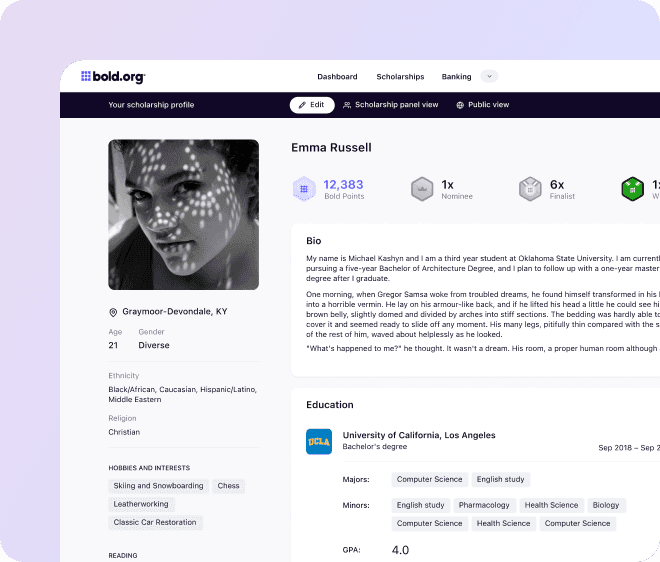
How it works
Bold.org is Built to Make Scholarships Feel Possible
Step 01
Start with your story
Bold.org helps students show donors who they are beyond a transcript.
Step 02
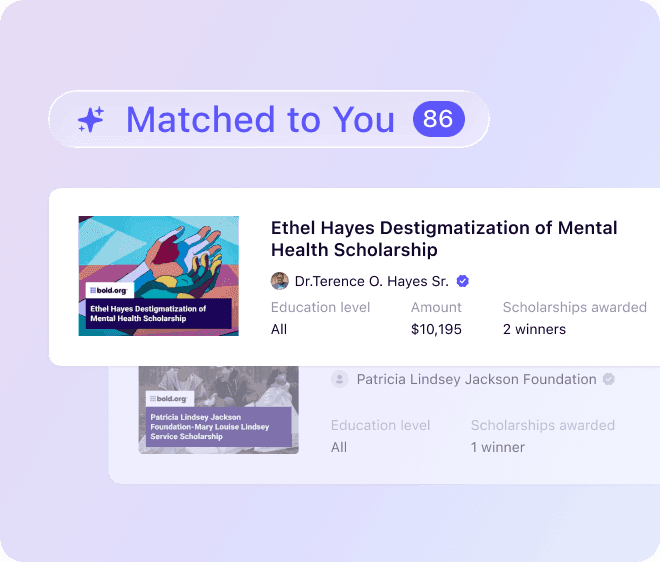
Where scholarships are awarded
Every scholarship is funded by donors and managed directly on Bold.org.
Step 03
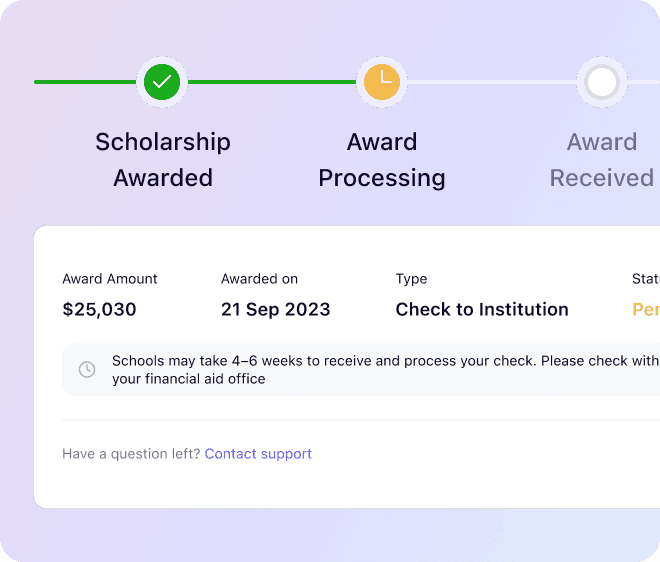
Fund your future
Scholarship dollars are disbursed through Bold.org to help students pay for school.
FAQ
When is the scholarship application deadline?
The application deadline is May 2, 2026. Winners will be announced on Jun 2, 2026.
How will scholarship application information be used?
Your privacy is a top priority on the Bold.org platform, and you can find our privacy policy in full here. You may opt out of communications from Bold.org at any time, and unless we’ve first notified you and gotten your consent, you’ll never receive communication from any third parties related to personal information you give us.
What is the scholarship award?
Award amounts per winner are designated by the donor. Check the award amount for a detailed breakdown.
When will the scholarship winner be chosen? How will they be notified?
The winner will be publicly announced on Jun 2, 2026. Prior to the announcement date, we may contact finalists with additional questions about their application. We will work with donors to review all applications according to the scholarship criteria. Winners will be chosen based on the merit of their application.
How will the scholarship award be paid?
Award checks will be sent to the financial aid office of the winner's academic institution or future academic institution in their name to be applied to their tuition, and in the name of their institution (depending on the school's requirements). If the award is for a qualified educational non-tuition expense, we will work with the winner directly to distribute the award and make sure it goes towards qualified expenses.
How will my scholarship application be verified?
Before we award the scholarship, the winner will be required to confirm their academic enrollment status. Depending on the circumstances, verification of Student ID and/or their most recent transcript will be required.
How should I get in touch with questions?
If you have any questions about this scholarship or the Bold.org platform, just email contact@bold.org and we’ll get back to you as quickly as we can.
Does the scholarship have terms and conditions?
Yes. The terms and conditions for this scholarship can be found here.
97% of students don't win scholarships. We’re here to change that.