Applying to Historically Black Colleges and Universities (HBCUs) offers various compelling reasons. HBCUs hold cultural and historical significance, providing a connection to a legacy of African-American education during times of segregation. They are known for academic excellence, foster supportive communities with smaller class sizes, offer unique cultural enrichment, provide scholarship opportunities, emphasize leadership development and community engagement, offer extensive networking opportunities through alumni networks, promote diversity within their own communities, uphold traditions, and have a track record of producing successful graduates across various fields. Ultimately, choosing an HBCU should align with the students academic and personal goals, necessitating research and consideration of individual preferences.
This scholarship seeks to help students who need financial assistance in order to pursue their dreams of higher education.
Any high school senior or undergraduate student attending or planning to attend an HBCU with at least a 2.8 GPA may apply for this scholarship.
To apply, tell us about yourself and your journey to get to this point. How do you plan to make a difference for your family and community through your actions and choice of study?
Selection Criteria:
Ambition, Drive, Impact
Essay Topic Requirements
Please tell us about yourself and your journey to get to this point.
What does it mean to you to attend an HBCU.
How do you plan to make a difference for your family and community through your actions and choice of study?
600–1000 words
$1,655
1st winner$828
2nd winner$827
Awarded
Application Deadline
Apr 14, 2026
Winners Announced
May 15, 2026
Education Level
High School, Undergraduate
7
Contributions
Share
Explore All Kinds of Scholarships for All Kinds of Students
My journey begins in Atlanta, where life taught me resilience long before I understood the word. My parents separated early, and my mom, who had us young and never finished high school, raised four children on her own. We moved from shelter to shelter, sometimes walking miles just to get to school. Even when we finally found an apartment, the neighborhood was so unsafe that gunshots at night became background noise. But even in the middle of instability, I promised myself I would never let my environment define me. I believed my circumstances were shaping me, not limiting me.
Everything began to shift when I joined a youth mentoring program in the third grade. For the first time, I saw men who led with discipline, respect, and professionalism. They showed me what it looked like to carry yourself with purpose. They did not just teach me how to behave, they taught me how to believe in myself. That experience planted the seed for the kind of man I wanted to become.
As I grew older, life demanded even more from me. When my mom lost her job, I stepped up. Between school, helping raise my siblings, and working to help pay bills, there was barely any space left for myself. Five of us shared a two bedroom apartment, and I slept in the same room as my brothers and sisters. Still, something in me refused to quit. I held on to the vision of a better future for my family and for the young people who would one day look up to me.
Then everything changed again. One morning while getting ready for school, my body gave out. I woke up in a hospital bed after having my first seizure. At the time, I did not know what it meant. What made it even harder was that this happened during the government shutdown, when my family’s Medicaid was turned off. I could not make follow up appointments, could not see a neurologist, and could not get answers. I was left to navigate a condition I did not even have a name for.
In the months that followed, my life shifted in ways I was not prepared for. I could not stay out as late as I wanted. I could not push myself the way I used to. I started having intense body jerks, and I had no idea what caused them. All I knew was that if I stayed up too late, did not drink enough water, or got too stressed, the jerks got worse. I learned to pray no one would notice when they happened in public. I learned to hide my hands under tables, to turn away when I felt one coming, and to pretend everything was normal even when my body was telling me otherwise.
Balancing school, leadership roles, mentoring younger boys, and helping at home became even harder. The stress built up, and without medical support, I felt like I was walking through life with a weight no one else could see. Then in January 2026, I had another seizure. This one scared me even more because I still did not know what caused them, and I still was not on medication. But that moment became a turning point. Instead of letting fear control me, I decided to let it push me. I realized that epilepsy did not have to define me. It could shape me into someone stronger and more aware.
When I finally received my diagnosis of myoclonic epilepsy in February 2026, it was almost a relief. I finally understood what I had been fighting alone for nearly a year. And with that understanding came a new sense of control. Today, I am not hiding anymore. I am learning to manage my condition, advocate for myself, and show up fully for the young boys I mentor. I want them to see that challenges do not disqualify you from your purpose. They refine it.
This journey is a major part of why attending an HBCU means so much to me. To me, an HBCU is not just a school. It is a community built on legacy, pride, and excellence. It is a place where students lift each other up, where culture is celebrated, and where young Black men like me are seen, valued, and pushed to grow. I feel like HBCUs are places where I will feel love and resilience, where I will be supported because the people around me are gifted and talented and they look just like me. At an HBCU, I see myself surrounded by people who understand my story without me having to explain it. I see myself learning from professors who look like me and know how to guide students with both rigor and compassion.
My purpose is to use my education to make a difference for my family and my community. I want to become a teacher, not just to teach a subject, but to teach life. Mentoring fifth grade boys showed me how many young Black boys feel disconnected from their teachers, how acting out is often a cry for attention, and how potential gets lost when no one sees it. I want to be the adult who understands where they come from, who recognizes their emotions, and who gives them the tools to build futures they cannot yet imagine. Representation is not just important, it is transformational.
My past gave me resilience, compassion, and vision. My purpose is to use those gifts to shape the next generation. I want to be the first in my family to graduate from college, but more importantly, I want to be the teacher who changes lives, the mentor who builds leaders, and the man who proves that where you start does not determine where you can go.
North Carolina A & T State UniversityGreensboro, NC
Growing up, I understood early that where you start does not have to determine where you finish. To make it out of the projects or any rural neighborhood, the first step is education. In many Black communities, higher education is not always emphasized the way it should be. Sometimes it is not because people do not care, but because survival becomes the focus. When you grow up seeing struggle as normal, it can feel safer to stay where you are than to step into something unfamiliar. I saw that mindset around me, even within my own family. Fear of the unknown can keep people stagnant.
But I knew from a young age that I was not going to let that be my story. I made a decision early on that I would break that cycle. I did not want the generations after me to understand what it feels like to struggle constantly or to feel like your only option is to accept whatever scraps are handed to you. I wanted more. Because of that, I stayed focused. I made sure I was at the top of my classes and involved in programs and activities that people in my family had never imagined for themselves. I pushed myself into spaces that felt unfamiliar because I understood that growth requires discomfort. Every achievement was not just for me. It was proof that my environment would not define my outcome.
I graduated high school as salutatorian of my class, determined to continue building something greater. When I chose to attend North Carolina A&T State University, an HBCU, it was intentional. Attending an HBCU means being surrounded by excellence that looks like me. It means learning in an environment where my culture is celebrated, not explained. At North Carolina A&T, I see future doctors, engineers, nurses, researchers, and leaders who come from backgrounds similar to mine. That representation strengthens my confidence and reminds me that I belong in every space I enter.
Attending an HBCU also connects me to a powerful history. These institutions were created at a time when Black students were denied access to education. Knowing that gives my education deeper meaning. I am walking in classrooms built on resilience, sacrifice, and determination. That legacy pushes me to take my opportunities seriously. I am not just earning a degree. I am honoring the sacrifices of those who came before me and proving that their fight was not in vain.
I chose to study nursing because I have seen how health disparities impact Black and underserved communities. I have watched family members struggle with chronic illnesses, limited access to quality care, and a lack of health education. As I advanced in nursing school, I gained experience in critical care settings and participated in research focused on social determinants of health in marginalized populations. Those experiences showed me that healthcare is not just about treating disease. It is about addressing inequities, advocating for patients, and educating communities.
My goal is to begin my career in critical care, serving patients during some of the most vulnerable moments of their lives. Long term, I plan to become a Certified Registered Nurse Anesthetist so I can continue advancing clinically while increasing representation in advanced practice nursing. Representation matters. When patients see providers who understand their cultural background and lived experiences, it builds trust. I want to be that provider.
For my family, my education represents generational change. I am building on sacrifices that were made long before me. I want to create financial stability and opportunities that were not always available to us. I want my younger siblings and cousins to grow up believing that college, advanced degrees, and professional careers are normal and attainable. I want them to see that fear of the unknown should never be stronger than the desire for something better.
For my community, I plan to give back through service, mentorship, and advocacy. I have already participated in community health initiatives that provide screenings and education in underserved neighborhoods. I plan to continue that work throughout my career. Whether through mentoring students interested in healthcare, volunteering in community outreach programs, or contributing to research that addresses health disparities, I intend to use my education to uplift others.
Attending an HBCU has strengthened my identity and sharpened my purpose. It has surrounded me with mentors who challenge me and peers who inspire me. Most importantly, it has reminded me that excellence is not rare in our communities. It has simply been overlooked. I am committed to changing that narrative.
My journey has required resilience, discipline, and faith. I am not pursuing education simply for personal success. I am pursuing it to break cycles, to create opportunities, and to serve others. My degree in nursing will allow me to provide care, advocate for equity, and lead with compassion. Through my actions and my career, I plan to make a lasting difference for my family and for the community that shaped me.
My Journey, My Purpose
My name is Jade Williams, and I am a proud student of entrepreneurship from Lancaster, California. Growing up in a close-knit yet resilient family, I learned early on the power of perseverance, love, and faith in the face of adversity. One of the most transformative experiences in my life has been watching my brother navigate life with schizophrenia. His journey has not been easy, nor has it been easy for my family. But through the challenges, I’ve witnessed an incredible strength within him—and within all of us. His experience has given me a profound sense of purpose: to advocate for mental health, break stigmas, and create opportunities for healing and growth in underserved communities.
From a young age, I saw how mental health struggles can isolate people, particularly in communities of color. For my brother, it was not just the illness but also the judgment and lack of resources that weighed heavily on him. For my family, it was a constant battle to find support systems that understood what we were going through. But these challenges didn’t break us; they motivated me to find solutions and use my passion for entrepreneurship to make a meaningful impact.
Attending an HBCU is not just an academic decision for me—it is a spiritual and cultural calling. HBCUs are more than institutions; they are havens of resilience, empowerment, and excellence. They represent the dreams and sacrifices of generations who fought for equality and opportunity. For me, attending an HBCU means walking in the footsteps of giants who paved the way for me to be here today. It means being part of a community that understands my story, values my culture, and pushes me to excel not only for myself but for my family and my community.
At my HBCU, I feel seen in ways I never have before. My professors, peers, and mentors believe in me and remind me that I am capable of greatness. This environment has helped me embrace my identity and given me the courage to dream bigger. It has also taught me that my success is not just my own—it is tied to a larger legacy. Every step I take is an opportunity to uplift others, and I don’t take that responsibility lightly.
My passion for entrepreneurship stems from a desire to create something meaningful out of life’s challenges. Inspired by my brother’s journey, I created JADED, a service where art and mental health intersect. The idea behind JADED is simple yet powerful: to provide a safe space for adults to process their emotions through painting. Art has a way of speaking when words fail, and I wanted to create a platform where individuals could express themselves without judgment. Each session also contributes to mental health nonprofits, ensuring that JADED has a ripple effect beyond its participants.
Through JADED, I have seen how something as simple as painting can be transformative. Participants have shared stories of healing, connection, and self-discovery, and each session reminds me why I chose this path. However, JADED is only the beginning. My ultimate goal is to grow this initiative into a larger platform that provides resources, education, and support for families impacted by mental health challenges. I want to be a voice for those who feel unheard and a bridge for communities that have been overlooked for far too long.
My entrepreneurial vision extends beyond mental health. I want to create businesses that address systemic inequalities, provide opportunities, and inspire others to dream beyond their circumstances. For my family, I want to offer stability and financial security, showing them that we are not defined by our struggles but by how we rise above them. For my community, I want to be a beacon of hope, proving that meaningful change is possible when we combine passion with purpose.
Attending an HBCU has been the foundation for this vision. It has taught me the importance of community, the power of resilience, and the value of education. My journey here has shown me that entrepreneurship is not just about building wealth—it’s about building a legacy. It’s about using my skills and knowledge to create a better world for those around me.
Every step I take in my journey is driven by love: love for my brother, who inspires me daily; love for my family, who have supported me unconditionally; and love for my community, who deserve more resources, opportunities, and understanding. My mission is clear: to combine my entrepreneurial skills with my passion for mental health advocacy to create lasting change.
I know the road ahead won’t be easy, but I am prepared. My experiences have given me the resilience to face challenges head-on and the determination to turn obstacles into opportunities. With the education and empowerment I am gaining at my HBCU, I am confident that I can make a difference—for my family, my community, and future generations.
Attending an HBCU is not just about my present; it is about my future. It is about honoring the past and creating a legacy that uplifts, inspires, and empowers. Through my entrepreneurial journey, I hope to show others that even the most difficult experiences can lead to purpose and greatness.
My name is Travis Rivers, and I’m an 18-year-old freshman majoring in mechanical engineering at North Carolina A&T State University. I come from Hampton, Virginia, and I take pride in everything I’ve accomplished—from leading environmental projects in high school to mentoring students through NASA programs. All of these experiences have led me to pursue my dream of becoming an engineer who solves real-world problems and helps others through innovation. My journey hasn’t always been easy, but it has shaped me into someone who is resilient, determined, and committed to making a difference.
Ever since I was young, I’ve been curious about how things work. Whether I was building LEGO structures or helping fix things around the house, I loved using my hands and my mind to solve problems. In high school, that curiosity developed into a passion for mechanical engineering. I was particularly drawn to areas like renewable energy, robotics, and infrastructure because I saw the potential to improve people's lives while also protecting the environment. I realized how powerful engineering can be in addressing some of the biggest challenges we face today, such as climate change and energy sustainability.
My time at Kecoughtan High School was filled with meaningful experiences that helped shape who I am today. I served as the president of the Ecology Club, where I led environmental initiatives that earned us the Innovative School Award from the Hampton Clean City Commission. I was also active in the Robotics Club, where I assisted in designing and building competition-ready machines. These leadership roles taught me the importance of teamwork, effective communication, and staying committed to goals—even when faced with challenges.
One of the most impactful experiences I’ve had was interning with the Virginia Space Coast Scholars program. There, I mentored high school students as they designed their own NASA missions. I taught them research, teamwork, and technical skills while guiding them through real engineering challenges. Watching them succeed and knowing I played a role in their growth reminded me of the importance of giving back and uplifting others.
Choosing an HBCU was a meaningful and personal decision. HBCUs represent more than just education—they stand for history, excellence, culture, and resilience. HBCUs gave us a place to learn, grow, and lead. Now, they continue to be a place where Black excellence thrives. At NC A&T, I’m not just earning a degree—I’m learning how to lead, how to create change, and how to be proud of who I am and where I come from.
Being at an HBCU has given me a strong sense of community. I’ve joined organizations like NSBE (National Society of Black Engineers), ASME (American Society of Mechanical Engineers), Aggie Toastmasters, and Men on the Move. These groups help me grow as a student, as a future engineer, and as a person. Through them, I’ve built friendships, found mentors, and developed skills in leadership, communication, and public speaking. Being part of this community makes me feel supported and confident in my journey.
My goal is to become a mechanical engineer who leads projects that make the world a better place. I want to focus on renewable energy, robotics, and environmental systems—fields that can improve lives and protect the planet for future generations. Whether it’s designing energy-efficient buildings, building robots that help people, or improving transportation systems, I want my work to have a lasting positive impact.
But my mission goes beyond engineering. As a young Black man in STEM, I know that fewer than 5% of mechanical engineers are Black. That number needs to change, and I want to be part of that change. I want to serve as a role model for others who look like me—especially young students who may not see themselves represented in engineering or science. I want them to know that they belong, that they’re capable, and that they can succeed.
Giving back to my community is one of my top priorities. Whether it’s through mentorship, public service, or innovation, I plan to use my education to help others. I want to return to my hometown and create programs that teach STEM skills to middle and high school students. I want to help build a pipeline of diverse engineers who care not only about technology but also about people and the planet.
Right now, one of the biggest challenges I face is the cost of college. My family is doing their best to support me, but the financial burden is heavy—especially with my younger sister starting college in a few years. Receiving this scholarship would relieve a lot of that pressure. It would allow me to focus more on my studies, attend workshops, participate in internships, and continue leading in the organizations I care about. Without the constant worry about money, I could dedicate more time to building my skills and preparing for my future career.
This semester, I’m taking tough but rewarding courses like Engineering Design & Ethics, Calculus II, Physics I, Chemistry, and Graphics for Mechanical Engineering. At first, the pace of college hit me hard. I struggled with time management and keeping up with difficult concepts. But I didn’t give up. I sought help from professors, joined study groups, and adjusted my habits. I learned that it’s okay to ask for help and that growth comes from persistence. These lessons have made me a better student and a stronger person.
Receiving this scholarship would not only support my education but also help me become the person I aspire to be: a leader in engineering, a mentor to others, and a changemaker in my community. Your investment in me would go far beyond the classroom. It would help me gain the knowledge, experience, and connections I need to lead teams, build innovations, and inspire future generations.
Thank you for considering my application and for supporting students like me who are striving to make a difference.
North Carolina A & T State UniversityFuquay Varina, NC
I am currently a Freshman at North Carolina Agricultural & Technical State University majoring in Social Work. I was recently inducted as a member of the Freshman Honors Society, Alpha Lambda Delta and I made the Dean’s List for the fall semester. I also am a member of a natural hair appreciation group on campus called NAPS. As a high school student, I was a member of many organizations both in and outside of school. For example, I was Treasurer of the SGA and the Treasurer and Social Media Manager for a non-profit group called Kimberly’s Touch. I also challenged myself with rigorous coursework starting with honors classes in my freshman year to undertaking the IB Diploma Program in my junior and senior years of high school. Upon graduating, I received the President’s Award and hosted a food truck rodeo service project for Kimberly’s Touch.
To me attending an HBCU means community and culture enrichment. When people think about attending an HBCU they think of just a college with a lot of black people attending in STEM fields, but an HBCU is much more than that. When you attend an HBCU you are instantly mixed with a lot of different cultures and you are given the privilege to interact and learn from all these different types of people on your campus. At an HBCU we are given a lot of opportunities that we may not have received if we went to a PWI because there is a focus and concern with advancing black leaders, doctors, engineers, social workers, speech pathologists, etc. of tomorrow. Whereas if we went to a PWI instead the opportunities may not be as tailored to us because there is no one there to look out for us and role models who share the same experiences and aspirations as we did and have to navigate the world as we (black people) do.
I plan on making a difference for my family and families like mine in the community through children. I will be able to create a brighter future for others by working with kids and their families to give them better opportunities to succeed in life. Kids are an important part of society, not only do they have a massive influence on society, but they determine how society works in the future. A child’s development plays a very important role in this. If a child grows up in a harmful environment it can negatively affect a child’s physical, moral, psychosocial, and cognitive developmental stages (according to popular developmental theorists like Kohlberg and Piaget) and one misstep in any stage of development will affect other stages of a child’s development. If a child grows up in a positive environment the opposite is true, and the child will grow up reflecting the positive environment they came from into adulthood. As a social worker, I can have an impact on the types of environments children live in. This will allow me to place children in a positive environment or help their parent(s)/ guardian(s) provide a better life for them. I believe that children are our future, and they are heavily affected by the world around them and if we want to build a brighter future, we must start by surrounding children with positive ideals, values, and goals.
My goal in my future career is to help surround children with positivity. As a social worker, I can put children into better living situations if they are currently in one that is unsuitable/ harmful or help their parents so that they don’t have to be removed from their homes. I can help keep families together by helping parents find low-cost or free daycare so they can work because some parents can’t work/ work many hours because they don’t have childcare. I can not only influence kids that I work with, but children in my community as well. I can support programs like the Boys and Girls Club to help keep kids out of trouble and promote academic and social success or I can work with leaders in my community to plan and implement local events for children so that they can socialize, and it also gives them a chance to spend time with their families. I want to leave a positive impact on everybody I encounter in life, but I must complete my educational goals to succeed in my career.
Getting to this point in my life has been a winding road of personal growth, determination, and the unwavering support of my family. I was born and raised in an intimate community where the values of tolerance, unity and education were encouraged from an early age. My journey has been shaped by the challenges we face as a family, the determination to overcome them and the belief that education is the key to unlocking a brighter future.
Growing up, my family faced financial hardship and the road to academic success was often full of obstacles. However, despite limited resources, my parents emphasized the importance of education to break the cycle of generational struggle. Their sacrifices and dedication became the driving force behind my knowledge and personal development.
HBCUs, historically black colleges and universities, have deep meaning for me. It is a choice rooted in both cultural pride and a desire for a supportive and empowering academic environment. HBCUs have a rich heritage of promoting academic excellence, cultivating leadership, and fostering a sense of belonging for students of color. When I step onto an HBCU campus, I see more than just a college; I see a community that values and celebrates diversity and provides an environment where I can thrive academically and culturally.
Being a member of an HBCU means connecting with the legacy of pioneers who fought for educational opportunity during a time of discrimination and segregation. It is a tribute to the tenacity and brilliance that have defined black scholars and leaders throughout history. Attending an HBCU is not just about getting a degree; it means embracing our heritage, advocating for our heritage, and being part of a community that understands the unique challenges and triumphs that people like me face.
My chosen field of study, Social Work, is a testament to my commitment to impact both my family and community. Social work is my calling—the opportunity to act as a catalyst for positive change, especially in underserved communities. My family and experiences of economic hardship and lack of available resources fueled my passion to address social inequality and advocate for those who may not have a voice.
I try to be a sign of hope for my family with my activities and studies. Doing social work means I gain knowledge and skills to deal with the systemic problems that have affected us. I want to create opportunities for others to overcome obstacles similar to my families, whether through community action, mentoring programs, or advocacy for political change.
In addition, my commitment to impact on the family extends to the wider community. I envision using my education and experience to develop and implement programs that address the unique challenges of marginalized groups. This includes promoting better access to quality education, affordable health care and social services that can uplift individuals and families.
HBCUs provide me with a platform to connect with like-minded people who share a commitment to social justice and community empowerment. It provides an environment where I can work with peers and mentors who understand the nuanced struggles of marginalized communities and are committed to making positive changes.
Finally, my journey has been a tribute to the transformational power of education and the resilience instilled in me by my family. Attending an HBCU is a deliberate decision to be a part of a community that supports diversity and empowers individuals to overcome historical obstacles. I hope to make a significant difference in my family and community by tackling systemic issues and pushing for positive change through my pursuit of social work. My experience exemplifies the concept that education is more than simply a personal triumph; it is also a tool for collective upliftment and empowerment.
How it works
Bold.org is Built to Make Scholarships Feel Possible
Step 01
Start with your story
Bold.org helps students show donors who they are beyond a transcript.
Step 02
Where scholarships are awarded
Every scholarship is funded by donors and managed directly on Bold.org.
Step 03
Fund your future
Scholarship dollars are disbursed through Bold.org to help students pay for school.
FAQ
When is the scholarship application deadline?
The application deadline is Apr 14, 2026. Winners will be announced on May 15, 2026.
How will scholarship application information be used?
Your privacy is a top priority on the Bold.org platform, and you can find our privacy policy in full here. You may opt out of communications from Bold.org at any time, and unless we’ve first notified you and gotten your consent, you’ll never receive communication from any third parties related to personal information you give us.
What is the scholarship award?
Award amounts per winner are designated by the donor. Check the award amount for a detailed breakdown.
When will the scholarship winner be chosen? How will they be notified?
The winner will be publicly announced on May 15, 2026. Prior to the announcement date, we may contact finalists with additional questions about their application. We will work with donors to review all applications according to the scholarship criteria. Winners will be chosen based on the merit of their application.
How will the scholarship award be paid?
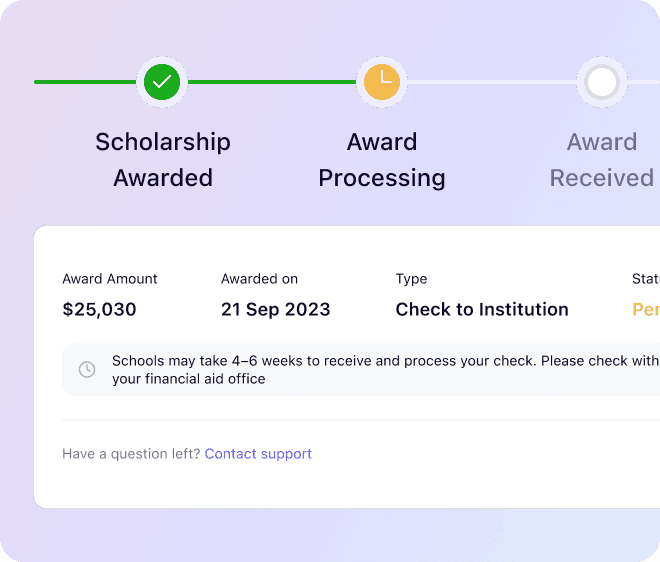
Award checks will be sent to the financial aid office of the winner's academic institution or future academic institution in their name to be applied to their tuition, and in the name of their institution (depending on the school's requirements). If the award is for a qualified educational non-tuition expense, we will work with the winner directly to distribute the award and make sure it goes towards qualified expenses.
How will my scholarship application be verified?
Before we award the scholarship, the winner will be required to confirm their academic enrollment status. Depending on the circumstances, verification of Student ID and/or their most recent transcript will be required.
How should I get in touch with questions?
If you have any questions about this scholarship or the Bold.org platform, just email contact@bold.org and we’ll get back to you as quickly as we can.
Does the scholarship have terms and conditions?
Yes. The terms and conditions for this scholarship can be found here.
97% of students don't win scholarships. We’re here to change that.