Dr. Shuqiao Yao was a renowned Chinese psychologist and psychiatrist, an incredible father and teacher who passed away too soon in 2024 after leading an incredible life. Throughout his illustrious career, Dr. Shuqiao Yao dedicated himself to advancing the fields of psychological assessment, psychiatry, and clinical neuroscience. His groundbreaking research on the neural mechanisms of psychological effects on stress-related diseases led to numerous discoveries that have significantly shaped our understanding of mental health.
This scholarship aims to support outstanding students who share Dr. Shuqiao Yao's passion for clinical psychology and psychiatry. By fostering the next generation of researchers, this scholarship hopes to continue Dr. Shuqiao's mission of advancing the understanding and treatment of mental health conditions.
Any graduate student of Asian descent pursuing psychology or psychiatry with at least a 3.0 GPA may apply for this scholarship opportunity.
To apply, tell us about your background, why you have chosen your field of study, and how your background has affected your decision to pursue this path. Please also provide a listing of any recent publications. You can include the title and the journal in the essay submission box.
Selection Criteria:
Ambition, Drive, Impact
Essay Topic Requirements
Please share about your background and why you are choosing to pursue psychology or psychiatry. Please also mention how your background has impacted your decision to pursue this field. Please also provide a listing of any recent publications. You can include the title and the journal.
University of North Carolina at Chapel HillCary, NC
My interest in psychology and psychiatry has developed through a combination of academic experiences, research involvement, and direct work with individuals navigating mental health challenges. As an Asian American student, I have also become increasingly aware of how mental health is often under-discussed in many communities, shaped by cultural stigma and expectations. This awareness has influenced my desire to pursue a field that not only advances scientific understanding, but also improves access to compassionate and culturally informed care.
I am currently a student at the University of North Carolina at Chapel Hill, studying psychology with minors in chemistry and medical anthropology. Through this interdisciplinary background, I have become interested in how biological, developmental, and social factors interact to shape mental health. My research experience in the Cohen Lab has played a significant role in shaping this interest. As a research assistant on the BrainMAP study, I have worked with data examining how brain development relates to ADHD symptoms and academic outcomes over time. This experience has shown me how complex developmental changes are and how important it is to study them longitudinally. In addition, my previous work on the CogMAP study, which focused on cognitive changes in breast cancer patients, introduced me to the relationship between physical health and cognitive functioning. These experiences have strengthened my interest in research that has clear clinical relevance.
Alongside research, my clinical and service experiences have deeply influenced my decision to pursue this field. As a Crisis Text Line counselor, I have supported individuals during moments of acute emotional distress, which made me more aware of how widespread and often invisible mental health struggles can be. I learned the importance of listening with intention and meeting people where they are. My time volunteering in the adolescent psychiatric unit at UNC Hospitals further exposed me to the ways in which developmental stage shapes how individuals experience and express mental health challenges. I became especially interested in working with children and adolescents, as well as in understanding how early experiences influence long-term outcomes.
Working with neurodivergent children at Friends Camp reinforced this interest. I learned to adapt my communication style, pay attention to nonverbal cues, and approach each child with patience and flexibility. These experiences taught me that effective care requires not only knowledge, but also empathy, cultural awareness, and adaptability. They also deepened my interest in the intersection of development, environment, and mental health.
My background has led me to pursue psychology and consider a future in psychiatry because I am drawn to work that bridges research and clinical care. I am particularly interested in understanding how brain development and environmental factors contribute to mental health outcomes, and how this knowledge can be used to improve treatment. I hope to contribute to research that advances our understanding of mental health while also working directly with individuals, especially those from communities where mental health is often overlooked.
I do not have any publications at this time, but I am actively involved in research and hope to contribute to publications in the future.
Currently, I am a doctoral student in the Clinical Psychology Ph.D. program at Boston University, where my research centers on understanding the daily emotional and contextual dynamics that give rise to suicidal ideation. As an international student from China, a person of color, and a first-generation college student, my background has deeply shaped this commitment, not only by influencing the questions I hope to address, but by shaping my broader mission to develop personalized treatment that is culturally informed, inclusive, and grounded in real-world experience.
My ongoing projects integrate ecological momentary assessment, situational taxonomy, and multilevel modeling to examine how emotion regulation strategies fluctuate across time and context to influence suicidal ideation. One line of my work uses dynamic structural models to study how emotion regulation strategies shift across the day and week. A parallel line of my research examines how cultural dimensions, such as tightness–looseness and collectivism, shape emotional processes and suicide risk across both U.S. states and countries. This work reflects my growing commitment to integrating cultural psychology with computational methods. As an international student who has experienced multiple cultural transitions, I have seen firsthand how cultural norms, social expectations, and shifting environments shape emotional expression, coping, and well-being. These experiences motivate my interest in the “contextual layer” of suicide risk, how culture, environment, and situational demands can shape emotional experience and regulation.
My future work seeks to bridge these lines of inquiry by developing real-time, culturally responsive models of suicidal ideation, with the long-term goal of informing just-in-time adaptive interventions. I aim to use idiographic modeling to identify moment-to-moment transitions in emotional–suicidal states. Integrating cultural frameworks, I hope to determine how these transitions differ across individuals of diverse backgrounds, including Asian and Asian American communities. This direction is motivated by the belief that suicide risk is not only a psychological process but also a culturally contextualized one and that effective prevention requires understanding both. Clinically, I am receiving advanced training in cognitive-behavioral therapy and acceptance-based interventions at my institution. Working with individuals experiencing anxiety, trauma, and mood-related difficulties has further strengthened my conviction that research and practice must be deeply interconnected. My experiences as an Asian international trainee, navigating stigma and cultural barriers, inform my clinical skills. I have learned that approaching clients with cultural humility, respect for their lived experiences, and an appreciation for the complex ways identity and context shape mental health.
My background has therefore influenced my path in two important ways. First, it has shaped my scientific questions: how cultural and contextual factors shape emotion regulation and suicide risk. Second, it motivates my broader career goal: to develop psychological research and interventions that are empirically rigorous, culturally grounded, and accessible to diverse communities.
Ultimately, I hope to become a clinical scientist who advances our understanding of suicide through a combination of computational modeling, real-time assessment, and cultural psychology, work that aligns closely with Dr. Shuqiao Yao’s mission of improving mental health through integrative, culturally informed science. Thank you for your consideration!
Li, S.M., Irani, K. & Liu, Q. (In press). Beyond depression severity: Symptom-specific associations of suicidal thoughts and behaviors. Journal of Adolescent Health.
Li, S.M., Kobrinsky, V., Irani, K., Sangani, A. & Liu, Q. (2025). Neural correlates involved in behavioral metrics of emotion regulation, suicidal thoughts, and behaviors. Archives of Suicide Research: official journal of the International Academy for Suicide Research, 1–21. Advance online publication.
Li, S.M., Kobrinsky, V., Bi, K. & Chen, M.S. (2025). An initial exploration of mechanisms contributing to higher suicidal ideation in bisexual+ compared to lesbian/gay individuals. Psychology of Sexual Orientation and Gender Diversity. Advance online publication.
I grew up in a typical Chinese family where emotions were rarely discussed, let alone mental illness. It was not until I was 16 years old that I realised what had plagued me since childhood was social anxiety. It came as such a relief -- all this time, I had come to believe that I was just not as strong or as capable as other people, and it was such a relief to know there was a name, a tangible explanation for myself. It was then that I knew I wanted to be a psychologist, and I wanted to help other young people who were silently struggling to get connected to care. I wanted young people to know that they are not morally flawed, and that there were skills and coping strategies they could learn to overcome their distress -- and most importantly, that they did not have to do this alone.
I went on to train as a clinical psychologist (and on the way, becoming the first person in my family to attend university, and the first woman to be financially independent) and I founded The Brightly Project, a mental health organisation working with high schools in Hong Kong, Singapore, and China, where me and my team developed a mental health app that provides mental health education to adolescents and helps connect them with caring adults at their school. More than 10,000 students have used our program.
I am continually focused on learning and bringing evidence-based tools back into East Asia. For example, I am currently receiving training in Dialectical Behaviour Therapy (DBT), which is a treatment that has shown efficacy for young people struggling with emotion dysregulation (resorting to self-harm and suicidal behaviours to cope). As of now, there are no DBT centres led by doctoral clinicians in Hong Kong or Singapore -- and it is my goal to bring DBT back into East Asia, where suicide and self-harm rates are very high among young people.
Aside from being a passionate and effective clinician (I love seeing my adolescent patients overcome and thrive, changing their trajectories and uncovering their potential), I am also actively engaged in psychiatric research. I am currently pursing a PhD in psychology and neuroscience -- using machine learning and AI to uncover mechanisms of depression and anxiety, and to understand how individuals learn and change during psychotherapy interventions. By better understanding how interventions work, we can design and tailor more effective treatments for individuals.
Receiving this scholarship would be an honour and an acknowledgement that my dedicated efforts are in the right direction. Thank you for considering my application.
How it works
Bold.org is Built to Make Scholarships Feel Possible
Step 01
Start with your story
Bold.org helps students show donors who they are beyond a transcript.
Step 02
Where scholarships are awarded
Every scholarship is funded by donors and managed directly on Bold.org.
Step 03
Fund your future
Scholarship dollars are disbursed through Bold.org to help students pay for school.
FAQ
When is the scholarship application deadline?
The application deadline is Dec 19, 2026. Winners will be announced on Jan 20, 2027.
How will scholarship application information be used?
Your privacy is a top priority on the Bold.org platform, and you can find our privacy policy in full here. You may opt out of communications from Bold.org at any time, and unless we’ve first notified you and gotten your consent, you’ll never receive communication from any third parties related to personal information you give us.
What is the scholarship award?
Award amounts per winner are designated by the donor. Check the award amount for a detailed breakdown.
When will the scholarship winner be chosen? How will they be notified?
The winner will be publicly announced on Jan 20, 2027. Prior to the announcement date, we may contact finalists with additional questions about their application. We will work with donors to review all applications according to the scholarship criteria. Winners will be chosen based on the merit of their application.
How will the scholarship award be paid?
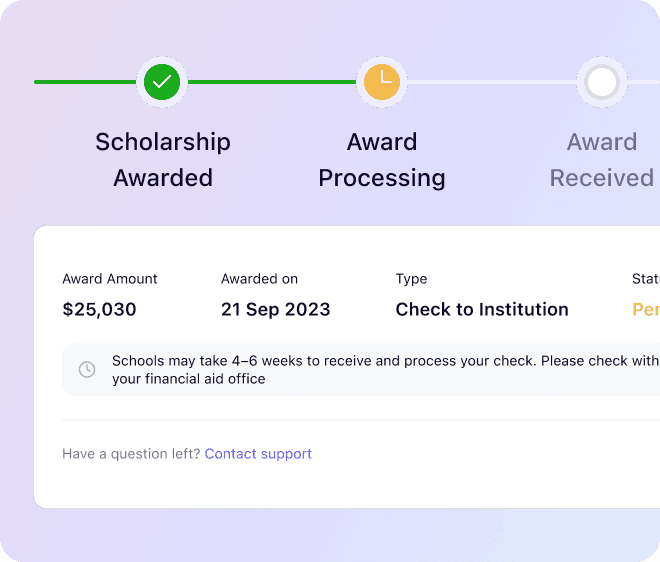
Award checks will be sent to the financial aid office of the winner's academic institution in their name to be applied to their tuition, and in the name of their institution (depending on the school's requirements). If the award is for a qualified educational non-tuition expense, we will work with the winner directly to distribute the award and make sure it goes towards qualified expenses.
How will my scholarship application be verified?
Before we award the scholarship, the winner will be required to confirm their academic enrollment status. Depending on the circumstances, verification of Student ID and/or their most recent transcript will be required.
How should I get in touch with questions?
If you have any questions about this scholarship or the Bold.org platform, just email contact@bold.org and we’ll get back to you as quickly as we can.
Does the scholarship have terms and conditions?
Yes. The terms and conditions for this scholarship can be found here.