The 85 Best Scholarships for Hispanic Students in October 2026
Updated: October 19, 2026


Finding scholarships that truly support Hispanic students takes time — but we’ve made it simple. Explore top Bold.org scholarships created for Hispanic students, with upcoming deadlines and easy applications you can complete directly on site.
Total scholarships awarded

$2,000 No Essay Scholarship by Sallie
Sallie awards a $2,000 scholarship each month to eligible students currently in high school graduating in 2027 or pursuing a bachelor’s degree graduating in 2028–2030. No essay or account profile required.Amount$2,000Deadline:Oct 31, 20265 days left!Education LevelAnyLearn More- Verified by Bold.org
- Sponsored
1
Hines Scholarship
Funded byKristin HinesOpen to minority high school and undergraduate students with a GPA of 2.0 or higher.Amount$3,000Deadline:Nov 14, 2026Education LevelHigh School, UndergraduateTakes minutes2
SoFi $2,500 Scholarship Giveaway
SoFi gives students a chance to win a $2,500 scholarship every month. No essays, interviews, or hoops. Winning is that easy! Must be 18+ apply.Amount$2,500Deadline:Oct 31, 20265 days left!Education LevelAny EducationLearn More- Verified by Bold.org
- Sponsored
3
Ryan McAuliffe Memorial Award
Funded byMirna McAuliffeOpen to Hispanic female high school students in Illinois.Amount$10,000Deadline:Mar 28, 2027Education LevelHigh SchoolTakes minutes4
$2,500 October Giveaway by CollegeXpress
CollegeXpress offers high school and graduate students a chance to win $2,500 this month. No essay required. Sign up for free to enter.Amount$2,500Deadline:Oct 31, 20265 days left!Education LevelHigh School, Grad StudentsLearn More- Verified by Bold.org
- Sponsored
5
Hue Ta Asian American Scholarship
Funded byTuan TaOpen to Asian American undergraduates with volunteering experience pursuing psychology, counseling, or mental health careers.Amount$1,000Deadline:Dec 7, 2026Education LevelUndergraduateTakes minutes6
American Dream Scholarship for Practical Nurses
Funded byFVI School of Nursing and TechnologyOpen to practical nursing students at FVI School of Nursing and Technology in Florida.Amount$1,500Deadline:Oct 31, 20265 days left!Education LevelUndergraduateTakes minutes7
American Dream Scholarship for Nurses
Funded byFVI School of Nursing and TechnologyOpen to associate degree nursing students at FVI School of Nursing and Technology in Florida.Amount$3,000Deadline:Oct 31, 20265 days left!Education LevelUndergraduateTakes minutes8
José Ventura and Margarita Melendez Mexican-American Scholarship Fund
Funded byBorders FamilyOpen to first-generation Mexican or Mexican American students starting or pursuing an undergraduate degree.Amount$2,000Deadline:Nov 7, 202612 days left!Education LevelUndergraduateTakes minutes9
MedLuxe Representation Matters Scholarship
Funded byMEDLUXE LLCOpen to low-income Black high school, college, and graduate students pursuing health care careers.Amount$500Deadline:Nov 10, 2026Education LevelAnyTakes minutes10
Undergraduate Minorities in STEM Scholarship
Funded byLeslie SmithOpen to BIPOC undergraduates studying STEM at HBCUs with a 3.0 GPA or higher.Amount$1,400Deadline:Nov 17, 2026Education LevelUndergraduateTakes minutes11
Sara Molina Memorial Scholarship
Funded byLisandra RichardsonOpen to female students in Puerto Rico at any level, from high school through graduate school.Amount$1,000Deadline:Nov 24, 2026Education LevelAnyTakes minutes12
Pereira Art & Technology Scholarship
Funded byThe Pereira FoundationOpen to BIPOC, low-income high school seniors and undergraduates with volunteer experience pursuing technology, arts, or business.Amount$500Deadline:Nov 24, 2026Education LevelHigh School, UndergraduateTakes minutes13
Aaron B. O’Reggio - Young, Gifted, & Black Scholarship
Funded byK DOpen to Black male-identifying undergraduate and trade school students pursuing computer science.Amount$2,000Deadline:Nov 27, 2026Education LevelUndergraduateTakes minutes14
William A. Lewis Scholarship
Funded byEdwards_Lewis FamilyOpen to BIPOC undergraduate and graduate students at HBCUs who are pursuing STEM.Amount$2,000Deadline:Nov 30, 2026Education LevelUndergraduate, GraduateTakes minutes15
Velazquez Social Sciences Scholarship
Funded byJorge VelazquezOpen to first-generation high school seniors of Puerto Rican heritage pursuing social work, psychology, or other social sciences.Amount$1,100Deadline:Dec 6, 2026Education LevelHigh SchoolTakes minutes16
Dr. Steve Aldana Memorial Scholarship
Funded byWellSteps, LLC.Open to undergraduate students pursuing wellness, employee wellness, or public health.Amount$500Deadline:Dec 14, 2026Education LevelUndergraduateTakes minutes17
Lotus Scholarship
Funded byFiona ChenOpen to BIPOC high school seniors, college, and graduate students from low-income or single-parent households.Amount$500Deadline:Dec 29, 2026Education LevelAnyTakes minutes18
Camille S. Amantine Scholarship
Funded byCamille AmantineOpen to undergraduate and graduate students who are low-income, first-generation, or BIPOC.Amount$2,000Deadline:Jan 28, 2027Education LevelUndergraduate, GraduateTakes minutes19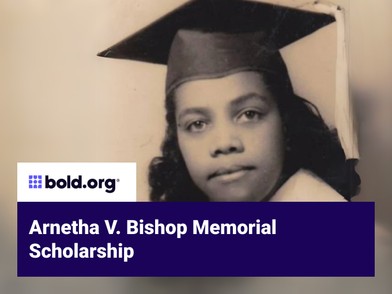
Arnetha V. Bishop Memorial Scholarship
Funded byAustin/Bishop FamilyThis scholarship will support BIPOC students pursuing a career in the mental health field.Amount$500Deadline:Jan 28, 2027Education LevelUndergraduate, GraduateTakes minutes20
Goellner Public Education Scholarship
Funded byGoellner FamilyOpen to BIPOC high school seniors and undergraduates planning to teach in K-12 public schools.Amount$4,000Deadline:Feb 26, 2027Education LevelHigh School, UndergraduateTakes minutes21
Healing Self and Community Scholarship
Funded byOG Dance School for Healing Self, LLC®Open to BIPOC high school seniors, college, and graduate students pursuing careers in art or health.Amount$2,000Deadline:Feb 28, 2027Education LevelAnyTakes minutes22
La Fuerza de Uno Scholarship
Funded byFrancisco HernandezOpen to Latino high school seniors raised in single-parent households who plan to continue their education.Amount$5,000Deadline:Mar 12, 2027Education LevelHigh SchoolTakes minutes23
Learner Tutoring Innovators of Color in STEM Scholarship
Funded byLearnerOpen to BIPOC high school seniors, undergraduates, and graduate students who are U.S. citizens or permanent residents pursuing STEM.Amount$500Deadline:Mar 29, 2027Education LevelAnyTakes minutes24
Balbina Ferrufino De Soto Scholarship for Latina Nurses
Funded byEileen O'Grady and Soledad SotoOpen to Latina high school seniors, college, and graduate students pursuing nursing.Amount$5,000Deadline:Mar 30, 2027Education LevelAnyTakes minutes25
Hispanic Climb to Success Scholarship
Funded byTirado FamilyOpen to low-income Hispanic or Latino high school seniors in New York.Amount$2,000Deadline:Apr 6, 2027Education LevelHigh SchoolTakes minutes26
Joan Free Thompson Scholarship
Funded byHowe and Linn FamiliesOpen to BIPOC high school students at Star City, Dumas, or McGehee High School in Arkansas.Amount$4,000Deadline:Apr 14, 2027Education LevelHigh SchoolTakes minutes27
Diversity in Music Education Scholarship
Funded bySymphonic DistributionOpen to BIPOC high school, college, and graduate students pursuing music creation, curation, or production.Amount$2,000Deadline:May 16, 2027Education LevelAnyTakes minutes28
Ojeda Multi-County Youth Scholarship
Funded byGeanette Rodriguez-OjedaOpen to Black or Hispanic high school seniors with at least a 2.9 GPA.Amount$500Deadline:May 24, 2027Education LevelHigh SchoolTakes minutes29
Jose Prado Scholarship – Strength, Faith, and Family
Funded byMIRTA PradoOpen to low-income, first-generation Hispanic or Latino high school seniors in Illinois.Amount$500Deadline:Jun 24, 2027Education LevelHigh SchoolTakes minutes30


How it works
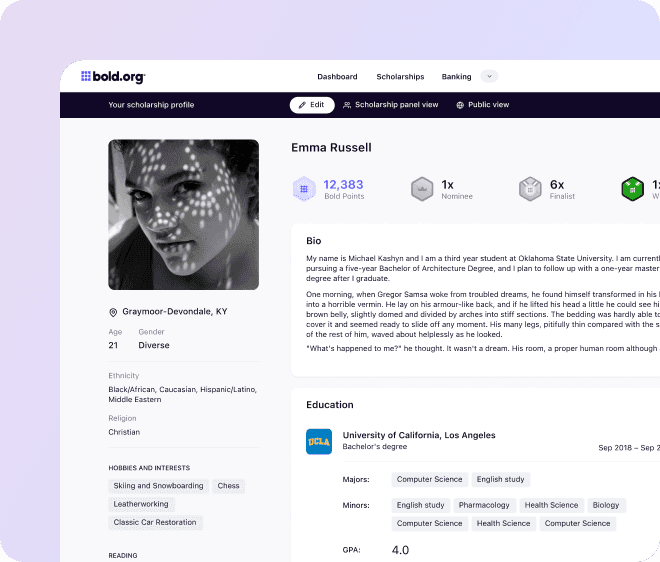
Bold.org is Built to Make Scholarships Feel Possible
Step 01
Start with your story
Bold.org helps students show donors who they are beyond a transcript.
Step 02
Where scholarships are awarded
Every scholarship is funded by donors and managed directly on Bold.org.
Step 03
Fund your future
Scholarship dollars are disbursed through Bold.org to help students pay for school.
Our methodology
The Bold.org Team reviews all scholarships individually and strives to exclude any scholarship where any of the below applies:
- The scholarship requires a fee to apply
- The scholarship requires paid membership in an organization (with certain exceptions for reputable trade organizations and others)
- The scholarship provider's privacy policy allows for the misuse of student data
- Students are required to sign up for a site or service to apply*
- The scholarship website has many grammatical errors and/or advertisements
- The scholarship or scholarship providing organization seem untrustworthy
- There is no evidence the scholarship was previously awarded
- The scholarship has not been awarded in the past 12 months
- There is no available contact information
Sponsored scholarships offered through Bold.org's vetted partner program -- companies that have been independently reviewed and approved by Bold.org -- are excluded from these conditions.
* There are certain exceptions to this, for example if the sponsoring organization is a major corporation or nonprofit with its own scholarship application system.
Learn about our editorial policies.
Hispanic Scholarships: What the Data Reveals About Funding, Winners, and How to Stand Out
Hispanic and Latino students are the fastest-growing group in U.S. college enrollment. Yet they face a funding gap that other students don't. Bold.org's scholarship data — tracking seekers, finalists, and winners — reveals a pattern most guides miss: first-generation and low-income Hispanic students are represented among winners at rates far above the overall applicant pool. Here's what the data shows (methodology).
The Funding Gap Behind Hispanic Scholarships
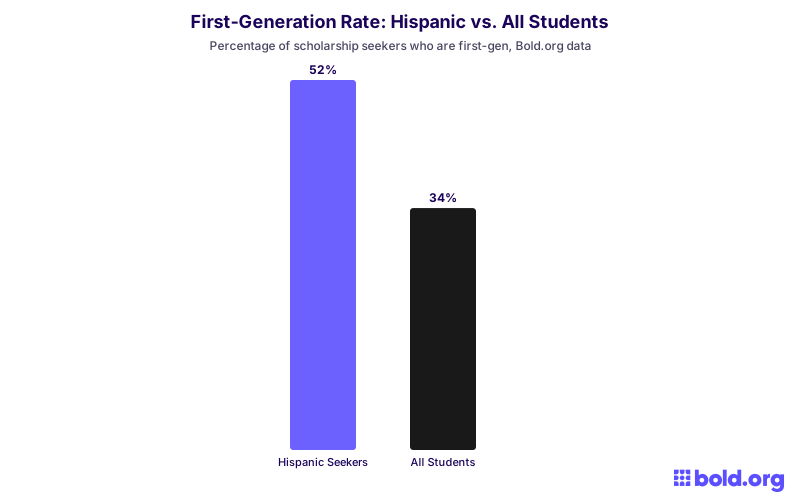
The financial picture for Hispanic students seeking scholarships is very different from the general student body. Among Hispanic scholarship seekers on Bold.org, 52% are first-generation college students. Across all students on the platform, that figure is just 34%. That 18-point gap shows a real difference in family resources. First-gen students often lack alumni networks, savings-based college funds, and parents who know how the financial aid system works.
The income picture is just as stark. Nearly 60% of Hispanic scholarship seekers on Bold.org are low-income, compared to 43% overall. Most Hispanic students on the platform are funding their education with little family help.
These patterns mirror national data. Excelencia in Education reports that Hispanic students now make up roughly 28% of all U.S. undergrads, yet they get a smaller share of grant aid relative to their enrollment. NCES data shows Hispanic undergrads borrow an average of $20,210 in student loans. For first-gen students, the burden is heavier — no family safety net to fall back on.
The result is a structural funding gap. Hispanic students are more likely to be first-gen, more likely to be low-income, and more likely to rely on outside funding. Scholarships exist to fill this gap — and the data below shows what successful applications look like.
Who's Represented on the Platform
The Hispanic and Latino community seeking scholarships on Bold.org spans many backgrounds, schools, and career goals. The median GPA among Hispanic seekers is 3.6, and 59.5% carry a GPA of 3.5 or above. These are strong applicants.
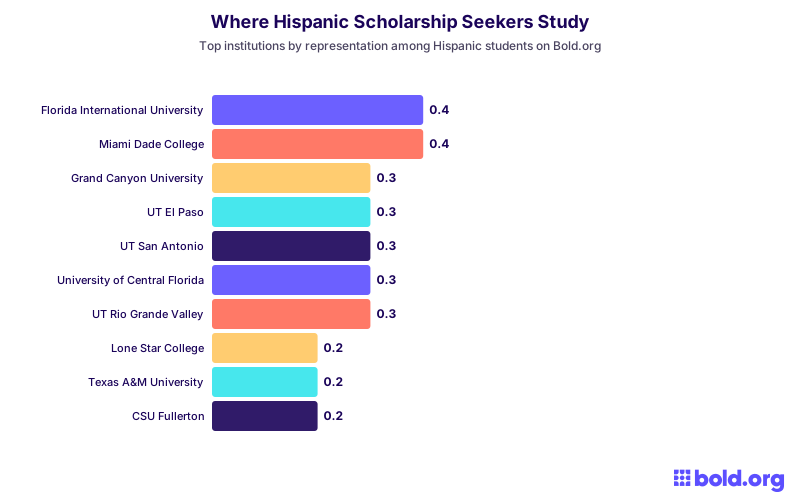
The top schools reflect the Hispanic-Serving Institution (HSI) pipeline. Florida International University and Miami Dade College lead, followed by UT El Paso, UT San Antonio, UT Rio Grande Valley, and the University of Central Florida. Community colleges like Lone Star College make the list too — two-year students are actively seeking scholarship funding, a group most guides ignore.
According to Bold.org data, California (21.8%) and Texas (21.1%) hold 43% of Hispanic scholarship seekers, tracking the largest population centers. Florida is next at 9.8%, then New York (5.4%), Illinois (3.8%), and Arizona (3.5%). But seekers are in all 50 states. Hispanic scholarships are a national opportunity, not a regional one.
Top fields of study among Hispanic seekers on the platform: Nursing (7.5%), Psychology (5.4%), Business and Management (5.1%), Health Professions (2.5%), Computer Science (2.2%), Biology (2.2%), Education (2.0%), and Criminal Justice (1.8%). This spread means Hispanic seekers match nearly every scholarship category, from STEM to social sciences to healthcare.
The education-level breakdown reveals who is actually seeking these scholarships: 59.7% of Hispanic scholarship seekers are high school students, making them the dominant segment by a wide margin. College students account for 18.7%, associate-degree students for 9.7%, adult learners for 9.1%, and graduate students for 2.8%. The high school majority means competition is steepest at that level — but it also means the scholarship ecosystem is built with high school seniors in mind, from eligibility criteria to essay prompts.
Women make up 70% of Hispanic scholarship seekers on the platform. NCES data confirms this tracks the national trend: Hispanic women have outpaced men in enrollment and degree completion for over a decade.
The Hispanic Scholarship Ecosystem
The funding landscape for Hispanic students is wider than most applicants realize. As of March 2026, Bold.org lists 52 active scholarships alongside 365+ from third-party providers — all accessible on one page. Students can build a complete funding plan without searching across dozens of separate sites.
Among the third-party scholarships on Bold.org, the median award is $2,500 and the average maximum reaches $5,853. About 30% target high school seniors. Another 14% serve college and graduate students. And 12% are open to college students across all years.
The ecosystem of organizations behind Hispanic scholarships runs deep. The Hispanic Scholarship Fund (HSF) is the largest, giving over $30 million per year in awards from $500 to $5,000 for high school seniors through graduate students. According to HSF, the organization has given more than $750 million since its founding and is the best-known name in Hispanic scholarship funding.
The Hispanic Association of Colleges and Universities (HACU) represents more than 500 colleges focused on Hispanic student success and runs scholarship programs tied to internship pipelines at federal agencies and corporations. LULAC (League of United Latin American Citizens), the oldest Hispanic civil rights organization in the country, runs the LULAC National Scholarship Fund with awards in multiple categories including general, honors, and community service. The Congressional Hispanic Caucus Institute (CHCI) provides scholarships, fellowships, and paid internship programs, with a focus on developing the next generation of Latino leaders.
Groups targeting specific segments of the community add further depth. The Society of Hispanic Professional Engineers (SHPE) Foundation supports Hispanic STEM students. Prospanica (the Association of Hispanic Professionals) funds business and STEM scholarships. The Chicana Latina Foundation awards scholarships to Latina women in Northern California, with mentorship programming. La Unidad Latina Foundation (LULF) supports students who serve their communities. MALDEF (Mexican American Legal Defense and Educational Fund) offers law school scholarships and advocacy training.
On Bold.org, the most common criteria for Hispanic-targeted scholarships are Ambition (31%), Impact (15%), Drive (14%), and Need (14%). Only 5% are purely essay-based. Most scholarships look at your full profile — your story, your goals, and your need. Writing skill alone does not decide the outcome.
When to Apply: The Hispanic Scholarship Calendar
Timing matters more than most applicants realize. Bold.org platform data shows Hispanic scholarship activity peaks sharply in spring and summer: June leads all months (seasonality index 159), followed by April (149), May (147), February (141), and March (127). December sees a secondary spike (index 120) as students prepare for the new year. The lowest-activity months are August (index 45), January (61), September (79), and November (78).
This pattern creates a strategic opening. The spring-summer surge from April through June coincides with graduation season — every Hispanic student and their counselor is thinking about scholarships at once. Competition is at its peak. But in August, activity drops to less than half the annual average. September and January are similarly quiet.
The smart move: start applying in August and September, when fewer students are submitting. Build momentum through fall and winter. By the time the spring peak arrives, you'll have applications out and experience writing essays — while students who wait until April are just getting started.
This strategy works especially well because 74% of external Hispanic scholarships on Bold.org use rolling deadlines. There is no single window you have to hit. Applying during low-competition months means your application lands in a smaller pool, with the same reviewers and the same award amounts.
What Hispanic Scholarship Finalists and Winners Look Like
Bold.org's three-stage funnel — who applies, who makes finalist, and who wins — reveals what actually drives outcomes for Hispanic scholarship applicants (methodology).
The GPA Picture
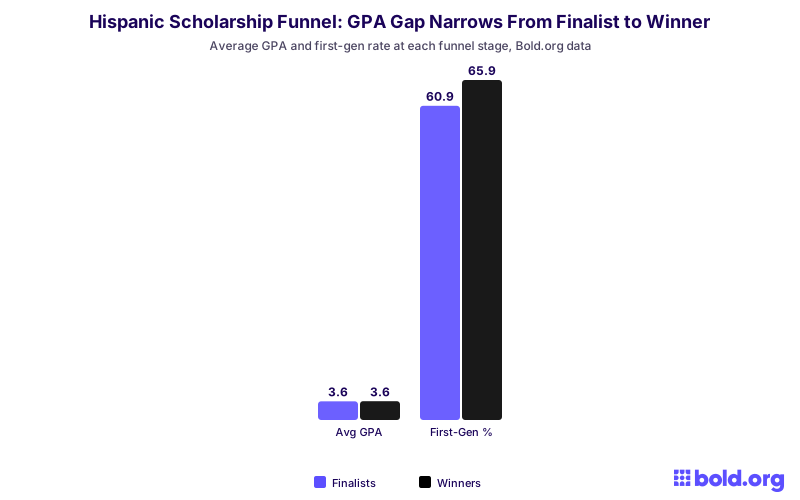
On Bold.org, the median GPA rises gently through the funnel: 3.6 for all seekers, 3.7 for finalists, and 3.8 for winners. The average tells the same story — 3.45, 3.62, and 3.65. The gap from finalist to winner is just 0.03 points. Once you reach the finalist stage, GPA is no longer what sets winners apart.
First-Generation Representation Through the Funnel
Among Hispanic seekers on Bold.org, 52% are first-gen. Among finalists, 60.9%. Among winners, 65.9%. First-gen representation increases at every stage of the funnel — a 13.9-point climb from seeker to winner.
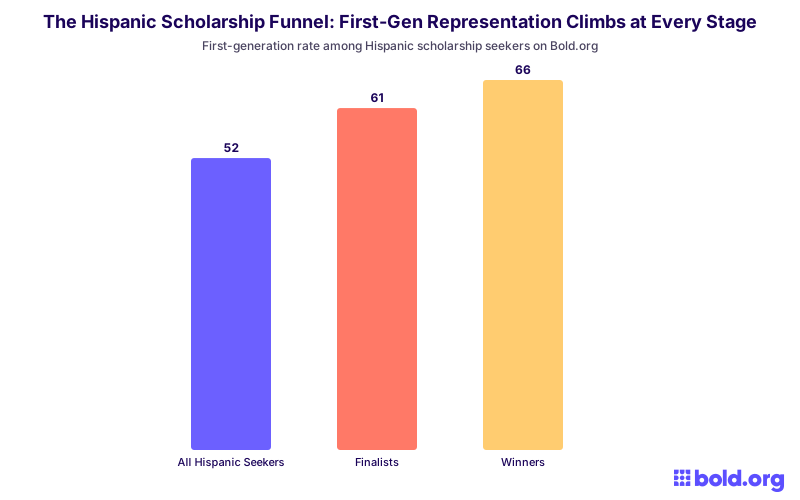
For context: across all scholarship winners on the platform (every demographic), the first-gen rate is 46.1%. Hispanic winners exceed that by nearly 20 points. First-generation Hispanic students are well-represented among winners — and that pattern holds across award types.
Financial Need and the Funnel
The pattern is even stronger for low-income students. Among Hispanic seekers on Bold.org, 59.6% are low-income. Among finalists, 69.3%. Among winners, 75.1%. Low-income representation climbs 15.5 points from seeker to winner.
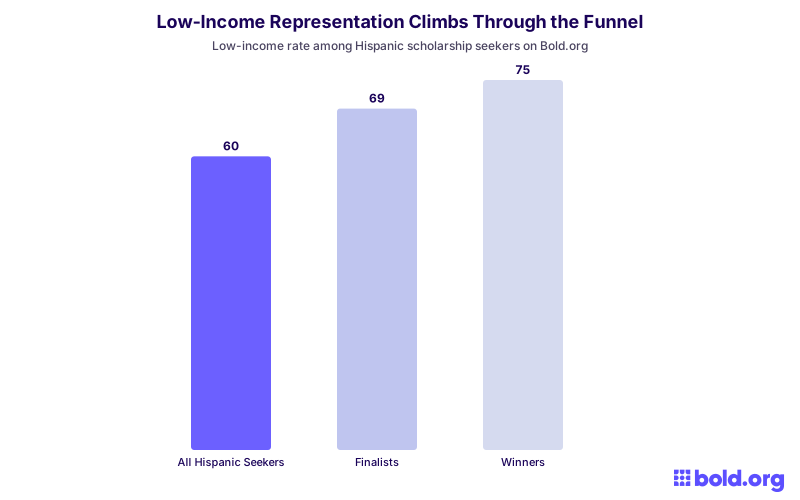
The effect is amplified for Hispanic students compared to the overall population. Among all winners on Bold.org, the low-income rate is 62.5%. Among Hispanic winners, 75.1% — a 12.6-point gap that reflects both the community's higher demonstrated need and the strong representation of low-income Hispanic students at every funnel stage.
Award Amounts
On Bold.org, Hispanic winners receive a median award of $1,000 and an average of $1,710. Nearly half (49%) fall in the $1,000–$2,499 range. About 9.4% top $5,000. Pair these with third-party awards on the same page (median $2,500), and students who apply across both can stack real funding.
Multiple awards can be stacked. A student who wins one Bold.org scholarship at $1,000 and one third-party award at $2,500 has already covered a significant chunk of textbook costs, supplies, or even part of tuition. The strategy is to apply broadly and consistently.
The scholarship listings above include both Bold.org and third-party awards with a median of $2,500. Filter by deadline to catch rolling opportunities — 74% of external Hispanic scholarships accept applications year-round.
Barriers Hispanic Students Face in the Application Process
The data reveals specific hurdles that hit Hispanic applicants harder than the general population. These come from the funnel numbers and essay analysis (methodology).
The first-generation knowledge gap. With 52% of Hispanic seekers on Bold.org being first-gen, more than half have no parent who has done this before. They may not know when to start applying, how to structure an essay, or which scholarships fit their profile. The jump from 52% (seekers) to 60.9% (finalists) shows that first-gen students who do apply are strong. But many may not be applying at all — the knowledge gap is a participation barrier, not a quality barrier.
Geographic gaps in mentorship and support. Platform data shows California and Texas hold 43% of Hispanic scholarship seekers. Students in states with smaller Hispanic communities — Georgia (2.1%), Colorado (2.0%), North Carolina (1.8%) — may have fewer local mentors and less school-based advising for Hispanic-specific funding. National platforms and organizations like HACU and LULAC help bridge this distance, but local awareness remains uneven.
The essay specificity problem. Analysis of winning essays on Bold.org shows a clear split. Winners describe concrete experiences and connect them directly to their career goals and community plans. Finalists who write about grades and activities in general terms — without grounding their story in real, specific detail — are less likely to advance. Reviewers for Hispanic-targeted awards respond to applicants who can describe their specific challenges and goals with genuine depth. One pattern worth noting: winning essays frequently describe bilingualism as a concrete, real-world skill — interpreting for patients, translating for community organizations, navigating bilingual classrooms. Students who show bilingual capability in action give reviewers evidence of professional readiness.
Time and money constraints on the process itself. When nearly 60% of seekers are low-income, the time cost of applying competes with work schedules and family duties. Researching scholarships, writing essays, and gathering documents all take hours. The fact that 74% of external scholarships on the page use rolling deadlines helps — students can apply on their own schedule rather than racing to meet narrow fixed windows.
How to Strengthen Your Hispanic Scholarship Application
The data's most surprising finding: among Hispanic finalists and winners, the GPA gap is 0.03 points. Once you make the finalist cut, grades don't push you over the top. Here is what does.
Anchor your essay in real family and cultural detail. Analysis of winning essays from Hispanic scholarship recipients shows a clear pattern: winners give concrete details about their family story. They describe specific moments — a parent working double shifts, a family's decision to move countries for educational opportunity, the exact way being first-gen shaped their school experience. They don't write vaguely about "hardship." Scholarship prompts for Diversity and Inclusion awards on the page ask about obstacles and cultural roots. Give the reviewers specifics, not summaries.
Connect your experience to your career goals. The strongest winning essays on the platform draw a direct line from the applicant's concrete experiences to their professional direction. A nursing student writes about the lack of Spanish-speaking providers in her community. An education major describes wanting to be the bilingual teacher she never had. A social work student connects growing up in a low-income neighborhood to her focus on mental health access in underserved communities. This experience-to-mission connection — where your real story informs your direction — is the clearest separator between finalists who win and those who don't.
Be specific about your first-gen experience. Bold.org data shows 65.9% of Hispanic winners are first-generation — 19.8 points above the overall winner rate of 46.1%. If this describes you, describe what being first-gen has looked like concretely: navigating applications without family guidance, translating financial aid documents, making college decisions independently. Specificity is what separates a memorable essay from a generic one.
Quantify the financial gap, don't generalize about it. Three of every four Hispanic winners on the platform are low-income. Reviewers respond to financial reality when it's precise. Winning essays in this category cite tuition numbers, describe specific trade-offs (choosing community college over a four-year school to avoid $40K in loans), or explain exactly how many hours of work fund each semester. "My family struggles financially" reads like every other essay. "I cover $8,000 per year through weekend shifts at my uncle's restaurant while carrying 15 credit hours" stands out because it shows the real math.
What gets filtered out. Hispanic scholarship finalists who don't advance share a pattern: their essays read like résumés in paragraph form. Club memberships, AP classes, and GPA stats — without a line connecting them to the applicant's Latino experience or community vision. The numbers show why this fails: GPA separates applicants from finalists (3.6 to 3.7) but not finalists from winners (3.7 to 3.8, a 0.03-point gap). Once past the academic screen, the essay is the entire contest.
Organizations and Resources for Hispanic Students
Beyond the scholarships listed on this page, several major organizations provide funding, mentorship, and professional development for Hispanic and Latino students:
- Hispanic Scholarship Fund (HSF): The largest organization backing Hispanic higher education, with over $30 million per year in scholarships from $500 to $5,000. Open to high school seniors through graduate students. (hsf.net)
- Hispanic Association of Colleges and Universities (HACU): Represents 500+ institutions focused on Hispanic success. Runs internship-to-scholarship pipelines with federal agencies and corporations. (hacu.net)
- LULAC National Scholarship Fund: The scholarship arm of the oldest Hispanic civil rights group in the U.S. Awards in general, honors, and community service categories. (lulac.org)
- Congressional Hispanic Caucus Institute (CHCI): Scholarships, fellowships, and leadership programs for future Latino leaders. (chci.org)
- Society of Hispanic Professional Engineers (SHPE) Foundation: Funding and career development for Hispanic students in STEM fields. (shpe.org)
- MALDEF (Mexican American Legal Defense and Educational Fund): Law school scholarships and civil rights advocacy training. (maldef.org)
- Prospanica: The Association of Hispanic Professionals (formerly NSHMBA). Funds business and STEM scholarships. (prospanica.org)
- Chicana Latina Foundation: Scholarships and mentorship for Latina women in Northern California. (chicanalatina.org)
- Excelencia in Education: The leading research and policy organization focused on Hispanic student success. Their annual Latino College Completion reports and institutional seal of recognition (Seal of Excelencia) are widely cited benchmarks — applicants can reference Excelencia's data in essays to ground claims about the Hispanic funding gap. (edexcelencia.org)
- La Unidad Latina Foundation (LULF): Scholarships for students dedicated to advancing the Latino community through service. (lulf.org)
Frequently Asked Questions
Can DACA recipients apply for Hispanic scholarships?
Yes — and many Hispanic-focused scholarships include DACA recipients by design. The Hispanic Scholarship Fund (HSF) accepts DACA applicants, as do many awards listed on this page. However, eligibility varies by individual scholarship. Some restrict awards to U.S. citizens and permanent residents. Others explicitly include DACA recipients and, in some cases, undocumented students.
Check the eligibility section on each listing. Organizations like TheDream.US fund scholarships specifically for DREAMers and DACA recipients. The LULAC National Scholarship Fund and CHCI also offer DACA-accessible tracks.
The key distinction is between federal financial aid (not available to DACA students) and private scholarships (which set their own rules). Hispanic-focused private scholarships are among the most DACA-inclusive in the entire scholarship ecosystem, because the organizations behind them understand the community they serve.
What GPA do you need for Hispanic scholarships?
According to Bold.org data, Hispanic scholarship winners have a median GPA of 3.8 and an average of 3.65. Finalists average 3.62. These numbers give a realistic target, but GPA alone does not pick winners. The 0.03-point gap between finalists and winners shows that at the final stage, your essay and personal narrative carry far more weight.
Many Hispanic-specific scholarships set GPA minimums between 2.5 and 3.0. HSF requires a 3.0. Meeting the floor gets you considered. The data shows that once you're past the minimum threshold, the strength of your story determines whether you advance.
Are there scholarships for Hispanic women specifically?
Yes. On Bold.org, 70% of Hispanic scholarship seekers are women, reflecting national enrollment trends. Organizations like the Chicana Latina Foundation fund Latina women directly. Many Diversity and Inclusion scholarships on the platform have been awarded predominantly to women. This page's listings include awards targeting Latina women in STEM, education, healthcare, and other fields.
Do you have to prove Hispanic heritage to qualify?
Most Hispanic scholarships rely on self-identification rather than documentation. Bold.org lets students select their ethnicity in their profile, and providers on the platform generally accept self-reported heritage. HSF asks applicants to be of Hispanic heritage but does not require genealogical proof.
The Hispanic and Latino community is broad. It includes Mexican-American, Puerto Rican, Cuban, Dominican, Central American, South American, and many other backgrounds. There is no single document that proves "Hispanic." Scholarship reviewers assess the quality of your application, not the specifics of your documentation.
Can undocumented students get scholarships?
Federal aid is not available, but private scholarships operate under their own eligibility criteria. Several Hispanic-focused organizations explicitly include undocumented students. TheDream.US is the largest scholarship fund dedicated to DREAMers. Golden Door Scholars and MALDEF also offer awards without immigration status requirements.
On Bold.org, eligibility varies by individual scholarship. Some donors specify citizenship requirements; others do not. Focus on scholarships that either explicitly welcome undocumented applicants or list no citizenship restriction. Twelve states plus the District of Columbia also offer state-level financial aid to undocumented students, which can be combined with private scholarship awards.
Are Hispanic scholarships only for Mexican-American students?
No. Hispanic and Latino scholarships serve the full diversity of the community. The terms encompass Mexican-American, Puerto Rican, Cuban, Dominican, Central American, South American, Afro-Latino, Indigenous-Latino, and every heritage within the Hispanic and Latino umbrella.
Some awards focus on specific groups: the Chicana Latina Foundation serves Latina women, LULAC has deep Mexican-American roots but now operates nationwide, and the Puerto Rican/Hispanic Youth Leadership Institute serves students in the Northeast. Read the eligibility criteria on each listing to see whether a scholarship aligns with your background.
When should Hispanic high school seniors start applying for scholarships?
As early as possible — ideally the summer before senior year. Bold.org platform data shows that August is the lowest-competition month for Hispanic scholarships (seasonality index 45, less than half the annual average). Starting in August means your applications land when fewer students are submitting. Build a list of target scholarships over the summer, draft your first essays in August and September, and apply steadily through fall. By spring — when competition peaks in April through June — you'll already have multiple applications out and a polished essay you can adapt.
Since 59.7% of Hispanic scholarship seekers on Bold.org are high school students, the competition at that level is real. The advantage goes to students who start early and apply consistently rather than waiting for a single deadline. With 74% of external Hispanic scholarships using rolling deadlines, there is no reason to delay.
How many Hispanic scholarships does Bold.org have?
As of March 2026, Bold.org lists 52 active scholarships for Hispanic and Latino students alongside 365+ third-party awards — all on one page. New scholarships are posted regularly, and the listings can be sorted by deadline, amount, and eligibility. Checking back often is the best strategy for catching fresh opportunities before deadlines pass.
Methodology
This analysis draws on Bold.org's database of student profiles, scholarship applications, and award records. The Hispanic student population was identified through self-reported ethnicity data on student profiles.
Data sources:
- Bold.org student profile data including GPA, education level, first-generation status, income status, school enrollment, and field of study
- Scholarship application records including finalist selections and winner designations
- Award disbursement data from Bold.org-hosted scholarships
- Third-party scholarship data from 365+ external providers integrated into the Bold.org platform
- External benchmarks from the National Center for Education Statistics (NCES), Excelencia in Education, the Hispanic Scholarship Fund, and the Bureau of Labor Statistics
Analysis approach: The three-tier funnel compares demographic and academic profiles at three stages: all Hispanic scholarship seekers on Bold.org, students selected as finalists, and students who received awards. Each percentage uses its own stage's total as the denominator. Essay theme analysis is based on aggregate patterns across winning and finalist application essays — no individual essays are quoted directly. All proprietary data points come from Bold.org's platform data as described above.
Limitations: Award statistics reflect Bold.org-hosted scholarships only and do not include outcomes from external providers. GPA and demographic data are self-reported by students during profile creation. First-generation and low-income indicators come from student profile selections and are not independently verified. Geographic data reflects the student's listed state, which may differ from their school's location. External scholarship data comes from third-party aggregation feeds and may not cover every Hispanic-focused scholarship available nationwide.
Last updated: March 2026
Frequently Asked Questions
First, there is a lack of Hispanic mentors to guide students through their education journey, as only 4.7% of full-time professors are Hispanic even though 19.8% of undergraduates are Hispanic. This discrepancy results from the disproportionate amount of white professors, who account for 73.2% of full-time professors, despite the fact that only 52% of undergraduate students are white. Furthermore, today there are many undocumented Hispanic college students in need of assistance. It is estimated that there are currently more than 450,000 undocumented immigrants enrolled in colleges and universities. Of these undocumented students, 46% are Hispanic or Latinx, and 65% of DACA-eligible students are Latinx.
There is still a significant wage gap between white and Hispanic workers, with Hispanic men who work full time making 14.9% less per hour than white men in 2016. This gap is partially due to the differences in college attainment rates, with around 40% of white men holding college degrees as compared to 16.4% of Hispanic men.
There are many scholarships available for Hispanic high school students to prepare for college and for Hispanic college students to prepare for professional life to help lessen their student loan debt. The CareerVillage.org Scholarship, for example, is open to a student who attends a Historically Black College or University (HBCU) or Hispanic Serving Institution (HSI). You can find even more exclusive scholarships on Bold.org!