High school senior, undergraduate, or trade school student
State:
New York
Education Level:
State:
High school senior, undergraduate, or trade school student
New York
Marcia Bick Herman dedicated her life to teaching mathematics in New York City public high schools.
Throughout her career, she worked tirelessly to uplift students facing adversity academically, emotionally, and financially. She believed deeply in the potential of every student, especially those who struggled to see their own worth and a path forward. Whether staying after class to help with math problems or offering quiet words of encouragement to a discouraged teen, she made it her mission to help young people gain the confidence to believe in themselves and their futures.
This scholarship aims to support graduating seniors and recent graduates in New York who are pursuing higher education. Students from New York City boroughs, particularly the Bronx and Queens are particularly encouraged to apply.
Any high school senior, undergraduate, or trade school student from New York may apply for this scholarship opportunity. However, applications are especially encouraged from students who have faced financial hardship, personal challenges, or limited support but remain committed to their education and growth. Students who applied last year, including finalists and winners, are encouraged to reapply.
To apply, tell us about your educational journey thus far, what obstacles you’ve overcome, and how this scholarship would help you take the next step in life.
Selection Criteria:
Ambition, Drive, Impact
Essay Topic Requirements
In 500 words or less, share the story of your educational journey thus far and what it has taught you. What obstacles have you overcome, and what motivates you to keep going? How would this scholarship help you take the next step in your education and life? Be open, be proud, and let your voice shine, because your story matters, and your future is worth investing in.
300–500 words
$30,000
6 winners, $5,000 each
Awarded
Application Deadline
Sep 9, 2026
Winners Announced
Oct 10, 2026
Education Level
High School, Undergraduate
Share
Explore All Kinds of Scholarships for All Kinds of Students
I grew up in Elba, New York, a rural community known as the “Onion Capital of the World.” As the daughter of Mexican farmworkers and one of only three students of color in my graduating class, I learned early what it felt like to stand out. Rather than allowing stereotypes about my background to define me, I used them as motivation to challenge expectations. I eventually made history as Elba’s first Latina Onion Queen, which taught me how powerful representation can be in a community where few people looked like me.
Today, I am a first-generation college student entering my senior year at the University of Rochester. To me, being first-generation means creating a path that did not exist before me. It means learning how to navigate college while knowing that every opportunity I pursue can open another door for my family and those who come after me.
That path has not always been easy. During my freshman year, my mother was diagnosed with breast cancer. I’ve supported her throughout her treatment while continuing my education. Just 13 months after her diagnosis, she unexpectedly lost the job she had held for more than 30 years, leaving my father as our family’s only wage earner. Despite these challenges, I continued moving forward. I earned Dean’s List recognition, pursued Honors in Dance Research, became involved in research at the University of Rochester School of Nursing, and am now approaching the completion of my double major in History and Dance Studies.
My experiences have also shaped what I want to do next. I entered college on the pre-medical track because I wanted to understand the human body and care for others, but my experiences as a caregiver showed me that nursing better reflected the healthcare professional I wanted to become. I want to combine clinical knowledge with advocacy, education, and meaningful relationships with patients. My long-term goal is to work in maternal and women’s health and eventually become a nurse practitioner, providing compassionate, culturally informed care to immigrant, low-income, rural, and underserved families.
Right now, finances are the greatest barriers between me and that goal. Although my university provided additional financial aid after reviewing my family’s circumstances, for which I am incredibly grateful, I still have a substantial balance my family cannot cover. Without additional assistance, I am concerned about my ability to complete my final year.
This scholarship would mean more than financial assistance. It would allow me to complete the education my family and I have sacrificed so much for, finish what I started, and take the next step toward becoming a nurse who provides compassionate and inclusive care. As a first-generation Latina, I know my education extends beyond me. The opportunities I receive can ultimately become opportunities to serve others. I first learned the importance of representation when I became Elba’s first Latina Onion Queen. Now, I hope to bring that same representation into healthcare—as a nurse who makes patients feel seen, heard, educated, and empowered.
CUNY LaGuardia Community CollegeMiddle Village, NY
I did not grow up assuming college was part of my story. Raised in Nepal, higher education felt distant — something for people with clearer paths and more resources than I had. When I made the decision to come to the United States and pursue a degree, I was stepping into the unknown. No family member had done it before me. No one could tell me what to expect. I just knew that if I wanted a different future, I had to be willing to build it myself.
That decision brought me to LaGuardia Community College in New York City, where I am now pursuing an Associate of Science in Computer Science. Adjusting to life here was not easy. I was navigating a new country, a new culture, and a new education system all at once — while keeping up with coursework that demanded real technical skill. Financial pressure added another layer. As an international student, many forms of aid that my peers could access were simply not available to me. I learned quickly that I would have to be resourceful, focused, and patient.
What kept me going was purpose. I fell in love with computer science — the logic of it, the creativity of it, the way it could be used to solve real problems for real people. I started to see a version of myself that could build things that mattered. That vision became my motivation on the hard days.
I have worked to turn that motivation into action. I currently hold a 3.96 GPA and am on track to graduate in spring 2027. I was accepted into the NYC Tech Talent Pipeline Residency, a competitive full-stack development program that has pushed me to grow as an engineer beyond the classroom. I have pursued internship opportunities in New York City's tech and venture capital ecosystem, because I want to understand not just how to build technology, but how it shapes the world.
My next step is transferring to the City College of New York to complete a bachelor's degree in Computer Science. From there, I want to work in software engineering — and eventually contribute to creating opportunities for people from underrepresented backgrounds, the way others are now helping to create it for me.
This scholarship would make a real difference. The financial weight of being an international student in New York is significant, and every bit of support allows me to redirect energy toward what actually matters: learning, building, and growing.
I left home to bet on myself. New York has been hard, and it has been worth it. I am not done yet — and with this scholarship, I would be one step closer to where I am going.
CUNY New York City College of TechnologyRosedale, NY
My educational journey has never been a straight line, but I believe that is what has made it meaningful. Ever since I was a little girl, I knew I wanted to pursue higher education. I did not always know what I wanted to study, but I knew I wanted a career where I could make a meaningful difference. For years, I found myself caught between politics and the automotive industry because my greatest passion has always been helping people. Eventually, I realized there is no better way to improve lives than by engineering practical solutions to real-world problems.
Because I already had a background in automotive, I enrolled in trade school to become a certified automotive technician. I expected to learn about vehicles, but I also expected to find more women in the field. Instead, I entered an industry that was overwhelmingly male. Rather than allowing that to discourage me, it motivated me to become more confident in my abilities. I became the student who constantly asked questions, wanting to understand not only how something worked, but why. Whether I was learning about transmission bell housings, common BMW oil leaks, or why certain manufacturers develop the reputations they do, every lesson strengthened my curiosity.
During my third month of trade school, I realized that many engineers design machines without ever experiencing what it is like to repair them. That moment completely changed my career path. I decided I wanted to become the engineer I wished existed as a technician—someone who designs with the people maintaining, repairing, and depending on those machines in mind.
My greatest challenge came outside the classroom. Last year, I survived a sexual assault while continuing my education. It was the lowest point of my life, and healing often felt like something I had to do on my own. There were days I questioned everything, but I refused to let one chapter become the entire story of my life. I kept showing up because I knew my future was bigger than my circumstances.
Receiving this scholarship would help remove financial barriers as I pursue my mechanical engineering degree, allowing me to focus on gaining the education needed to turn my ideas into reality. My goal is to design innovative vehicle technologies, alternative fuel systems, and machines that improve everyday life.
Fifteen years from now, I hope I am remembered not only for the technology I create but for the people I inspire. I want to prove that a young Black woman from Queens can help shape the future of engineering and encourage others to believe they belong in spaces where they have historically been underrepresented. If I could tell my younger self one thing, it would be this: keep going. Every obstacle, opportunity, and lesson will be worth it.
I grew up in the Bronx watching my parents work jobs that never seemed to match how hard they worked. My father came from the Dominican Republic with a pair of loafers he'd saved months for, believing that looking put-together was the closest thing to armor he could afford in a country that didn't always see him as he was. I learned early that appearance and reality rarely lined up for people like us, and that the gap between them was where most of our family's struggle lived.
As a first-generation student, I didn't have anyone at home who could walk me through the college process. I filled out FAFSA forms at the kitchen table while translating financial aid letters into Spanish for my parents, who worked long hours to keep my three siblings and I, afloat. Being bilingual in English and Spanish wasn't just a skill I built for myself, it became a tool I used constantly to bridge my family into systems that were never designed with us in mind.
The obstacle that shaped me most wasn't a single event but a pattern: watching people who looked like my father get treated as suspects before they were ever given the benefit of the doubt. When I was old enough to understand the Central Park Five case, I saw my father's loafers differently. I understood that respectability was never going to be enough protection, and that the system itself needed people willing to stand inside it and fight for fairness from within.
That recognition is what pulled me toward law. At Fordham, I am pursuing a Political Science and International Studies double major on a pre-law track, and this past summer I was one of five students selected for the Hope Reichbach Fund Fellowship at Brooklyn Defender Services, where I worked across criminal, immigration, and family defense practice areas. I've also spent time at Lincoln Square Legal Services, sitting with the same neighborhoods and public spaces that shaped my own upbringing, now from the other side of the table, trying to make sure people get real representation instead of assumptions made about them.
None of this has been financially easy. Every unpaid fellowship, every semester of tuition, every application fee has meant asking my family to stretch further, or finding ways to stretch further myself. What keeps me going is knowing that the work is not abstract to me. Immigrant rights, housing equity, and civil rights are not policy topics I picked up in a classroom, they are the conditions my own family has lived through.
This scholarship would let me keep saying yes to the fellowships, internships, and coursework that are building me into the public defender I want to become, without having to weigh that growth against my family's financial survival. It would be an investment in someone who already knows exactly what he's working for.
My educational journey has not been a straight line — and that is exactly what has made it meaningful.
I grew up in Laurelton, Queens, the child of Nigerian immigrants who worked hard so that I could do what they never had the opportunity to do: earn a college degree in the United States. As a first-generation college student, I had no family blueprint to follow. I navigated financial aid forms, registration deadlines, and academic expectations largely on my own, learning the language of higher education one step at a time.
I began my academic path pursuing Legal Studies, and I completed that degree. But somewhere along the way, a deeper calling emerged. My work as a Direct Support Professional through the Office for People With Developmental Disabilities brought me face to face with something I could not walk away from — the dignity and vulnerability of people who depend on skilled, compassionate caregivers. I realized that the most direct way I could serve my community was through healthcare. That realization led me to Monroe University in the Bronx, where I am now enrolled in the Bachelor of Science in Nursing program.
The transition has not been without sacrifice. I work full-time while carrying a full course load. There are nights where the demands of caring for others by day and studying by night feel impossible to balance. But I think of my parents — who showed up every single day in a country that was not built for them — and I keep going. I maintain a 3.906 GPA not because it has been easy, but because I have learned that difficulty and determination can coexist.
New York City shaped who I am. It is a city that demands resilience, that rewards those who show up even when the system creates obstacles. I have seen that in the communities around me in Queens, and I see it every day in the Bronx, where Monroe University sits among neighborhoods that deserve more healthcare professionals who understand their lived experience.
This scholarship would directly ease the financial pressure of my final nursing courses and clinical requirements. It would allow me to focus more fully on my education rather than calculating how to cover the next tuition bill. More importantly, it would affirm that students like me — first-generation, immigrant-raised, committed to service — belong in rooms like this.
Marcia Bick Herman believed in students who struggled to see their own potential. I see mine clearly. I am going to become a registered nurse who serves the underrepresented communities of New York City, and this scholarship would help me get there.
Growing up in the New York City public school system taught me early on that you don’t always get the newest books or the biggest budgets, but you learn how to make the most out of what you have. My family never had the money to send me to a private school, and honestly, at times I wondered if I was missing out. But looking back, I’m proud of the path I took because it shaped who I am.
At Herbert H. Lehman High School, I saw firsthand how hard teachers and staff worked even when resources were tight. There were so many things they wanted to do for us, but the answer was usually “there’s no budget for that” or “we don’t have enough supplies.” Sometimes we shared worn-out textbooks, or teams would have to reuse the same equipment year after year. It wasn’t perfect, but instead of letting it hold me back, it pushed me. I realized that if I could succeed in that environment, then I could handle a lot more than I thought.
I stayed focused on my goals. By the time I graduated, I earned a 3.9 GPA, ranked in the top 10, and completed several college credits. But honestly, some of my biggest lessons came from sports. Being captain of both the soccer and lacrosse teams taught me how to keep people motivated, how to stay calm when everything feels chaotic, and how to lead by example. I learned how to be dependable, even on days when I was tired or stressed.
There were challenges the whole way. Crowded classrooms, old materials, and watching students at better-funded schools get things we didn’t made it easy to feel like I was behind. But every time I faced something like that, it just made me want to work harder. I learned how to advocate for myself, how to pay attention even when there were distractions everywhere, and how to squeeze every bit of opportunity out of a system that didn’t always have a lot to give.
Now, what pushes me forward is my goal of becoming a civil engineer. I want to help New York keep up with the future. Growing up here, I’ve seen what happens when infrastructure is stretched too thin. I want to be part of the solution, helping build safer roads, stronger bridges, and systems that can handle the needs of this huge city.
This scholarship would make a real difference for me. Paying for school is not easy for my family, and having extra support would let me focus fully on my classes, internships, and building my career without constantly worrying about money.
The NYC public school system taught me resilience and showed me that where you start doesn’t decide where you end up.
My journey through the NYC public school system has been shaped by resilience and a determination to achieve what many believed was impossible for me. I entered a New York City middle school after transferring from Spring Valley in upstate New York, where I had been placed in advanced classes and was on track to take my Regents exams before entering high school. Education had always been a space where I felt challenged and supported.
When I transferred, I was placed in classes far below the level I had previously been studying. Instead of continuing in advanced biology, I was moved into earth science with only four months left in the school year. I went from being stimulated to feeling unseen. The shift was so drastic that I failed the Regents exam and had to attend summer school. I was also unable to sit for some of the Regents I had spent months preparing for simply because I was no longer in the classes that aligned with them. That experience taught me a hard lesson: sometimes, even when you work hard, the system still determines the worth of your efforts.
High school brought its own obstacles. I began experiencing severe seizures almost every time I entered the school building. Despite my best efforts, accommodations were limited and unrealistic. Eventually, I was placed into online schooling. Instead of receiving the support I needed, I often felt forgotten. Teachers missed assignments, grading, and even attendance for me. I was enrolled in four AP classes, yet several teachers never registered me for the AP exams. Although discouraging, these experiences strengthened my resolve to pursue higher education.
Socially, high school was just as challenging. Bullying made it difficult to feel comfortable in classrooms. Still, I pushed myself to participate in as many activities as I could—equity groups, journalism, debate, robotics, culture club, wrestling, Still I Rise, and student council. I refused to let negative experiences take away my ambition. Ultimately, I graduated a year early by taking my Regents exams ahead of schedule, proving to myself that while I cannot control others’ actions, I can control my own path.
What motivates me now is my aspiration to provide children with the support I did not receive. I have spent years working in childcare supporting children with developmental and behavioral needs while studying psychology. I plan to earn my master’s degree in social work and special education. My goal is to become a licensed social worker and special education teacher focused on child development and family systems. I want to work as a teacher during the school day and as a play therapist after school, creating nurturing environments where children can build the life skills they need to thrive.
My experiences have shown me how deeply school support impact a child’s life. This scholarship would provide the financial foundation I need to continue my education. I am determined to transform barriers into opportunities, just as I did for myself, I will do for my students.
Growing up in the NYC public school system taught me early on what it means to adapt, to keep going, and to believe in a future I couldn’t always see yet. My journey was never the smoothest, but it shaped me into someone who refuses to settle and who understands the power of education, opportunity, and resilience.
In school, I didn’t always have the perfect environment or the most stable circumstances at home. There were times when money was tight, when responsibilities piled up, and when I had to balance school with helping my family. Even now, as I work to support myself, deal with housing issues, and try to keep up with bills, I’m still pushing forward with my education because I know it’s the key to changing my life. These challenges taught me to be resourceful, patient, and stronger than I ever realized.
One of the biggest obstacles I’ve faced recently was trying to continue college while dealing with financial struggles. At one point, my balance with CUNY held me back from registering for classes. I felt stuck wanting to move forward, but unable to because of something out of my control. But instead of giving up, I started doing everything I could to find scholarships, reach out for support, and keep myself focused on the long-term goal. That experience showed me that asking for help is not weakness it’s part of climbing higher.
What motivates me to keep going is the life I’m building for myself. I want to start a career in cybersecurity, a field where I can combine my interest in technology with the drive to solve problems and protect people. Coming from where I did, there weren’t many role models in tech around me, but I’ve learned to become the example I never had. I want to show that you can come from a public school in NYC, face setbacks, hit walls, and still break through.
This scholarship would do much more than help me pay for classes. It would give me the chance to finally move to the next step without constantly worrying about falling behind because of money. It would allow me to focus on school, earn the degree I’ve been working toward, and move closer to a career that will change my future. It would lift a weight off my shoulders and open a door I’ve been trying to push open for a long time.
My story is still being written, but everything I’ve been through has made me determined, grounded, and hungry for success. I’ve learned that even when things feel impossible, I can push forward. I’m proud of where I come from, and I’m even more proud of where I’m heading.
My motivation to pursue higher education comes from my desire to support my parents and build a stable future for me and my family. My parents have worked tirelessly for years, often putting their own needs aside so that I could have opportunities they never did. Watching their sacrifices, quiet, constant, and sometimes painful, has shaped me to be the woman I am today. Their determination has inspired me to aim higher, to use every chance I’m given not just for myself, but as a way to repay the love and resilience they’ve shown me.
Throughout high school, my family faced several financial challenges that affected nearly every part of my academic life. I hated coming home to find my mom slumped on the couch during another depressive episode, weighed down by stress she tried so hard to hide. I remember my little sisters asking why there was only rice and stew in the fridge again, or why we couldn’t try something “new” like their friends did. And I remember my dad handing me a few dollars every morning, money I knew he needed far more than I did, but still offering it with a smile he hoped I wouldn’t see through.
My friends never fully understood why I always had to rush home after school, why I rarely hung out, or why I avoided conversations about weekend plans. But the truth was simple: my family needed me, and I needed to make sure I didn’t make things harder for them.
These experiences sharpend me. They made my path clearer. I want to earn a degree in Computer Science because I see it as a bridge: a bridge from instability to security, from surviving to thriving, and eventually, from receiving help to giving it. Technology is power connect communities, and create solutions where none existed. My dream is to become a software engineer who not only transforms my own circumstances but helps build systems and tools that empower people, and the countless families who struggle quietly in the background.
This dream feels big, sometimes almost out of reach because it requires more than talent; it requires stability, focus, and opportunities that my family has always struggled to afford. This scholarship would relieve a burden that has followed me for years. Instead of worrying about tuition, textbooks, or whether I can afford basic necessities, I could focus on learning, growing, and pushing myself toward the future I want so badly. To get there, I will continue working hard academically, seek internships that challenge me, build projects that matter, and surround myself with mentors and peers who believe in thinking boldly.
I know my dream is ambitious, but so were the dreams of my parents when they chose to build a life from scarcity and hope. Their courage fuels mine. And with support like this scholarship, I believe I can turn what feels just out of reach into something real, something that lifts not only me, but the community that raised me.
Collegiate Institute for Math and ScienceBronx, NY
How it works
Bold.org is Built to Make Scholarships Feel Possible
Step 01
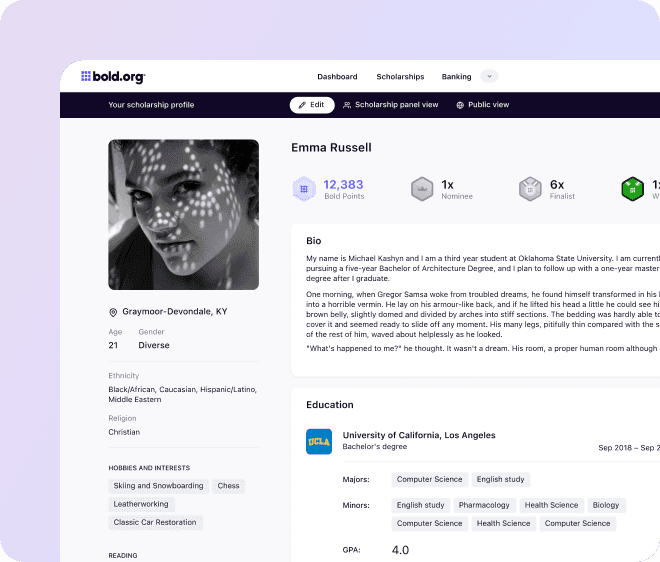
Start with your story
Bold.org helps students show donors who they are beyond a transcript.
Step 02
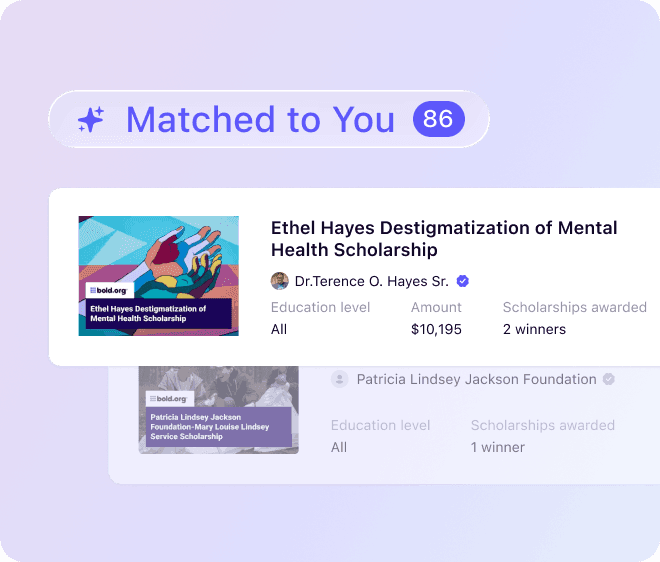
Where scholarships are awarded
Every scholarship is funded by donors and managed directly on Bold.org.
Step 03
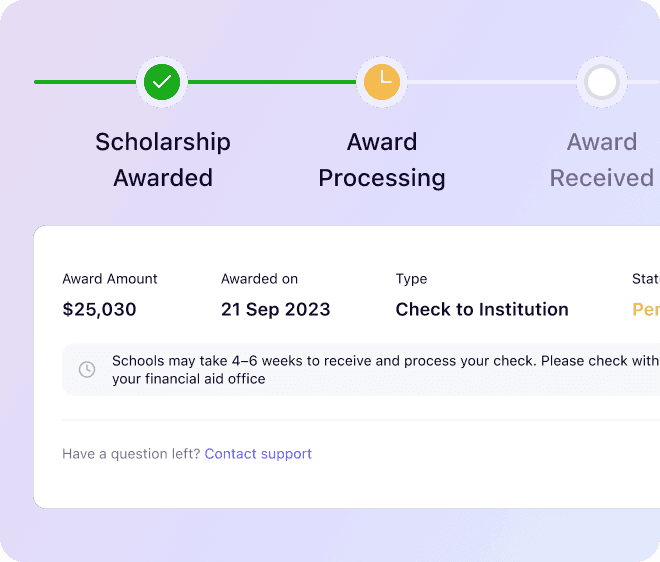
Fund your future
Scholarship dollars are disbursed through Bold.org to help students pay for school.
FAQ
When is the scholarship application deadline?
The application deadline is Sep 9, 2026. Winners will be announced on Oct 10, 2026.
How will scholarship application information be used?
Your privacy is a top priority on the Bold.org platform, and you can find our privacy policy in full here. You may opt out of communications from Bold.org at any time, and unless we’ve first notified you and gotten your consent, you’ll never receive communication from any third parties related to personal information you give us.
What is the scholarship award?
Award amounts per winner are designated by the donor. Check the award amount for a detailed breakdown.
When will the scholarship winner be chosen? How will they be notified?
The winner will be publicly announced on Oct 10, 2026. Prior to the announcement date, we may contact finalists with additional questions about their application. We will work with donors to review all applications according to the scholarship criteria. Winners will be chosen based on the merit of their application.
How will the scholarship award be paid?
Award checks will be sent to the financial aid office of the winner's academic institution or future academic institution in their name to be applied to their tuition, and in the name of their institution (depending on the school's requirements). If the award is for a qualified educational non-tuition expense, we will work with the winner directly to distribute the award and make sure it goes towards qualified expenses.
How will my scholarship application be verified?
Before we award the scholarship, the winner will be required to confirm their academic enrollment status. Depending on the circumstances, verification of Student ID and/or their most recent transcript will be required.
How should I get in touch with questions?
If you have any questions about this scholarship or the Bold.org platform, just email contact@bold.org and we’ll get back to you as quickly as we can.
Does the scholarship have terms and conditions?
Yes. The terms and conditions for this scholarship can be found here.
97% of students don't win scholarships. We’re here to change that.