Arlin Diaz was a beloved daughter, wife, and mother whose vibrant spirit continues to be an inspiration to many.
Arlin was of Dominican and Puerto Rican descent and touched the lives of all who knew her with her warmth, kindness, and unwavering determination. Even though Arlin passed away far too soon at the age of thirty-seven, her legacy of resilience and compassion lives on.
Arlin was not only a proud graduate of Kean University, where she earned her B.A. in psychology in 2010, but she was also a beacon of hope for individuals facing the challenges of epilepsy. Despite her own struggles with the condition, Arlin approached life with courage and grace, never allowing epilepsy to define her or limit her dreams.
This scholarship seeks to honor the incredible life of Arlin Diaz by continuing her legacy of courage and compassion in supporting the aspirations of students with epilepsy.
Any high school or undergraduate student who has epilepsy may apply for this scholarship opportunity, but Hispanic applicants who are studying psychology are preferred.
To apply, submit an essay about your personal journey or the impact of this scholarship and upload any relevant images that will help your essay and story stand out.
Please respond to one of the following prompts: 1. Personal Journey - share your own experience with epilepsy. How has epilepsy impacted your life, and what challenges have you encountered along the way? 2. Impact of the scholarship - explain how receiving this scholarship would help alleviate the financial burden of your education and enable you to pursue your academic endeavors with greater focus and determination. How do you intend to honor Arlin's memory and legacy as a recipient of this scholarship?
Embry-Riddle Aeronautical University-PrescottPrescott, AZ
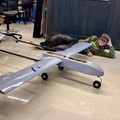
love for aviation stems from my grandfather, who has held his Private Pilot Certificate for 51 years, and from his mother, who was a WASP transport pilot in World War II. My dream of becoming a pilot, however, was crushed in sixth grade after I had my first seizure. I learned from my neurologist that given my new epilepsy diagnosis, I would never be able to fly. Despite this major setback, I adapted to my disability, and earned awards for academic achievement while playing sports, holding jobs, volunteering in my community, and building a drone business. As a high school junior, I earned my FAA Part 107 license to be an unmanned aircraft pilot.
My academic journey has been shaped by a strong interest in aviation, geospatial technology, and applying emerging tools to solve real-world problems. I am currently pursuing a Bachelor of Science in Unmanned Aircraft Systems with a minor in Geographic Information Systems at Embry-Riddle Aeronautical University, where I have combined technical coursework with hands-on research, field operations, and leadership roles. My goal is to build a career using the combination of aerial data acquisition, remote sensing, and environmental and infrastructure analysis.
Throughout my time at Embry-Riddle, I have sought opportunities to apply classroom knowledge in practical settings. I have conducted undergraduate research focused on environmental monitoring using multispectral imagery, GIS analysis, and NDVI validation, with projects examining habitat patterns and vegetation health. This work has resulted in published student research and upcoming presentations at professional conferences, including Geo Week 2026.
In addition to research, I serve as both a UAS Lab Assistant and a GIS Teaching Assistant, roles that allow me to support fellow students while strengthening my own technical and communication skills. In these positions, I assist with sensor integration, aviation safety, data accuracy, and geospatial workflows, helping students translate theory into practice. I am also an active member of professional organizations such as the American Society for Photogrammetry and Remote Sensing and the National Honor Society for Geospatial Technology, which have connected me with industry professionals and emerging trends in the field.
My academic experiences extend beyond the United States. Through a study abroad program in South America, I conducted UAS operations in Argentina, Chile, and Uruguay, using multispectral sensors to assess crop health and photogrammetry to map vineyards for local farmers. Working in unfamiliar environments strengthened my adaptability, problem-solving abilities, and appreciation for the global impact of geospatial technologies.
Scholarship funding would have a profound impact on my academic journey. My family is currently supporting three children in college, and despite our efforts, we have not received federal financial aid. This scholarship would significantly reduce financial stress, allowing me to focus more fully on my coursework, research, and professional development rather than financial constraints. It would also support my goal of completing my degree, GIS minor, and GIS and Remote Sensing certificate.
By investing in my education, this scholarship would enable me to continue building the skills, experience, and leadership needed to contribute meaningfully to the geospatial and aviation industries. It would not only ease a financial burden, but also allow me to pursue my academic and career goals with greater focus and confidence.
Despite my epilepsy diagnosis, my approach in life is to live it to the fullest. Although the phrase “carpe diem” is an overused cliché, it does embrace my outlook and how I want to make the most of my future. I took a leap of faith in moving across the country away from my family, friends, and medical support, to further my education and try new experiences. In just two years, I have grown as an individual, a researcher, an international traveler, and as a highly motivated student who just happens to be living with a life-altering condition. I have not and won’t ever allow epilepsy to control my life or define me as a person.
Thank you for the opportunity to apply for the Arlin Diaz Memorial Scholarship. I appreciate your consideration.
Noah Morales
California State University-Channel IslandsLancaster, CA
When I was 11 years old I had my first seizure in my 6th grade history class. That same day I was diagnosed with epilepsy. I did not know what epilepsy or what seizures were. I knew even less how this would impact my life. I quickly learned that life with epilepsy would be a difficult one. From being that "seizure girl" to navigating life with stigmas, treatments, and everything in between. I found myself ashamed and embarrassed to say I have epilepsy so I lived a double life for 20 years.
My double life put me in dangerous situations many times. I wasn't taking my anti-convulsant medications as my doctor suggested. I was sneaking out, lying, denying anything associated with seizures even while having a seizure. My denial caused me to injure myself several times putting unnecessary stress and worry on my single mother and family.
I had low self-esteem and believed I wasn't enough to be loved by anyone. I was told by someone who claimed they love me that, "No one would love me because no one would want to deal with my seizures," and I believed them. This belief kept me in a toxic relationship, accepting the bare minimum and thinking it was enough. I also believed I was a burden to my loved ones. This led to depression and anxiety that no one knew I was dealing with. I felt very alone in my struggle.
I didn't believe anyone could ever understand what I was dealing with. People believed my seizures were caused by a demon and even performed an exorcism on me. No matter what combination of medications I tried nothing seemed to help not even my neurologist. My mom and I were often dismissed when we expressed concerns about the correlation between my seizures and hormones. Even though medication didn't work for me that was the only treatment ever suggested to me. Forcing me to look for alternatives and spending thousands of dollars my family and I didn't have. Anything to help prevent me from consistently having seizures.
For 20 years I hated myself, my epilepsy, and what it did to my family. It wasn't until a conversation with my older brother that made me viewed epilepsy in a new light. Rather than see epilepsy as my curse I realized that it was my blessing. I was meant to help others in the epilepsy community through their journey. That is why I started using social media as a way to not only bring awareness to epilepsy but also to help those in the community. I wanted others to not feel alone as I did for so long.
What made life with epilepsy even more difficult was I didn't know anyone else with epilepsy. Just in the U.S., about 3 million people are living with epilepsy. One in twenty-six will develop epilepsy in their lifetime. Epilepsy isn't a rare condition but it is a hidden one. Like me most in the epilepsy do not feel comfortable letting others know they have epilepsy. Whether it is due to stigmas, societal treatment, low self-esteem, etc. epilepsy continues to be in the shadows. With my education, I plan on continuing to help this overlooked community.
Explore All Kinds of Scholarships for All Kinds of Students
The application deadline is Apr 14, 2026. Winners will be announced on May 15, 2026.
How will scholarship application information be used?
Your privacy is a top priority on the Bold.org platform, and you can find our privacy policy in full here. You may opt out of communications from Bold.org at any time, and unless we’ve first notified you and gotten your consent, you’ll never receive communication from any third parties related to personal information you give us.
What is the scholarship award?
Award amounts per winner are designated by the donor. Check the award amount for a detailed breakdown.
When will the scholarship winner be chosen? How will they be notified?
The winner will be publicly announced on May 15, 2026. Prior to the announcement date, we may contact finalists with additional questions about their application. We will work with donors to review all applications according to the scholarship criteria. Winners will be chosen based on the merit of their application.
How will the scholarship award be paid?
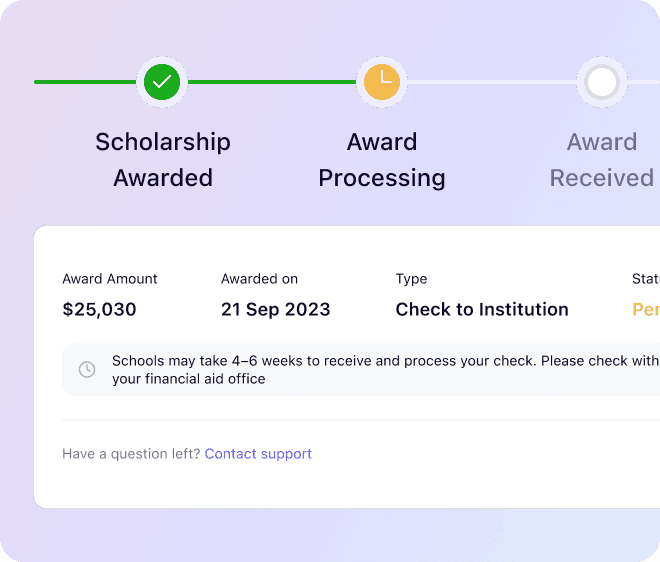
Award checks will be sent to the financial aid office of the winner's academic institution or future academic institution in their name to be applied to their tuition, and in the name of their institution (depending on the school's requirements). If the award is for a qualified educational non-tuition expense, we will work with the winner directly to distribute the award and make sure it goes towards qualified expenses.
How will my scholarship application be verified?
Before we award the scholarship, the winner will be required to confirm their academic enrollment status. Depending on the circumstances, verification of Student ID and/or their most recent transcript will be required.
How should I get in touch with questions?
If you have any questions about this scholarship or the Bold.org platform, just email contact@bold.org and we’ll get back to you as quickly as we can.
Does the scholarship have terms and conditions?
Yes. The terms and conditions for this scholarship can be found here.
97% of students don't win scholarships. We’re here to change that.