LoginJoin Bold.org
For DonorsFor Applicants
LoginJoin Bold.org
Get in touch
Donor Inquiries
donors@bold.org
Award Inquiries
awards@bold.org
Student Inquiries
contact@bold.org
Join 300k+ followers across
Donors
How It WorksBold FoundationDonor FAQTerms & ConditionsDonor Help Center
Applicants
How It WorksScholarship RulesScholarship BlogWinnersStudent Help Center
Get the app
Download on the App StoreGet it on Google Play
Scholarship Categories
Graduate School ScholarshipsScholarships for Nursing StudentsNo-Essay ScholarshipsMerit-Based ScholarshipsScholarships for WomenScholarships for High School SeniorsUndergraduate ScholarshipsHigh School ScholarshipsScholarships for Black StudentsExplore More Scholarship Categories
Company
About UsContact UsCareersPress CenterPartnershipsReviewsImpact & Transparency
©2026 All Rights Reserved. Bold.org, Inc.
Terms of UsePrivacy PolicyDo Not Sell My Personal Information

S3G Advisors NextGen Scholarship

Funded by
user profile avatar
Sunil Agarwal
$5,000
1st winner$2,500
2nd winner$1,500
3rd winner$1,000
Awarded
Application Deadline
Jul 20, 2026
Winners Announced
Aug 21, 2026
Education Level
Undergraduate
Share
Eligibility Requirements
Education Level:
Undergraduate student
Race:
BIPOC
Background:
First-generation college student
Location:
From the Midwest attending a Midwest state school
Desired Career Field:
Engineering, Computer Science, Physical & Applied Sciences, Mathematics, Business, Design
Education Level:
Race:
Background:
Location:
Desired Career Field:
Undergraduate student
BIPOC
First-generation college student
From the Midwest attending a Midwest state school
Engineering, Computer Science, Physical & Applied Sciences, Mathematics, Business, Design

Today’s young entrepreneurs, tinkerers, and visionaries are the future of the world and will go far if they stick to their dreams.

However, the many challenges and obstacles that life prevents can cause even the most ambitious students to lose faith in their goals. Students from underestimated backgrounds, in particular, can face barriers that may seem insurmountable, such as financial limitations, social discrimination, and a lack of mentorship.

This scholarship seeks to support the next generation of students who plan to do big things by forging their own paths.

Any BIPOC undergraduate student who is a first-generation college student may apply for this scholarship opportunity if they’re from the Midwest and attending a Midwest state school and if they’re pursuing Engineering, Computer Science, Physical & Applied Sciences, Mathematics, Business or Design.

The first-place winner will receive $2,500, followed by a $1,500 runner-up award, and a $1,000 award for the third-place student.

To apply, describe a specific problem you personally encountered in school, work, or daily life. 

Selection Criteria:
Ambition, Drive, Impact
$5,000
1st winner$2,500
2nd winner$1,500
3rd winner$1,000
Awarded
Application Deadline
Jul 20, 2026
Winners Announced
Aug 21, 2026
Education Level
Undergraduate
Share
Essay Topic

Describe a specific problem you personally encountered in school, work, or daily life. What exactly was happening? What did you try to do about it (even if small)? What worked, what didn’t, and what would you try next? Focus on a concrete situation you directly experienced rather than a broad societal issue.


400–600 words

Explore All Kinds of Scholarships for All Kinds of Students

Scholarships for High School SeniorsScholarships for Black StudentsGraduate School ScholarshipsScholarships for Women in STEMScholarships for High School JuniorsScholarships for MinoritiesScholarships for International StudentsMichigan ScholarshipsUndergraduate Scholarships
Scholarships for Undergraduate Women
Indiana ScholarshipsOhio ScholarshipsMinnesota Scholarships
Scholarships for College Students
Missouri ScholarshipsWisconsin ScholarshipsIowa ScholarshipsNebraska ScholarshipsSouth Dakota ScholarshipsKansas ScholarshipsIllinois ScholarshipsNorth Dakota ScholarshipsNeed-Based ScholarshipsFirst-Generation ScholarshipsEssay ScholarshipsSTEM ScholarshipsBusiness ScholarshipsCollege Students ScholarshipsScholarships for Non-Traditional StudentsScholarships for Part-Time StudentsView all

Winners and Finalists

August 2026

Winners
Jainil Thakkar1st PLACE
Madison Area Technical College
Madison, WI
John Bessman2nd PLACE
University of Minnesota-Twin Cities
Woodbury, MN
Alex Nyanteng3rd PLACE
Beloit College
Beloit, WI
Finalists
Arina Akter Riya
Indiana Institute of Technology
Fort Wayne, IN
Simone Peacock
University of Michigan-Ann Arbor
Detroit, MI
kenan larry
Maryville University of Saint Louis
Country Club Hills, IL
Aziret Niiazbekov
Lake Forest College
Lake Forest, IL

July 2025

Winners
David Castro 1st PLACE
Taylor University
Upland, IN
Fatima Ali2nd PLACE
Herzing University-Minneapolis
Minneapolis, MN
Jose Munoz3rd PLACE
Northeastern Illinois University
Burbank, IL
Finalists
Donte Smith
Metropolitan Community College-Blue River
Kansas City, MO
maron yousif
Fullerton College
Keego Harbor, MI
Alesha Alexcee
Metropolitan State University
St Paul, MN
Toni Ivory
School of the Art Institute of Chicago
Chicago, IL
Isabelle Vargas
University of Nebraska at Omaha
Omaha, NE

Winning Applications

Jainil Thakkar
Madison Area Technical CollegeMadison, WI
The problem started simple enough. The temple I volunteered at was losing donations because the process was too confusing. People wanted to give, but when they asked how, the answer was essentially "figure it out." There was no clear system, no dedicated account, and the owners were older and didn't have anyone to walk them through setting something up. Some people gave cash when they came in. Most didn't give at all because there was no easy way to do it remotely. The owners knew money was being left on the table but didn't know where to start. I told them I'd figure it out. I didn't actually know if I could. My first attempt was straightforward; I thought I could just link a personal PayPal account to a Zelle account and have donations come in there. That lasted about an hour before I realized the problem. Transactions were routing inconsistently, there was no separation between personal and temple funds, and there was definitely no way to notify the owner automatically when something came in. The owner was checking manually, which meant donations were sitting unacknowledged sometimes for days. That wasn't going to work. I went back to the documentation. I spent a few hours reading through PayPal's business account setup, understanding how to configure a dedicated account that was entirely separate from any personal finances, and figuring out how Zelle's notification system actually worked. The key thing I hadn't understood the first time was that the routing logic and the notification trigger were two separate configurations; I had been treating them like one thing. Once I separated them in my head, the solution became clearer. I set up a dedicated temple business account, configured PayPal to route all incoming donations directly into it, and set up automatic notifications so the owner received an alert the moment any transaction came through. The first test transaction worked. Someone across the city sent a donation from their phone, the money hit the account, and within seconds the owner got a notification on hers. She called me into the room to show me like I hadn't just set it up myself. That part was genuinely satisfying. What didn't work perfectly was the documentation for new donors. People still occasionally sent money to the wrong place because we hadn't made the instructions visible enough. I put together a simple one-page instructions sheet that we posted on the temple website and shared in the community group chat, which cut down on the confusion significantly but didn't eliminate it entirely. If I were doing it again, I'd build a dedicated donation page on the website with the instructions embedded directly rather than as a separate document one fewer step for the donor, one fewer thing to miss. That experience taught me something I've thought about a lot since. The first version of a solution is almost never the right one, and the gap between "this should work" and "this actually works" is where most of the real learning happens. I'm building a mini ERP app right now with the same temple, and I think about that template system constantly; every time something doesn't behave the way we expected, I know what to do. Go back to the documentation, separate the problem into its parts, and try again.
John Bessman
University of Minnesota-Twin CitiesWoodbury, MN
Alex Nyanteng
Beloit CollegeBeloit, WI
As the Coding Club President at St. Hubert Seminary Senior High School in Kumasi, Ghana, I faced one big problem that was affecting all of us students every term. After we finish major exams like the WASSCE(West African Senior School Ceritifcate Examination) mocks or end-of-term tests, students had to go and queue for long hours at the administration block just to check their results. The school office will print the results on big papers and paste them on the notice board. But many times the lists were not complete, they come late, or the rain will spoil the paper. Some students even travel from far hostels only to reach there and the results are not yet ready. We used to miss our meals and afternoon classes because of this. Standing in the hot sun for hours was really frustrating and it made us feel anxious. It was hard to know how we were doing in our studies. I wanted to change this situation. Since I was the president of the coding club, I decided to build a simple web application for students to check their results easily. I used ReactJS for the front end and a basic backend. Students could just login with their index number and see their results private on their phone. I started small. First I made a prototype during our club meetings and tested it with some of my close friends. After that I went to the ICT teacher and begged him to allow me demonstrate it to the administration. What worked well was the speed and convenience. Once the data was uploaded, students could check their results instantly without any queuing. Many of my classmates started using it and they gave me positive feedback. Some even told me it saved them a lot of time and stress. But what didn’t work at first was that the school administration was scared to give me the full results database because of privacy. So I had to enter sample data manually at the beginning. Also, not every student had good internet or smartphones, so some people still couldn’t use it properly. If I get the chance to do it again or improve it, I will work closely with the school to make it an official and secure platform that connect directly with their system. I will add new features like result trend tracking and send notifications to students when results are ready. This whole experience taught me that technology can really solve real problems especially in places like Ghana where resources are limited. It has made me even more determined to study Computer Science at Beloit College so I can create more useful tools that help people in my community and beyond.
David Castro
Taylor UniversityUpland, IN
Fatima Ali
Herzing University-MinneapolisMinneapolis, MN
From the moment my family arrived in the United States as refugees, healthcare became a labyrinth of unspoken rules and hidden barriers. I remember watching my mother's hands tremble as she filled out endless forms in a language she barely understood, seeing the confusion in my grandmother's eyes when doctors dismissed her traditional remedies as superstition, and feeling the weight of responsibility when I had to translate medical terms at age twelve that even I didn't fully comprehend. These experiences revealed a truth that would become my life's work: the American healthcare system, while advanced in many ways, systematically fails immigrant communities through a combination of linguistic isolation, cultural misunderstanding, and structural inequity. The problem I've become obsessed with solving goes beyond mere access to care, it's about transforming the entire experience of healthcare for populations who currently navigate it with fear, confusion, and far too often, preventable suffering. My obsession crystallized during a single heartbreaking night in the emergency room with my diabetic uncle. His blood sugar had spiraled out of control, but he'd avoided treatment until collapse because he feared the cost and didn't understand his medication instructions. As I watched the nurses work to save him, I noticed how their frustration at his "noncompliance" melted into compassion when I explained he couldn't read the English dosage instructions. That moment revealed the chasm between healthcare providers and immigrant patients—not due to malice, but to a system not designed for true cross-cultural care. The statistics paint a grim picture: Limited English proficiency patients experience significantly higher rates of medical errors, immigrants utilize preventative care at dramatically lower rates, and chronic conditions like hypertension and diabetes run rampant in our communities not because we don't care about our health, but because the system hasn't cared enough to make health understandable and accessible to us. What drives my passion is the knowledge that these barriers are solvable with the right combination of cultural competence, systemic advocacy, and community empowerment. As a nursing student, I'm already working to bridge these gaps by volunteering as a medical interpreter and developing visual medication guides that transcend language barriers. But my vision extends far beyond individual interactions. I dream of reforming intake procedures to be truly multilingual, creating training programs that teach providers not just medical terminology but cultural humility, and ultimately establishing community health centers where patients aren't just treated but truly understood. The path won't be easy, it requires challenging entrenched systems and confronting uncomfortable truths about healthcare inequity, but every time I see a elderly Somali woman light up because I greeted her in our shared language, or watch relief wash over a father's face when he finally understands his child's treatment plan, I know this is the work I was born to do. This scholarship would provide not just financial support, but validation that our community's health matters, that our voices deserve to be heard in hospitals and clinics as much as in our homes, and that the next generation of immigrant families might navigate healthcare with confidence rather than fear. That possibility of transforming a system that currently excludes into one that truly heals is what gets me out of bed for 6am clinicals and keeps me studying late into the night. Our communities have survived so much; we deserve healthcare that helps us thrive.
Jose Munoz
Northeastern Illinois UniversityBurbank, IL
The problem I’m most passionate about solving is healthcare inequality in underserved and immigrant communities—a crisis I’ve lived through and committed to confronting. I dream of building solutions that bridge the gap between medical institutions and marginalized people—solutions rooted in cultural competence, compassion, and accessibility. I first realized the urgency of this issue as a child growing up in a working-class Mexican-American household in Chicago. My family, Indigenous Amuzgo and proud, often avoided going to the doctor. Not because they didn’t care about their health—but because healthcare wasn’t designed for people like us. My parents didn’t speak fluent English. We didn’t have consistent insurance. I remember interpreting for my mother at medical appointments as a young teen, feeling the burden of a system that ignored people like her. I knew then that healthcare should not be a privilege—but a right that meets every person where they are. As I matured, my frustration with the healthcare system transformed into action. I took on the role of President of the Future Health Professionals Club at Northeastern Illinois University, where I organize health education events and mentorship opportunities for students from low-income and immigrant backgrounds. I also co-founded the Islas-Muñoz Foundations, a nonprofit dedicated to mentoring Latino youth in Chicago through college prep workshops and motivational outreach. Most recently, I was selected as a ChicagoCHEC Fellow at Northwestern University, a cancer research and health equity program that deepened my understanding of how race, class, and geography intersect with access to care. These experiences have shown me the transformative power of action, and I am inspired to continue making a difference. This summer, I’ll travel to Burundi, Africa, on a fully funded medical service trip to assist in healthcare outreach and learn from international physicians. For someone who once lacked access, contributing to global solutions is humbling and empowering. I’ve also launched a small cleaning business, JM Building Cleaning Services, LLC, to help support my education and family—proving that even with limited means, there’s always a way forward. I’m triple-majoring in Human Resource Development, Psychology, and Pre-Medicine with a Spanish minor. I envision opening a bilingual community clinic that offers affordable primary care, mental health services, and preventative education for immigrant and low-income families. I want to create the safe, respectful, and inclusive space I wish my family had. My aspiration is not just to become a doctor, but to revolutionize the healthcare experience. This is not just a passion, it’s deeply personal. It’s my purpose. And I am unwavering in my commitment to making healthcare a system that serves everyone equally.

How it works

Bold.org is Built to Make Scholarships Feel Possible
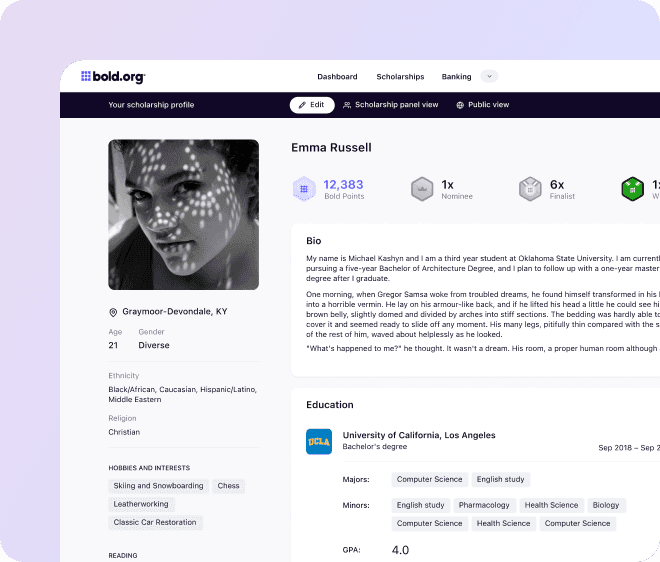
  • Student scholarship profile on Bold.org

    Step 01

    Start with your story

    Bold.org helps students show donors who they are beyond a transcript.
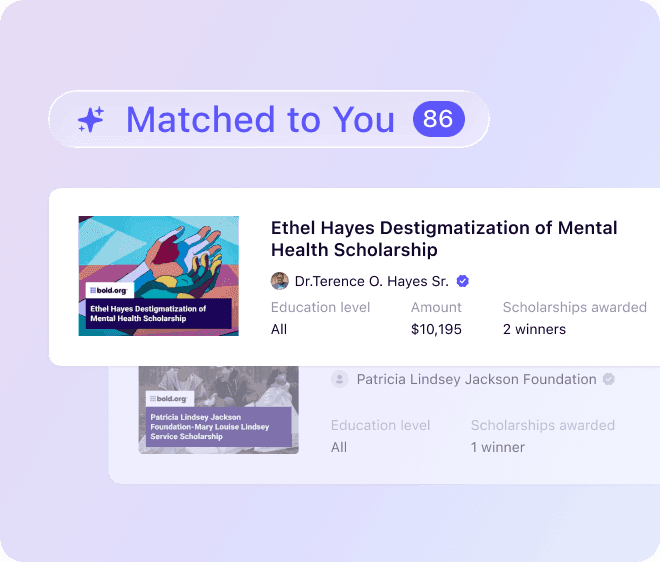
  • Scholarship matches on Bold.org

    Step 02

    Where scholarships are awarded

    Every scholarship is funded by donors and managed directly on Bold.org.
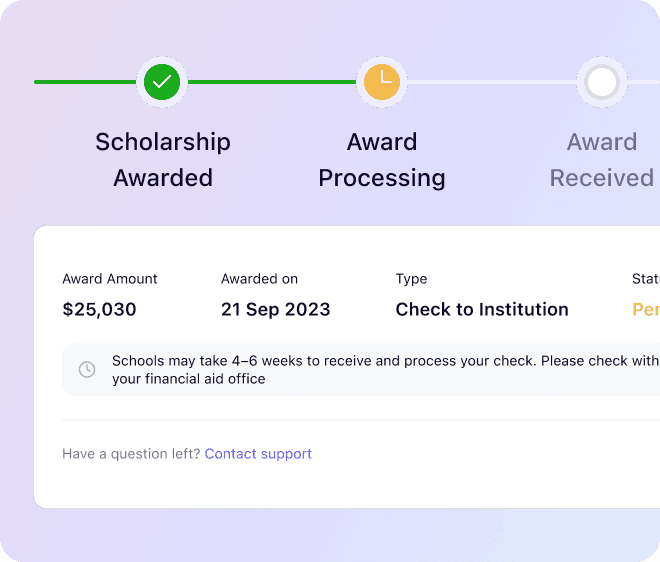
  • Scholarship award tracking on Bold.org

    Step 03

    Fund your future

    Scholarship dollars are disbursed through Bold.org to help students pay for school.

FAQ

When is the scholarship application deadline?

The application deadline is Jul 20, 2026. Winners will be announced on Aug 21, 2026.

How will scholarship application information be used?

Your privacy is a top priority on the Bold.org platform, and you can find our privacy policy in full here. You may opt out of communications from Bold.org at any time, and unless we’ve first notified you and gotten your consent, you’ll never receive communication from any third parties related to personal information you give us.

What is the scholarship award?

Award amounts per winner are designated by the donor. Check the award amount for a detailed breakdown.

When will the scholarship winner be chosen? How will they be notified?

The winner will be publicly announced on Aug 21, 2026. Prior to the announcement date, we may contact finalists with additional questions about their application. We will work with donors to review all applications according to the scholarship criteria. Winners will be chosen based on the merit of their application.

How will the scholarship award be paid?

Award checks will be sent to the financial aid office of the winner's academic institution in their name to be applied to their tuition, and in the name of their institution (depending on the school's requirements). If the award is for a qualified educational non-tuition expense, we will work with the winner directly to distribute the award and make sure it goes towards qualified expenses.

How will my scholarship application be verified?

Before we award the scholarship, the winner will be required to confirm their academic enrollment status. Depending on the circumstances, verification of Student ID and/or their most recent transcript will be required.

How should I get in touch with questions?

If you have any questions about this scholarship or the Bold.org platform, just email contact@bold.org and we’ll get back to you as quickly as we can.

Does the scholarship have terms and conditions?

Yes. The terms and conditions for this scholarship can be found here.

97% of students don't win scholarships. We’re here to change that.
LIVE     
$17,153,844
Total scholarships awarded
Start Winning
user profile avatar
Kaydence Veach
Won $1,000 scholarship
32m ago
Dr. Kevin L. Rhodes Scholarship