Undergraduate junior or senior, masters students, or a graduate of a bachelors or masters program
Desired Degree Level:
PhD
Field of Study:
Operations management
Education Level:
Desired Degree Level:
Field of Study:
Undergraduate junior or senior, masters students, or a graduate of a bachelors or masters program
PhD
Operations management
Students interested in pursuing a PhD in Operations Management can often use a boost as they embark on that journey. The right boost, the right spark can go a long way to inspire brilliant minds to take their first steps along that path. That is the mission of the DOME Scholarship initiative: Inspiring current students to consider PhD program opportunities to extend their educational development and venture down a path critical to intellectual progress and our field’s impact on the world.
The ideal scholarship applicant is either a current undergraduate or graduate student, in their last year of their current program, interested in continuing their educational experience in pursuit of a PhD, and a career in academia. Individuals with academic backgrounds in fields of business, economics or engineering tend to have the most alignment with the curriculum and topics considered in Operations Management. Most critically, individuals applying should have a clear contextual understanding of the field, what is involved in a typical PhD program, and the nature of an academic career in Operations Management (all of these details are provided are www.project-DOME.com ). They should be able to identify a set of 5-10 programs of a coherent theme, aligned with their own interested, that they plan to apply to, and they should also express a commitment to a 4-6 year in-person residency on a campus providing these programs (in-person, not on-line).
To apply, tell us about your pursuit of operations management, how it has prepared you for a PhD program, and where you are in the PhD application process.
Selection Criteria:
Ambition, Drive, Impact
Essay Topic Requirements
No AI can be used in crafting essays (checks will be made). We want to hear about your genuine interest. Your essay should provide a narrative that includes the following details:
a) Educational experience / gained knowledge aligning with the field of Operations Management (this can include coursework, research projects, internships, student organizations, independent projects, or other relevant experiences)
b) Commitment to a 4-6 year in-person residency on a campus providing these programs
c) Knowledge of the Operations Management field, and example research questions of interest to the applicant
d) Understanding of what is involved in a typical PhD program
e) Understanding of what is involved in the career post-PhD
f) A coherent and meaningful identification of 5-10 programs that fit their specific interests
Applicants are encouraged to use the DOME project resources to assist in developing details on each point: www.project-DOME.com
My decision to pursue a PhD in Operations Management comes from work experience, academic training, and research that showed me how analytical models improve real operations.
I hold a Bachelor’s degree in Engineering and an MS in Data Analytics and Information Systems from Texas State University. My coursework in operations management, statistical modeling, optimization, and data analysis gave me a solid base in demand forecasting, uncertainty modeling, and decision analysis.
Industry work in demand planning and supply operations exposed gaps between theory and practice. I saw how classical inventory models often fail in retail systems because of shrinkage, variable demand, and behavioral effects. This drove my interest in research.
As a Graduate Research Assistant under Dr. Dincer Konur, I extended the classical newsvendor model to include random theft behavior. I built a simulation framework, modeled demand with Poisson processes, and used optimization to assess how losses affect profit and order decisions. Presenting this research at the 2025 POMS Conference showed me how Operations Management uses data, modeling, and validation to guide key supply chain decisions.
Through this work, I learned that Operations Management connects analytical modeling, data-driven decisions, and behavioral insights to design efficient systems. My research interests lie in stochastic inventory theory and adapting Operations Research models to real systems influenced by imperfect data and disruptions.
I know the PhD path requires 4 to 6 years of focus. It demands discipline, collaboration, and independent work. I am ready to commit full-time, in person, to doctoral seminars and research collaborations that build strong academic skills and relationships.
My goal is to become a faculty member in Operations Management. I want to produce research that balances analytical depth and practical relevance while training future managers and analysts in decision modeling. An academic career will let me study real operational problems and contribute to both research and education.
I am applying to programs that emphasize quantitative Operations Management research, including: University of North Texas- Supply Chain Management,Rensselaer Polytechnic Institute - Decision Sciences and Engineering Systems, University at Buffalo (SUNY) -Operations Management and Strategy, University of Arkansas-Supply Chain Management, Iowa State University - Supply Chain Management, Auburn University - Supply Chain Management, University of Nebraska–Lincoln -Supply Chain Management and Analytics, Washington State University - Operations and Management Science, University of Massachusetts Lowell - Decision Sciences
These programs fit my interests in stochastic modeling, supply chain analytics, and decision optimization. Their faculty and training align with the research skills I aim to build.
The DOME Scholarship will help me transition from applied analytics to academic research. My goal is to create models that reflect uncertainty in modern supply systems and to prepare students to apply analytical thinking to operational challenges.
My introduction to operations management began informally through my experience helping build a pediatric epilepsy clinic in the border city of El Paso, Texas. One of our earliest obstacles was increasing the number of patients we could see in a single day while ensuring the clinic remained financially viable. Streamlining preparation time became critical to expanding our clinical capacity. Even after improving efficiency, we soon reached maximum volume and had to coordinate expansion into additional rooms within the building complex we rented. To further improve workflow, we transitioned from the Athena electronic health record system to the Charm system to accelerate referrals and clinical documentation. Through these experiences, I developed an understanding of bottlenecks, capacity planning, process improvement, and quality control in healthcare operations long before I had the academic language to describe it.
One major project that pushed me toward the field of operations management involved addressing challenges with electroencephalogram (EEG) exams, which were essential for diagnosing patients but required up to two hours to complete despite the actual machine running for only thirty minutes. To combat this issue, I began developing a device prototype aimed at reducing preparation time from more than an hour to under thirty minutes. This project became my entry point into operations management as I analyzed workflow inefficiencies, identified constraints, and developed solutions to optimize throughput without compromising patient care. I later expanded this experience through the entrepreneurship program at the McCombs School of Business in Austin, Texas, where I learned the logistics and supply chain strategy required to bring a medical device from concept to production. This included sourcing materials, coordinating with offshore manufacturers in China, and establishing connections with medical-grade plastic suppliers such as Nypro Healthcare. Through this process, I gained hands-on knowledge in procurement, cost management, production cycles, and value-driven operational decision making. These experiences became the foundation of my interest in operations management.
For these reasons, I am particularly interested in the MD/PhD programs with an operations management focus at the University of California San Francisco, Johns Hopkins, The Pennsylvania State University, Yale, Texas A&M University, and the University of Michigan. These schools provide the resources necessary to learn both the manufacturing and logistical aspects of operational management, including access to FDA regulatory guidance that is critical for understanding early decisions in product development and avoiding unnecessary costs. For example, in my current EEG device project, I had to iterate the prototype using materials compatible with prior FDA approvals. Understanding these considerations is a key part of operational management in healthcare, and it is highly beneficial that these institutions offer structured support and access to regulatory expertise. In addition, they have a strong focus on underserved populations, which I believe is crucial for understanding how to manage a clinic or private practice in resource-limited settings and provide care for lower-income patients.
As I approach medical school, I understand that pursuing an MD/PhD will require a six- to eight-year in-person program on campus to complete both degrees. I also recognize that excelling in this path requires mastery of the full PhD process: developing a research proposal, conducting rigorous studies, analyzing data, iterating solutions, and publishing findings. Beyond the PhD, a career in medicine while applying operations management skills demands using research insights to address large-scale issues, from improving hospital efficiency and implementing cost-saving measures without compromising quality, to designing private practices and healthcare ventures that fill critical gaps in care. These experiences will enhance my ability to identify unmet needs in clinical settings and act upon them by developing devices, programs, or business models that bring meaningful innovations directly to patients.
The pursuit of a PhD in Operations Management is not just an academic ambition for me, it is a deeply intentional next step grounded in lived experience, rigorous professional engagement, and a relentless curiosity for systems thinking and process innovation. My academic and professional path has aligned strategically with the core tenets of OM: optimizing performance, managing uncertainty, and designing scalable, data-driven solutions that drive impact.
With a foundation in IT and business management, I have spent the last several years operating at the intersection of technology, service delivery, and strategic operations. As an independent contractor, I have successfully led complex operational transformations across industries, ranging from digital marketing systems for small businesses to scalable SOP frameworks in the cybersecurity and RV service sectors. Through these experiences, I developed a fluency in lean systems design, capacity planning, resource allocation, and workflow optimization, all of which are fundamental pillars in OM. The systems I have built, whether supply chain protocols, client onboarding funnels, or quality assurance loops, reflect my practical application of OM theories.
More recently, as an MBA student with an emphasis in IT Management at Western Governors University, I have delved into the academic underpinnings of OM. Courses in operations strategy, supply chain analytics, and process modeling have sharpened my interest in research questions centered on resilience, data-enabled decision-making, and service operations. These academic experiences have not only solidified my commitment to OM but also prepared me for the methodological rigor of a PhD program. I understand that PhD training involves deep immersion in research design, mathematical modeling, and peer-reviewed scholarship, often within a 4–6 year in-person residency, an undertaking I am fully committed to. I am ready and willing to relocate, immerse, and collaborate at a top-tier institution that shares my research focus.
Through my review of Project DOME and program syllabi, I have gained a strong contextual understanding of the OM field. I am particularly drawn to research on service operations, human-centered systems design, and behavioral OM. I have familiarized myself with the structure of PhD programs, coursework, qualifying exams, research seminars, and dissertation phases, and the collaborative culture that underpins academic success. Equally, I recognize that a post-PhD career in academia demands not only publication and teaching excellence but also a passion for mentorship and field-wide contribution, responsibilities I view as a natural extension of my current work mentoring small business owners and adult learners.
In alignment with my research interests, I identified ten PhD programs whose faculty and focus areas reflect my goals: MIT Sloan, Carnegie Mellon Tepper, University of Michigan Ross, Wharton, Columbia Business School, UT Austin McCombs, Kellogg Northwestern, Georgia Tech Scheller, Arizona State W.P. Carey, and the University of Florida Warrington. These programs share strengths in empirical OM, behavioral operations, and/or human-technology interfaces, areas I believe are critical to the future of the discipline.
The DOME Scholarship represents a catalytic opportunity to deepen my contribution to OM scholarship and to the larger goal of improving operational effectiveness in sectors that often overlook it. I am driven by both intellectual curiosity and practical urgency to refine systems that serve real people, in real time. This PhD path is not just a continuation of my education, it is the channel through which I will make my greatest impact.
How it works
Bold.org is Built to Make Scholarships Feel Possible
Step 01
Start with your story
Bold.org helps students show donors who they are beyond a transcript.
Step 02
Where scholarships are awarded
Every scholarship is funded by donors and managed directly on Bold.org.
Step 03
Fund your future
Scholarship dollars are disbursed through Bold.org to help students pay for school.
FAQ
When is the scholarship application deadline?
The application deadline is Apr 22, 2027. Winners will be announced on May 23, 2027.
How will scholarship application information be used?
Your privacy is a top priority on the Bold.org platform, and you can find our privacy policy in full here. You may opt out of communications from Bold.org at any time, and unless we’ve first notified you and gotten your consent, you’ll never receive communication from any third parties related to personal information you give us.
What is the scholarship award?
Award amounts per winner are designated by the donor. Check the award amount for a detailed breakdown.
When will the scholarship winner be chosen? How will they be notified?
The winner will be publicly announced on May 23, 2027. Prior to the announcement date, we may contact finalists with additional questions about their application. We will work with donors to review all applications according to the scholarship criteria. Winners will be chosen based on the merit of their application.
How will the scholarship award be paid?
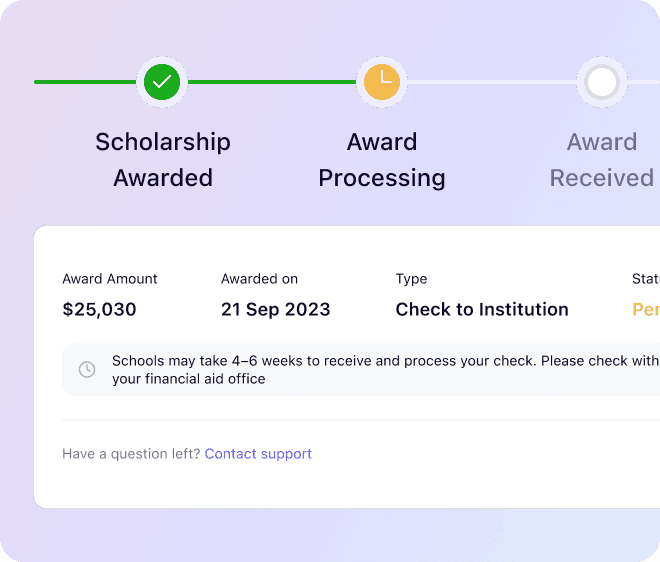
Award checks will be sent to the financial aid office of the winner's academic institution in their name to be applied to their tuition, and in the name of their institution (depending on the school's requirements). If the award is for a qualified educational non-tuition expense, we will work with the winner directly to distribute the award and make sure it goes towards qualified expenses.
How will my scholarship application be verified?
Before we award the scholarship, the winner will be required to confirm their academic enrollment status. Depending on the circumstances, verification of Student ID and/or their most recent transcript will be required.
How should I get in touch with questions?
If you have any questions about this scholarship or the Bold.org platform, just email contact@bold.org and we’ll get back to you as quickly as we can.
Does the scholarship have terms and conditions?
Yes. The terms and conditions for this scholarship can be found here.