Tom LoCasale represented the good in the world and improved the lives of those around him.
Tom believed that a happy, healthy, and productive life came from a set of skills and was always working on bettering himself. Tom was able to develop patience, perseverance, and character through his practice of golf. He spent many years volunteering with First Tee, introducing the game of golf and its inherent values to youth.
This scholarship seeks to honor Tom LoCasale’s life by supporting students who have learned valuable life skills through the sport of golf.
Any high school senior who plays golf may apply for this scholarship. Candidates who will be a first-generation college student or identify as part of an underrepresented group are highly encouraged to apply.
To apply, tell us about the biggest lesson you’ve learned from golf and how you’ll use those lessons in the future.
Selection Criteria:
Ambition, Need, Boldest Bold.org Profile
$3,000
3 winners, $1,000 each
Awarded
Application Deadline
May 29, 2026
Winners Announced
Jun 30, 2026
Education Level
High School
Share
Essay Topic
Please tell us the biggest life lesson you have learned through golf and how you plan on utilizing the lessons learned throughout your future.
400–600 words
Explore All Kinds of Scholarships for All Kinds of Students
British International School of HoustonRowland Heights, CA
In golf, there's a specific sinking feeling that players must face: the walk to a ball that has landed in the rough or the fear that the ball has disappeared after a perfect swing or a hiccup during the backswing. As a competitive golfer playing in the SCPGA and AJGA, I spent years believing that my success was defined by perfection. I viewed a double bogey as a poor score and a personal failure that threatened to unravel the remaining seventeen holes. However, the most profound lesson golf has taught me is that life isn't defined by a single hiccup on a hole, but resilience to calm down, dig yourself out, and face the challenge with grit.
Golf is a unique sport because it forces you to live with your mistakes in real-time. Unlike basketball, a turnover is immediately followed by a chance to play defense; a bad shot in golf leaves you with a long, solitary walk to face the consequences. Early on, I let those walks become mental traps. If I lipped out a crucial putt, I would carry frustration to the next tee box, letting a three-inch mistake dictate a five-mile game.
The turning point came when I began to view each hole as a metaphor for chapters in life. I realized a round of golf is a series of isolated events connected by a single mindset. If I hit a ball into a hazard, it's merely a hiccup, not destiny. This shift in perspective, treating each shot as its own fresh start, became the foundation of my mental toughness. I learned that the ability to recover is far more valuable than being perfect.
I have already begun utilizing this lesson outside the course. When I moved from the U.S. to Shanghai at the start of eleventh grade, I was met with a "shot into the rough." The language barrier and the cultural shift felt like a daunting hazard. Rather than letting the initial shock paralyze my progress, I applied my golf mindset: I assessed my lie, stayed patient, and focused on the next "stroke." This led me to leadership roles such as school Prefect and Deputy Secretariat for BISSMUN, where I managed complex logistics. When a project stalled, or a meeting didn't go as planned, I did not see it as a setback, but saw it as a difficult lie from which I could still save par.
In my endeavors managing Magnet Burger, I applied this principle. When I noticed our packaging was environmentally and financially inefficient, I did not view the past waste as a failure. Instead, I focused on the next move-- researching sustainable suppliers and pitching a transition to recyclable containers. I treated the business problem like a difficult green-side chip: precision, a calm head, and the understanding that a single adjustment could change the outcome of the entire venture.
In the future, I plan to utilize these lessons to pursue a career in public policy and business. The world is full of "hiccups"-- economic shifts, regulatory hurdles, and social challenges. My experience in the course has prepared me to face these not as insurmountable obstacles, but as parts of a larger game. Whether I am advocating for the UN SDGs-- as I did with my 'Uplift project-- or navigating the complexities of global markets, I will carry the golfer's control: the understanding that while I cannot control where every ball lands, I have complete control over how I play the next shot. I will remain a student of the recovery, ensuring that no single setback ever dictates the outcome of my game.
University of Washington-Seattle CampusGrandview, WA
The biggest life lesson I’ve learned through golf is that patience, perseverance, and personal dedication will always show in the end. Golf is one of those sports where you can’t fake your way through it. You can’t rely on a team to carry you, you can’t blame anyone else when things go wrong, and you can’t rush the process. It’s just you, the course, and whatever effort you’re willing to put in. That’s a lesson that has shaped me far beyond the sport itself.
Golf taught me patience in a way nothing else really could. Some days you can swing perfectly and still end up in the rough. Some days everything clicks and you finally see the progress you’ve been working toward. The game forces you to slow down, breathe, and trust that the work you’re putting in will pay off eventually. I’ve learned that getting frustrated doesn’t help. Quitting doesn’t help. The only thing that actually moves you forward is staying patient with yourself and trusting the process. That mindset has carried over into every part of my life, from school to leadership to my goals for the future.
Perseverance is another lesson golf hammered into me. There were so many moments where I wanted to give up, where I felt like I wasn’t getting any better, where the game felt impossible. But every time I pushed through those moments, I came out stronger. I learned that growth doesn’t happen on the good days. It happens on the hard days, when you choose to keep going even when nothing feels like it’s working. Life is going to throw a lot of hard days at me, especially as a first generation college student chasing big dreams, and golf taught me that I have what it takes to keep going no matter what.
The biggest thing golf taught me though is that your own effort and personal dedication will always show. There’s no shortcut in golf. The people who put in the work get better. The people who skip practice don’t. It’s that simple. That lesson has shaped the way I approach everything in my life. I show up. I put in the work. I stay dedicated even when nobody is watching, because I know my effort will speak for itself in the end. Whether it’s in the classroom, in leadership, or in my future career as a teacher, I trust that dedication always pays off eventually.
I plan to carry these lessons with me into my future as an educator. Becoming a teacher takes patience, perseverance, and dedication just like golf does. There will be days when teaching feels rewarding and days when it feels overwhelming, but I know how to keep showing up. I want to model these same lessons for my future students. I want to teach them that they don’t have to be perfect right away. They just have to be willing to keep trying, keep growing, and keep believing in themselves. I want them to know that the effort they put in now will absolutely show in the future, even if they can’t see it yet.
Golf gave me more than just a sport. It gave me a mindset. It taught me how to stay calm when things get hard, how to keep going when I want to quit, and how to trust that my dedication will always lead me somewhere worth being. Those lessons will carry me through college, through my career, and through every challenge life throws my way.
When I first started playing golf, I did not expect it to mean much to me. At the time, it was simply something new to try. That changed quickly once I realized how challenging the game truly is. Golf has a way of exposing your weaknesses—not only physically, but mentally. It demands patience, focus, and the ability to keep moving forward when frustration sets in.
The moment I truly understood golf was not after a great shot, but after one of my worst holes. I remember standing alone, staring at the grass, trying to hide my frustration and disappointment. In that moment, I realized golf was testing more than my ability to swing a club. It was testing my mindset and my determination to continue when quitting felt easier. I questioned whether I was good enough to keep playing, but something inside me pushed me to keep going. That struggle is what made the game meaningful. Golf became more than a sport—it became a lesson in resilience and growth.
The biggest life lesson golf has taught me is how to accept failure without letting it define me. In golf, mistakes are unavoidable. Even the best players in the world miss shots, and there is no one else to blame. I have played rounds where nothing felt right and frustration built with every hole. Through those experiences, I learned how to control my emotions, reset my focus, and remind myself that one bad shot does not determine the rest of the round. That lesson has shaped how I approach challenges in life. Setbacks are not signs of weakness; they are opportunities to learn and improve.
Golf has also taught me the importance of integrity and personal responsibility. Players are trusted to keep their own scores and follow the rules, even when no one is watching. That responsibility has strengthened my character and reinforced values of honesty, accountability, and respect. I have learned that true character is revealed in the quiet moments when no one is there to correct you.
Beyond competition, golf has given me peace and balance. Walking the course allows me to clear my mind, manage stress, and reflect. The quiet moments between shots teach me patience and focus—skills that extend far beyond the course. Golf has given me confidence, not because I am perfect at it, but because it has shown me that improvement comes from dedication and consistency.
As I move forward in my education and future career, I plan to apply these lessons daily. Whether facing academic challenges, professional setbacks, or personal obstacles, I will rely on the resilience, discipline, and accountability golf has instilled in me. Golf reminds me that progress takes time, effort, and belief in improvement. Life, like the game, is unpredictable—but with persistence and focus, growth is always possible.
South Dakota School of Mines and TechnologyGastonia, NC
Kaliyah Watson
Tom LoCasale: Developing Character Through Golf Scholarship
May 21, 2025
One of the biggest life lessons I have learned from playing golf is how much hard work can help you achieve your goals. In eighth grade, one of my friends wanted to try out for the golf team and encouraged me to join him so he would have someone to talk to. Later, I told my mom I wanted to play golf, but there was a problem: I had never played before, and I didn’t know what I needed or what I was about to experience. Before the tryout, we visited a pawn shop and bought a putter, a nine iron, and a sand wedge. At the tryout, I made the team because the coaches saw my potential. One of the coaches, Mr. John Gamble, gave me a bag and some extra balls, urging me to keep working on my game.
My mom learned from my aunt about a program called The First Tee, specifically Greater Charlotte, which helps youth improve their golf skills. The program and the coaches I had that season played a significant role in my development. Unfortunately, COVID-19 disrupted our plans, and schools were closed for the rest of the year. During 2020 and that summer, I continued to practice diligently to improve my skills in preparation for high school golf. I spent my days on the golf course from morning until night, preparing for tournaments that would help me get better.
As my freshman year of high school approached, I was ready for tryouts again. This time, I made the team, and I developed a strong relationship with my high school coach, especially since I was the only player on the team for the first two years. We would often practice together, focusing on specific aspects of my game, like my short game and consistency with approach shots and fairway accuracy. These two years allowed me to blossom in high school golf and inspired me to compete effectively against my opponents.
Since my opponents had started playing at a younger age, they had a slight advantage over me. However, with the dedication I demonstrated during my summer practice, I returned to the basics and worked on improving my skills. As I continued to get better, I began to compete alongside our lower scorers and even won several matches. That year, I made the team for the Big South Conference in our district and earned my ticket to the 3A Western Regional, but I fell short of qualifying for the State Championships.
Fast forward to now: I have been a four-time Big South Conference Player of the Year, a four-time Regional Qualifier, the 2024 Mountaineer Golfer of the Year, and a one-time state qualifier, with numerous trophies to my name. I am now committed to playing golf at the South Dakota School of Mines and Technology, where I will pursue a degree in chemical engineering with a minor in music.
Throughout my years playing golf, I have developed a greater sense of humility and strength in facing challenges. The game has taught me how to confront adversity head-on and strive for more—not just in golf, but as an individual. Outside of golf, I have worked hard to overcome obstacles while managing numerous AP courses at my school. My journey hasn’t been easy, but I am grateful for the lessons I’ve learned that have shaped me into a better person. I plan to utilize my strong work ethic to keep pushing forward in my life as I tackle my degree, golf, band, and music minor.
From the Fairway to the Field: How Golf and Mission Work Shape My Path
The biggest life lesson I have learned through golf is the importance of perseverance and resilience in the face of challenges. Golf is a sport that requires both physical skill and mental fortitude. It’s not just about perfecting your swing; it’s about staying composed, learning from mistakes, and consistently improving, even when things don’t go as planned. Which can happen from hole to hole. Whether it's dealing with a bad round or a missed shot, golf has taught me that setbacks are part of the journey, and success comes not from avoiding failure, but from how you respond to it.
This lesson has shaped my approach to life in ways that go beyond the golf course. It has taught me the value of patience and the importance of staying calm under pressure, which are crucial qualities for both academics and my future career aspirations. When faced with a difficult situation whether it’s managing my time as a student-athlete, working on a challenging project, or navigating the uncertainties of mission work in Nicaragua. I’ve learned that the key is not to give up but to stay focused, positive, and push through the tough moments.
Through my mission work in Nicaragua, I’ve seen firsthand the resilience of the communities I’ve served. Despite facing poverty and adversity, the people in Nicaragua continue to press forward with hope and determination. Whether we were building homes in the barrios, organizing youth workshops, or simply offering support to those in need, I witnessed the power of resilience and the impact of sticking with something despite the challenges. These experiences have reinforced my belief that, just like in golf, the ability to stay committed through difficult times is what ultimately leads to success.
I plan to carry these lessons with me throughout my future, especially in my pursuit of a career in investigative journalism. Like golf, investigative work requires patience, resilience, and an ability to stay calm under pressure. It often involves long hours of research, sifting through complex information, and facing moments of frustration and uncertainty. The resilience I’ve developed in golf and through my mission work will help me tackle these challenges head-on, knowing that success comes through persistence and a willingness to learn from mistakes. Golf has also taught me to appreciate the importance of consistency and self-discipline. Just as a golfer must commit to regular practice, I know that I will need to dedicate myself to continuous learning and improvement throughout my career in journalism.
Additionally, golf has helped me develop a strategic mindset. Every round is different, and every shot requires a different approach. Similarly, every story I pursue in journalism will require unique strategies and careful planning. Whether it's determining how to approach an investigation or finding a way to tell a story in a compelling and ethical way, I will use the lessons of strategic thinking and adaptability learned through golf and my mission work to guide my decisions and ensure that I am always prepared for the challenges ahead.
Ultimately, the lessons I have learned through golf resilience, patience, consistency, and strategic thinking are invaluable tools that I will continue to use throughout my academic, professional, and service-oriented endeavors. These lessons will not only help me overcome obstacles but will also allow me to approach my future endeavors with determination and a clear focus on long-term success; while always keeping the resilience I’ve seen in the communities I’ve served at the forefront of my journey. Thank you for reading my essay.
Zakai White
Through golf, I have learned many lessons about patience, discipline, and self control. However, The most important lesson that stands out to me would be staying grounded in who I am no matter what happens. When it comes to course play, no matter how perfectly I play on any hole, one bad shot can humble me very fast.
I didn't grow up with a typical childhood. I grew up in foster care. From a young age, I've had to support myself both emotionally and mentally. A lot of people might not understand the struggle of how isolation can feel. Yet when I picked up golf, it brought me a sense of peace. On the course, I didn't have to be anyone else. I could be the calm, focused, and present person that I am. Golf forced me to slow down and really think about exactly what I need to do in the moment. This is vital in a world that often feels to me that it is moving too fast.
I have also learned accountability. In golf, I can't blame anyone but myself for my score. That responsibility has shaped the way I approach life. I don't make any excuses. When I mess up on the course or in my day to day life, I always look at how what happened can teach me something.
This fall, I plan to attend Washington State University and major in construction management. My dream is to start my own construction business one day. I know that it will take a lot of hard work, but I also know how to commit to something because of what I have learned from golf. I know how to keep pushing when it is complicated and frustrating even when I don't see immediate results. Golf has taught me that progress is slow, and consistency is key.
Being a foster child, I know what hard work looks like and how to support myself. However, I also know that I cant do everything on my own. I am applying for this scholarship because financial aid will help relieve some of the pressure that comes with independence. This will keep me focused on my education, continue to grow as a person, and one day have the ability to give back to others the same way I have been blessed.
Tom LoCasale strongly believed in patience, perseverance, and character. These are values that I live by, thanks to the game of golf. Golf has been more than just a sport to me, it has been a mentor and an escape. It is really a reminder that no matter what background I have or what I am going through in life, I will always need to work for what I get and be the best version of myself on and off the course. And I will.
Golf is the sport I am passionate about. One of my earliest and fondest memories of golf was when I was in Panama with my family. My grandfather had me in the backyard trying out clubs to see if I was left-handed or right-handed. Of course, I just wanted to play tag with my cousins. But, when I swung a club for the first time, I was hooked. Luckily, my grandfather and my older cousin already were in the sport of golf and all I needed to do was learn from their expertise. I already had the discipline and determination from the other sports I have done like gymnastics, dance, and diving. So, all I had to do was focus my energy on golf.
During the past four years, I have dedicated myself to playing and succeeding at golf in high school. Golf was a sport that challenged me mentally and brought out my leadership skills, which I used to help my school and fellow students. This sport can often be overlooked–it is expensive, underfunded, and associated with wealth.
I believed that golf should be available to all, including the students at my public high school. Accordingly, I have worked tirelessly to secure the resources and support needed to make golf a top sport in my school and to create a community for students who love this sport. Last year, I helped raise over $2,000 for uniforms, golf bags, hats, golf shirts, and food through posters, announcements, emails, and phone calls. I spent countless hours communicating with family members, friends, teachers, and students to raise funds for the program and expand participation.
As a result of such efforts, I have helped build a robust program for myself and other students. This year, I have already helped two other golfers and myself attain resources to play golf this season, including golf bags inscribed with our team name "Berry Cardinals,” new t-shirts, and pullovers for playing in the winter cold later in the season. As team captain, I had to repeatedly advocate for my team through numerous discussions with my school’s athletic director to ensure that our golf team had adequate support.
I have also played a key role in helping ensure that our school hired a new golf coach after our previous coach retired. Again, my advocacy and persistence with my school administration made a difference. I was nervous over the summer into this year about not getting a coach in time but a coach was hired.
I love helping my teammates improve their skills and step out of their comfort zone with a complicated sport like golf. The fact is, golf is great training for life. It provides the satisfaction that comes from completing a hard course and refusing to give up no matter how hard the challenge is. That is why I made an effort to create a legacy for future women golfers who will follow behind me once I have left Phillip O. Berry with the necessary resources to play the sport we love.
There was one match this year during the golf season that stood out from all of the others I've played in my four year high-school career. Mostly because it shattered my expectations for the remainder of my final season.
It started late because road construction near my home course had made the visiting team’s bus driver confused, leading to a 45 minute delay. I had already had a long day, waking up at the crack of dawn for early morning choir, only then to have multiple tests, followed by what was supposed to be a friendly 9-hole practice to prepare for the conference match in four days . I was exhausted, and the months of golf were starting to further aggravate my already painful chronic back problems. When we finally got to the tee box, I was dead on my feet, hurting all over, and ready to absolutely rock the next nine holes.
As the only senior on the varsity team, my place on the conference squad was pretty much assured, but I really wanted to end my last season with a blaze of glory. My junior year, I had to miss conference because of a compacted nerve that was caused by my back problems. My sophomore year, my mildly malicious junior varsity coach took me off the roster for “not smiling enough” on the course. I felt the need to make up for years of disappointing golf by giving one-hundred-and-ten-percent the entire season. I stayed after practice most days, spending hours on the putting green and hitting hundreds of balls on the range. I also spent hours on the couch with a heating pad, trying to relieve the agonizing muscle tightness and fiery nerve pain in my back and shoulders.
But that friendly match derailed my conference dreams for good. My first tee shot was a testament to my hard work, going straighter and further than I could have dreamed at the beginning of the season. I was playing great golf for the first three holes. But by the fourth, I could tell something was wrong. By the fifth, the muscles in my back were so tight that I couldn't swing the club without excruciating pain. I wasn't able to twist. My back betrayed me four days before the competition I had been preparing for all year.
I knew this was the end for my season, and I was devastated. Even though I knew my high school golfing career would come to an abrupt end, I realized that this match didn't have to. I played the rest of the match. I couldn't twist, or bend, or move very fast without pain, but I finished the match anyways. My score was understandably abysmal, but I was so proud. My difficulties did not destroy my ability to persevere.
Golf is a game of perseverance. Every bad shot is an opportunity to make a better one next turn. Every bad round is an opportunity to improve. Failure is a key part of golf, because it teaches us how to endure and conquer whatever challenges we face. My flare-up should have caused me to quit, but my love of the game enabled me to persist. The tenacity I learned from golf propelled me to a spot on the JV conference line-up too, and although I definitely didn't win any medals, I was able to finish my season despite my almost complete physical inability to swing correctly. I found personal success this year, because I was able to prove that my physical limitations could not hold me back. All because I learned to golf.
For me, the game of golf has been a journey of highs and lows that has taught me the value of resilience and composure—two of the most important life skills. Golf seemed to incite anger and irritation in me at first; it was a sport that brought out the worst in me. I became angrier and more impatient with each mishit, missed putt, and lost ball because it seemed like a personal failure. But as time has gone on, I've grown to understand that golf is more than simply a physical game—it's also a cerebral struggle that represents the difficulties of real life. I've managed to channel the lessons I've learnt from my golfing experiences into resilience and peace by being persistent and reflecting on them.
Golf is a special kind of testing your mental toughness and patience. I had a hard time handling obstacles on the route at the beginning. A bad shot would send me into a tailspin of annoyance, impairing my judgment and performance. But as time went on, I realized that hardships are a necessary component of both life and the game. I came to terms with the fact that errors are inevitable and that obsessing over them makes matters worse. Rather, I concentrated on maintaining my composure, owning up to my mistakes, and moving on with a clear head.
This change in viewpoint did not occur suddenly. It required many rounds of golf, with each one offering a unique mix of obstacles and chances for improvement. I eventually came to understand the value of resilience and mindfulness. I developed emotional self-control, turning my annoyances into drive to push through with my resolve. Instead of allowing a poor shot to end my round, I started to view every error as an opportunity to grow. My performance on the course was enhanced by this mental shift, which also had a significant positive effect on my general wellbeing.
These lessons are with me now as I look forward to my time in college. The move to college can be intimidating, fraught with uncertainties and difficulties. But because of golf, I've gained the fortitude and flexibility to handle any challenge that comes my way. I'm aware that there will be challenging times, but even in situations where things appear bleak, I have faith in my capacity to remain composed.
I'm going to use everything I've learned from golf to help me deal with problems in my academic, personal, and professional life in college. I'll tackle every challenge with endurance, patience, and an optimistic outlook, understanding that failures are chances for personal development. Whether I'm pursuing my goals on the golf course, managing a challenging course load, or adjusting to life away from home, my major focus will always be on maintaining my composure and fortitude in the face of difficulty.
In the end, golf has taught me that mentality and attitude are just as important to success as aptitude and technique. I can handle any challenge that comes my way, on or off the course, if I maintain my composure. I'm appreciative of the lessons golf has taught me as I start this new chapter in my life and look forward to seeing where my increased resilience will take me.
There have been two constants throughout my life, golf and the perseverance to succeed. I was diagnosed with a life-threatening autoimmune disease called Very Severe Idiopathic Aplastic Anemia when I was six years old. Because of the disease, I underwent chemotherapy, radiation treatments, blood transfusions, two bone marrow transplants, and a stem cell boost. Because of my illness and treatments, I matured quickly for my age to adapt to what was happening to me. This growth caused me to look for a deeper understanding of the circumstances around me, such as questioning, “Why is this happening?” and “How am I going to persevere through this?” That thought process of searching beyond the face value has stuck and helped develop my character.
The lesson from golf that I use in my life is determination. Since I was ten years old, I have dedicated myself to improving my golf talents and the life skills that come with it. Like my sickness, golf is a mental game requiring determination and concentration. No matter how talented I am, I will always have other obstacles to overcome, but with my perseverance, I can clear it. Whether sand traps or a blood disorder, golf has taught me that I must persevere through any challenge.
My dedication to golf and determination to never give up have had the most significant impact on developing my character. Using the perseverance I learned from golf, I will apply it to the aspects of my life in the future. Determined to succeed in my academic career, I will work tirelessly to achieve my goals, no matter how challenging. I will graduate from Ringling College of Art with a distinguished portfolio and the knowledge to create an impact on my community. In the future, I plan to develop inspiring masterpieces by becoming a creative director for a leading entertainment studio. I will face any challenges I meet along the way with determination and find new innovative ways to inspire change in others.
Golf has taught me a valuable lesson in perseverance that I plan on utilizing throughout my future by applying it to all aspects of my life, especially in my academic career. Golf has taught me that no matter how challenging the obstacle is, I will overcome it with perseverance. Looking back, I realize that my illness was an impactful point in my life that taught me the value of perseverance and determination and remained a guiding point in my advancements toward golf and academics. With my determination and perseverance, I can achieve success.
There are several lessons that I have learned through golf that are useful in everyday life and in my future. Golf teaches patience, and balance with your mind and your body. Golf has also taught me that overthinking only leads to more problems. Self control over your mind and mood is definitely important. It has also taught me that just because you might make a mistake doesn’t mean that you aren’t doing well. Others make mistakes, too. You can’t tell someone’s skill set by looking at them, either. The old adage of not judging a book by its cover is very true in the game of golf. It is best just to be patient and do your personal best. You will have good games and bad games. The game of golf is very much like life itself.
I have also learned a lot about life while golfing. This may not have anything to do with the act of golfing itself. It may be due to whom I practice with. I practice with 2 senior citizens who have grandkids older than me, and with two adults with kids my age. Don’t make the mistake of thinking I win often because I have age on my side. These men have experience and course knowledge on their side. On the course, there is plenty of time for talking between shots. I have gotten to hear so many of these gentleman’s stories. I would say wisdom, but some of it is just hilarious banter. Still, there is something to be said for learning from those who have blazed the trail of life before you. I don’t get any time with my own grandfather these days and it is nice having these goofy golfers in my life. My own grandfather is busy taking care of my grandmother with severe Alzheimer’s, but he had gone with me to a charity golf tournament for father’s day once.
The biggest lesson that I have learned through golf is how important preparedness is. Alexander Graham Bell said, “before anything else, preparation is the key to success.” When I went to regionals with my school, I realized how important being prepared truly was. If I had not gotten there a day earlier to play the course like the others had, I would have felt more nervous and would have definitely let that get in the way of my mental game. I also had a good breakfast and went to bed at a good time. Each of these things are important in feeling prepared. Feeling prepared makes you more confident and professional, even though I had never done anything like this before. I didn’t win regionals that year, but I did feel happy with how far I had come in my first season golfing for high school. This year my school doesn’t have a team, and that does make me sad. I still golf with my buddies, and I will take the lessons learned from this experience with me my whole life.
How it works
Bold.org is Built to Make Scholarships Feel Possible
Step 01
Start with your story
Bold.org helps students show donors who they are beyond a transcript.
Step 02
Where scholarships are awarded
Every scholarship is funded by donors and managed directly on Bold.org.
Step 03
Fund your future
Scholarship dollars are disbursed through Bold.org to help students pay for school.
FAQ
When is the scholarship application deadline?
The application deadline is May 29, 2026. Winners will be announced on Jun 30, 2026.
How will scholarship application information be used?
Your privacy is a top priority on the Bold.org platform, and you can find our privacy policy in full here. You may opt out of communications from Bold.org at any time, and unless we’ve first notified you and gotten your consent, you’ll never receive communication from any third parties related to personal information you give us.
What is the scholarship award?
Award amounts per winner are designated by the donor. Check the award amount for a detailed breakdown.
When will the scholarship winner be chosen? How will they be notified?
The winner will be publicly announced on Jun 30, 2026. Prior to the announcement date, we may contact finalists with additional questions about their application. We will work with donors to review all applications according to the scholarship criteria. Winners will be chosen based on the merit of their application.
How will the scholarship award be paid?
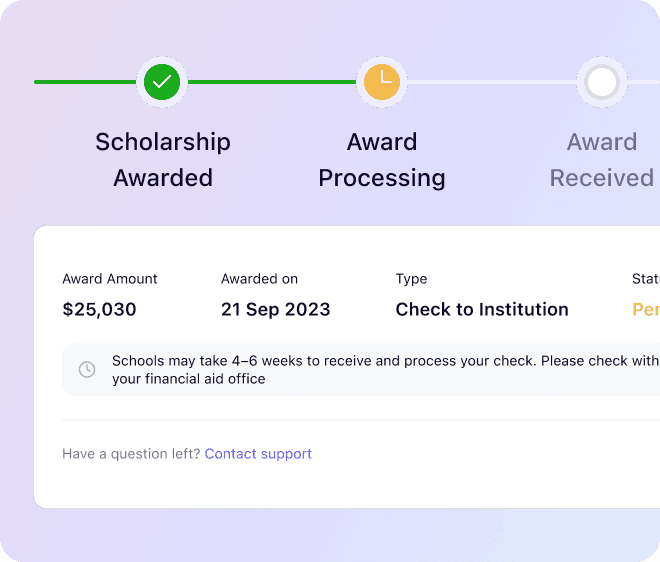
Award checks will be sent to the financial aid office of the winner's academic institution or future academic institution in their name to be applied to their tuition, and in the name of their institution (depending on the school's requirements). If the award is for a qualified educational non-tuition expense, we will work with the winner directly to distribute the award and make sure it goes towards qualified expenses.
How will my scholarship application be verified?
Before we award the scholarship, the winner will be required to confirm their academic enrollment status. Depending on the circumstances, verification of Student ID and/or their most recent transcript will be required.
How should I get in touch with questions?
If you have any questions about this scholarship or the Bold.org platform, just email contact@bold.org and we’ll get back to you as quickly as we can.
Does the scholarship have terms and conditions?
Yes. The terms and conditions for this scholarship can be found here.
97% of students don't win scholarships. We’re here to change that.